
US Fiscal Imbalance Worsens as Debt Climbs Beyond $39 Trillion
Concerns about U.S. fiscal stability are intensifying as borrowing continues to accelerate, with economist and gold advocate Peter Schiff warning March 18 on X that national debt has moved past $39 trillion and could climb much higher if current conditions persist. His comments point to expanding deficits and increasingly expensive financing as central pressures shaping the outlook.
Schiff wrote on X:
“The U.S. national debt just surpassed $39 trillion, up $2.8 trillion since Trump took office 14 months ago. But as war costs soar, interest rates rise, and recession ensues, budget deficits will skyrocket. The national debt could hit $50 trillion before Trump leaves office.”
He argued that multiple forces—ranging from economic slowdown risks to elevated spending—are converging in a way that may accelerate debt accumulation.
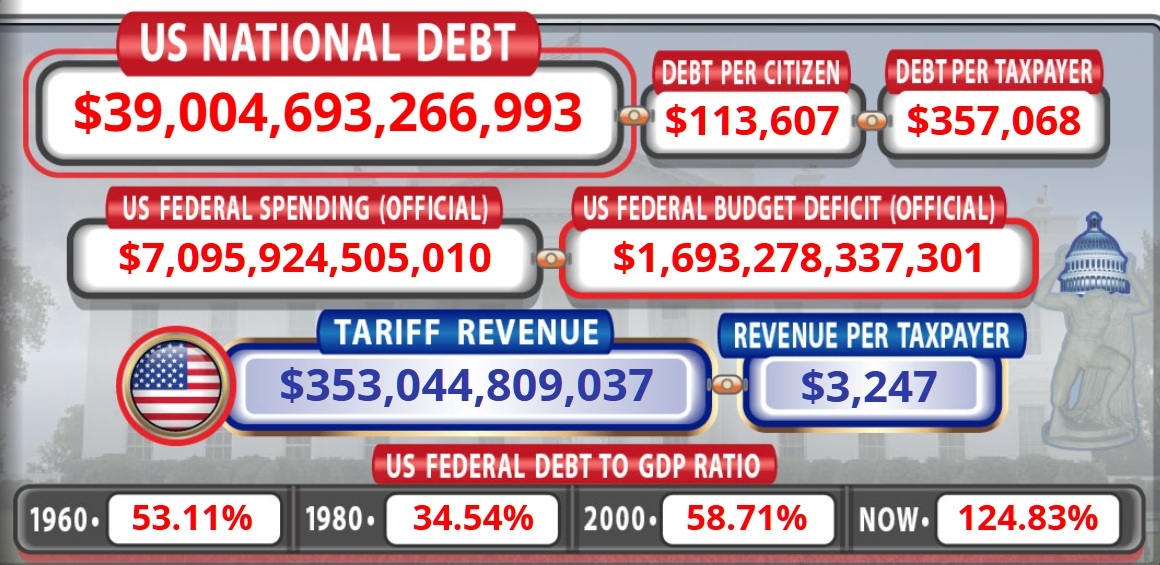
Current data underscores the scale of existing imbalances even before new geopolitical costs are fully absorbed. As of writing, figures displayed by the U.S. Debt Clock website show total national debt at $39,004,693,266,993, alongside a federal budget deficit of approximately $1.69 trillion and total spending exceeding $7.10 trillion. The same dataset places debt per citizen at $113,607 and per taxpayer at $357,068, while tariff revenue stands near $353 billion, highlighting the structural gap between inflows and obligations.
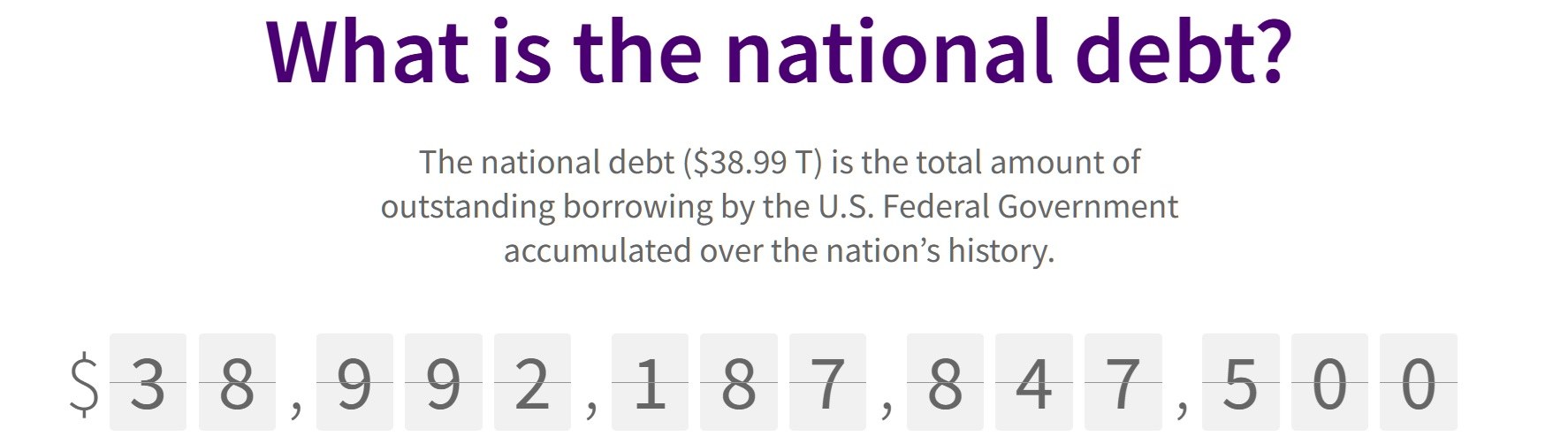
Meanwhile, U.S. Treasury data shows total national debt approaching $39 trillion.
Those pressures were already building prior to the latest conflict, which began Feb. 28, when the United States and Israel launched coordinated strikes on Iranian military infrastructure. Iran responded within days with large-scale missile and drone attacks, while the conflict expanded regionally and disrupted global energy flows after the Strait of Hormuz was closed. Pentagon estimates indicate the first six days alone cost more than $11.3 billion, adding a new layer of spending to an already elevated fiscal baseline.
Alternative accounting suggests the fiscal burden may be significantly larger than headline figures indicate. Kent Smetters, faculty director of the Penn Wharton Budget Model, has argued that when unfunded obligations tied to programs such as Social Security and Medicare are included, total liabilities approach $100 trillion. He stated that these implicit commitments—often excluded from official debt metrics—are roughly twice the size of explicit obligations, reflecting long-term promises not fully captured in federal balance sheets.
War Spending and Interest Costs Intensify Risks
Given that the current presidential term is set to conclude Jan. 20, 2029, Schiff’s projection implies an increase of roughly $11 trillion within less than three years. That pace would require a sharper acceleration than the recent $2.8 trillion rise over 14 months, indicating that worsening deficits, elevated interest costs, and sustained war-related expenditures would need to compound significantly to reach the $50 trillion threshold within that timeframe.
One of the most significant shifts is how quickly borrowing costs themselves are rising, as debt issued during years of low interest rates is now being replaced with higher-yield securities. As a result, annual interest payments have exceeded $1 trillion, changing the composition of federal spending and making debt servicing a central budget priority rather than a secondary cost. This dynamic creates a feedback loop, where additional borrowing is increasingly used to meet existing obligations.
At the same time, long-term spending trends are adding persistent pressure. An aging population is driving higher costs for Social Security and Medicare, while prior inflation adjustments have permanently lifted benefit levels. Meanwhile, discretionary spending remains elevated, with defense allocations nearing $1 trillion and continued funding for border and security initiatives contributing to overall expenditure growth. Together, these factors are keeping federal spending on a trajectory that outpaces revenue generation.
Jamie Dimon, Ray Dalio, Elon Musk Sound Alarm as US Fiscal Path Spins out of Control
The issue is drawing consistent warnings from major financial figures, many of whom see the current path as difficult to sustain. JPMorgan Chase CEO Jamie Dimon warned that “the deficits in the United States and around the world are quite large,” adding: “We don’t know when that’s going to bite. It will bite eventually because you can’t just keep on borrowing money endlessly.” Bridgewater Associates founder Ray Dalio has characterized the environment as being in the later stages of a long-term debt cycle, a phase that can precede significant economic adjustments. Citadel CEO Ken Griffin has also emphasized that rising sovereign debt levels represent a key systemic risk with global implications.
Beyond Wall Street, technology leaders and policymakers are increasingly echoing these concerns, particularly regarding the long-term impact of rising interest obligations. Tesla CEO Elon Musk wrote that the U.S. is “1,000% going to go bankrupt” without meaningful changes to fiscal policy or stronger economic expansion, warning that interest costs could eventually crowd out essential government functions. Federal Reserve Chair Jerome Powell has likewise noted that fiscal policy is on an “unsustainable path,” urging policymakers to address the growing imbalance between debt growth and overall economic output. JPMorgan’s Chief Global Strategist David Kelly said late last year: “While we are going broke, we are going broke slowly.”
FAQ 🧭
- Why is U.S. debt rising so quickly?
Expanding deficits, higher interest costs, and war spending are accelerating borrowing. - How do rising interest rates affect federal debt?
They increase servicing costs, forcing more borrowing to cover existing obligations. - What risks do investors face from higher U.S. debt?
Potential volatility in bonds, inflation pressure, and shifts in fiscal policy. - Could U.S. debt reach $50 trillion soon?
It is possible if deficits widen and spending remains elevated over the next few years.