Analysts: Trump’s New Tariff Regime Might Also Be Considered Illegal
After a U.S. Supreme Court landmark decision striking down the previous unilateral tariff regime under the International Emergency Economic Powers Act (IEEPA) authority, President Trump shifted to Plan B.
Trump announced a new round of global tariffs effective on February 24, previously of 10% and then increased to the “fully allowed, and legally tested” 15% level, invoking now the authority of Section 122 of the 1974 Trade Act, which allows the president to take this new measure for a period of 150 days whenever a short list of conditions are met.
Section 122, which deals with the President’s Balance of Payments authority, states that these measures can be taken whenever the administration has “to deal with large and serious United States balance-of-payments deficits, to prevent an imminent and significant depreciation of the dollar in foreign exchange markets, or to cooperate with other countries in correcting an international balance-of-payments disequilibrium.”
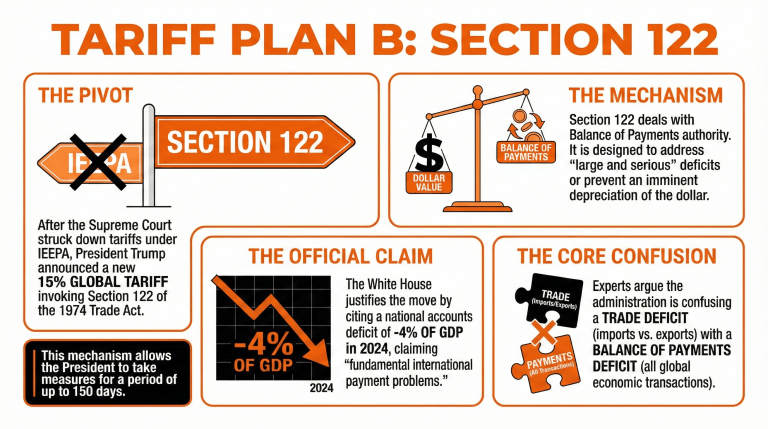
While the fact sheet issued by the White House on the new round of tariffs states claims that “the United States faces fundamental international payment problems, in particular a large and serious balance-of-payments deficit,” and that the country maintained an accounts deficit of -4% of its gross domestic product (GDP) in 2024, analysts believe the administration is confused regarding this concept.
Andrew McCarthy, a former Assistant United States Attorney for the Southern District of New York and a notable Trump supporter, explains that there is a fundamental difference between the balance of payments and the balance of trade. While a trade deficit occurs when imports surpass exports in value, a balance of payments deficit is a broader concept encompassing all economic transactions between the U.S. and the world.
McCarthy assessed that:
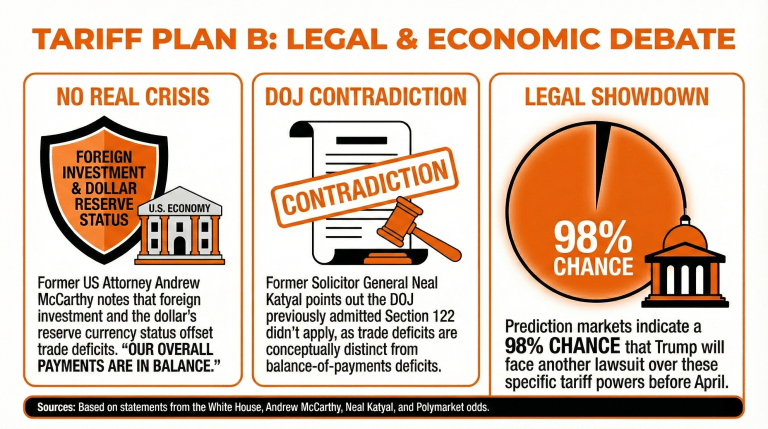
“Foreign investment in the United States, coupled with the advantages our nation accrues because the dollar is the world’s reserve currency, more than make up for the longstanding trade deficit in goods. Our overall payments are in balance. There is no crisis.”
Former Solicitor General Neal Katyal, who argued against Trump’s IEEPA tariffs and took the case to the Supreme Court, states that the DOJ itself denied the feasibility of applying Section 122 to the contested tariffs. Effectively, the DOJ declared Section 122 tariffs did not have “any obvious application here, where the concerns the President identified in declaring an emergency arise from trade deficits, which are conceptually distinct from balance-of-payments deficits.”
“If he wants sweeping tariffs, he should do the American thing and go to Congress. If his tariffs are such a good idea, he should have no problem persuading Congress. That’s what our Constitution requires,” Katyal concluded.
Prediction markets are betting that this new round of tariffs will be contested in court. While it is still an early market, Polymarket bettors believe there is a 98% chance that Trump will be sued again before April for invoking tariff powers.
FAQ
What is the latest announcement from President Trump regarding tariffs?
Trump announced a new round of global tariffs set to take effect on February 24, increasing from 10% to 15% under Section 122 of the 1974 Trade Act.What conditions allow the president to impose these tariffs?
Section 122 allows tariffs to be implemented for 150 days when addressing significant balance-of-payments deficits or preventing depreciation of the dollar.What are experts saying about the tariffs and their legal basis?
Experts like Andrew McCarthy argue that the balance of payments is misinterpreted, stating the U.S. has no immediate crisis due to foreign investment and the dollar’s status.Is there potential for a legal challenge against these tariffs?
Prediction markets indicate a 98% chance that Trump will face legal challenges regarding these tariffs before April, suggesting significant controversy surrounding their implementation.