Smart Contract Origins
If you keep up with cryptocurrency news you’ve likely heard of “smart contracts.” Smart contracts, in their current form, are self-executing agreements housed on a blockchain.
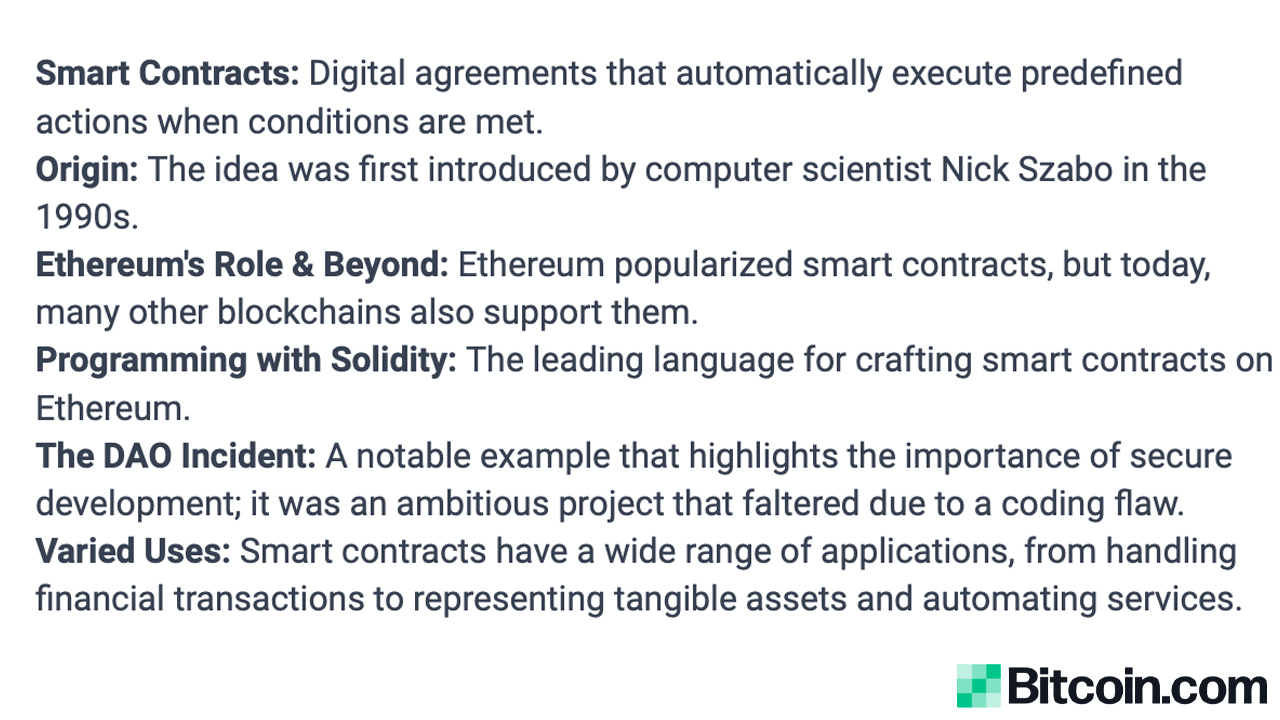
Fundamentally, the “smart” in smart contracts stems from automation, while the “contract” denotes a binding agreement or function that runs automatically. The idea of smart contracts was first posited by American computer scientist Nick Szabo.
Ethereum’s Role & Beyond
In the early 1990s, Szabo defined smart contracts as “a set of promises, specified in digital form, including protocols within which the parties perform on these promises.” Modern smart contracts, however, didn’t emerge overnight.
But with the advent of Ethereum, the blockchain’s Turing completeness and coding capabilities quickly made it the preferred platform for smart contract protocols. Ethereum’s Turing completeness means that, in theory, any computable function can be run on Ethereum, given sufficient processing power and time.

Programming With Solidity
This capability offers vast potential for the kinds of applications and contracts that can be developed, extending well beyond mere financial transactions. Typically, these contracts are coded in Solidity, a Turing complete language tailored for smart contract development.
Solidity code is then translated into bytecode, which the Ethereum Virtual Machine (EVM) executes. Today, smart contracts facilitate a multitude of applications, including the trading of money, goods, real estate, tokenized bonds, securities and more.
The DAO Incident and Risks
Among the first smart contracts on Ethereum were a crowdfunding contract, a blockchain domain registration system, and digital assets and tokens. For instance, The DAO, a decentralized autonomous organization for venture capital, debuted in 2016.
Despite being the first DAO, it faltered due to a flaw in its smart contract. So, while smart contracts offer numerous benefits, they come with inherent risks such as software bugs, tainted oracle data, and the potential loss or theft of contract-controlling credentials.
Varied Use Cases
Comprehensive audits, formal verification, simplifying contract design, bug bounties and following best development practices can reduce these risks. Nevertheless, challenges with smart contracts persist. Yet, they have ushered in trustless peer-to-peer trading via decentralized exchanges, and streamlined lending and borrowing processes to facilitate collateral-backed loans and interest accrual.
They’ve enabled the birth of digital tokens that represent tangible assets like real estate, non-fungible tokens (NFTs), commodities, stocks, and more. Additionally, they’ve given rise to decentralized autonomous organizations (DAOs) and other automated services, including file storage, prediction markets and shared computing power.
It’s safe to say that smart contracts have and still are revolutionizing the digital currency landscape, offering automation, security, and diverse applications. As they continue to evolve, their influence on trust and collaboration in our digital society is undeniable and transformative.
What do you think about smart contracts? Share your thoughts and opinions about this subject in the comments section below.