

A Hard Deadline for Europe’s Crypto Industry
The transitional period under the EU’s Markets in Crypto-Assets (MiCA) regulation will officially expire on July 1, 2026. After that date, any exchange, broker or wallet service provider operating without a MiCA license will no longer be permitted to serve users in the bloc.
The scale of potential disruption is significant as only around 210 of the more than 1,200 virtual asset service provider (VASP) entities that held pre-MiCA national registrations have converted to full crypto-asset service provider (CASP) authorization (a conversion rate of roughly 17%). That leaves approximately 83% of firms without full authorization as the deadline approaches.
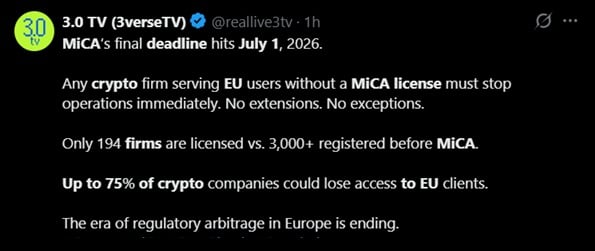
The European Securities and Markets Authority (ESMA) has left little room for ambiguity since a statement issued on April 17 clarified that a pending application offers no protection from subsequent suspensions. In sum, firms either hold a license by July 1 or stop serving clients.
No Grace Period for Pending Applications
“Having a MiCA application already in review doesn’t protect you,” ESMA’s guidance made clear, emphasizing that pending applications create no legal shield. The position closes a loophole that some service providers had hoped might buy additional time.
MiCA, which entered into application in stages, is the EU’s effort to create a single, harmonized rulebook for crypto across all 27 member states. A CASP license obtained in one member state can be “passported” across the bloc, allowing a single authorization to cover the entire EU market.
Yet adoption of full authorization has been uneven and as Bitcoin.com News reported recently, only a small fraction of registered CASPs are cleared to operate centralized exchanges, with major platforms covering much of the market through passporting. Implementation has also lagged in some jurisdictions, complicating compliance for firms racing against the clock.
What Happens After July 1
For firms that miss the deadline, the consequences are stark, i.e. a loss of legal access to one of the world’s largest crypto markets. Some operators may withdraw from the EU entirely, while others could relocate or restructure to maintain a compliant foothold. The shake-out could concentrate market share among the larger, better-resourced platforms that secured authorization early, such as those that recently obtained licenses to operate across the European Economic Area.
For the end user, the practical effect could include service interruptions, forced migrations to licensed platforms, or the withdrawal of certain products from EU markets. ESMA has emphasized the enforcement as essential to investor protection and market integrity.
In sum, the July 1 deadline could turn out to be one of the most consequential regulatory milestones in the EU crypto industry’s history, given that a large share of firms operating within this space are still unauthorized.