
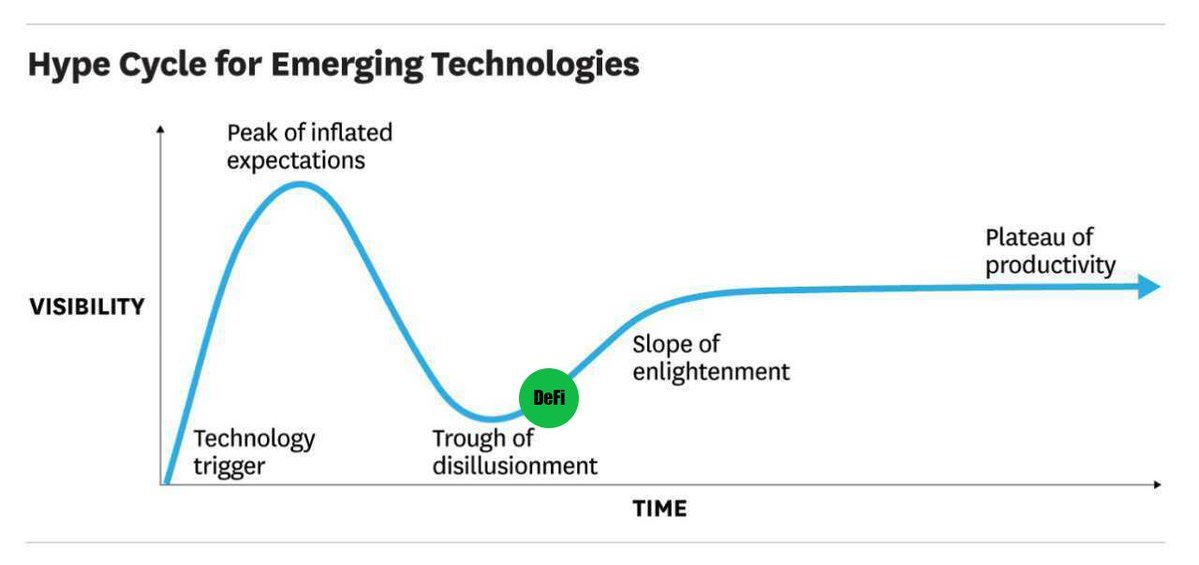
Introduction: DeFi’s Position in Crypto Today
Decentralized Finance (DeFi) has evolved significantly from its early days of explosive hype to a more measured, mature phase. According to Alyo’s insights, DeFi is emerging from a phase of “disillusionment,” as foundational protocols begin to stabilize. Previously viewed as the on-chain financial institutions of the future, DeFi protocols are now facing increased regulatory clarity, driving market interest forward.
While uncertainty around DeFi’s role has long hindered its growth, recent trends suggest a changing landscape where DeFi holds one of the strongest Product-Market Fits (PMF) in crypto, with undeniable use cases. As DeFi matures, investors are finding renewed opportunities within the sector, both for short- and long-term gains.
DeFi’s Legal Challenges and Market Dynamics
For years, DeFi’s progress was stifled by regulatory ambiguity, especially in key markets like the U.S. While this uncertainty initially posed challenges, it also provided DeFi developers with the opportunity to innovate and build resilience. Today, the market appears to be moving ahead of these regulatory issues, with investors and developers anticipating and preparing for a future with clearer guidelines.
The shift away from hostility, particularly in the U.S., offers DeFi a pathway to realize its potential. With the impending regulatory adjustments, DeFi may finally advance as a core financial infrastructure, potentially rivaling traditional financial services in accessibility and utility.
Product-Market Fit: DeFi’s Core Advantage
One of DeFi’s greatest strengths within the crypto ecosystem is its tangible Product-Market Fit. While many crypto assets rely heavily on speculation, DeFi has demonstrated real utility, becoming the largest use case in crypto. For users, DeFi offers accessible, transparent financial services such as lending, borrowing, and trading—services traditionally monopolized by centralized institutions.
As Alyo noted, the value of DeFi tokens could soon transcend the role of “governance tokens.” With the possibility of financial utility, DeFi tokens have a chance to represent real value through revenue-sharing models, protocol fees, or dividends. This would elevate DeFi assets from mere governance roles to real, utility-driven financial products.
Revenue Generation: An Indicator of DeFi’s Growth Potential
For investors and market observers, one of the key metrics to assess DeFi’s growth is the revenue these protocols generate. Unlike other sectors in crypto, DeFi protocols are consistently showing a strong revenue stream. By analyzing protocol earnings, investors can gauge both the demand for DeFi services and the potential for continued growth.
Protocols like Uniswap, Aave, and MakerDAO generate substantial revenue, indicating a sustained demand for decentralized financial services. These revenue figures hint at the long-term profitability potential within DeFi, as more users migrate from traditional financial services to on-chain alternatives.
A Growing Advantage Over Layer 1 and Layer 2 Solutions
Looking at the crypto market, DeFi stands out with its ability to provide functional, valuable services. This positions DeFi protocols with a unique advantage over many Layer 1 (L1) and Layer 2 (L2) projects, which often replicate one another without distinct value propositions. In the long term, the utility and revenue generation of DeFi protocols could outweigh these other projects, creating a solid investment case for DeFi.
The Future of DeFi: Where Opportunities Lie
As DeFi emerges from its initial hurdles, it’s entering a period ripe with opportunities. Investors can look toward both well-established protocols and emerging DeFi projects for short- and long-term gains. With improvements in infrastructure and user experience, DeFi may not only reach but potentially redefine what it means to offer accessible, inclusive financial services on a global scale.
With the U.S. and other key regions potentially easing their stance, DeFi’s path forward could solidify its place as a true alternative to traditional finance. This shift, supported by regulatory clarity, might be the tipping point that brings DeFi into mainstream financial systems, fulfilling its promise of democratizing finance worldwide.
Conclusion: DeFi is at a pivotal moment, transitioning from a phase of regulatory uncertainty to one of growing recognition and maturity. By focusing on user needs, building sustainable revenue models, and navigating legal landscapes, DeFi protocols are set to transform the financial world. For investors and users alike, DeFi’s evolution signals an era where decentralized finance could truly rival and complement traditional financial institutions.