Tokenomics may no longer be the first thing everyone checks when researching new crypto projects, but it remains essential for creating a sustainable blockchain ecosystem. Poorly designed Tokenomics can lead to a project’s failure right after launch, while effective models drive growth, development, and network security.
Blockchain giants like Bitcoin with its halving, Ethereum with its L1-L2 architecture, and Arbitrum with its massive TVL are clear examples of how Tokenomics can help a project thrive. However, many new Layer 1 (L1) blockchains falter due to weak or misaligned Tokenomics, resulting in unsustainable ecosystems.
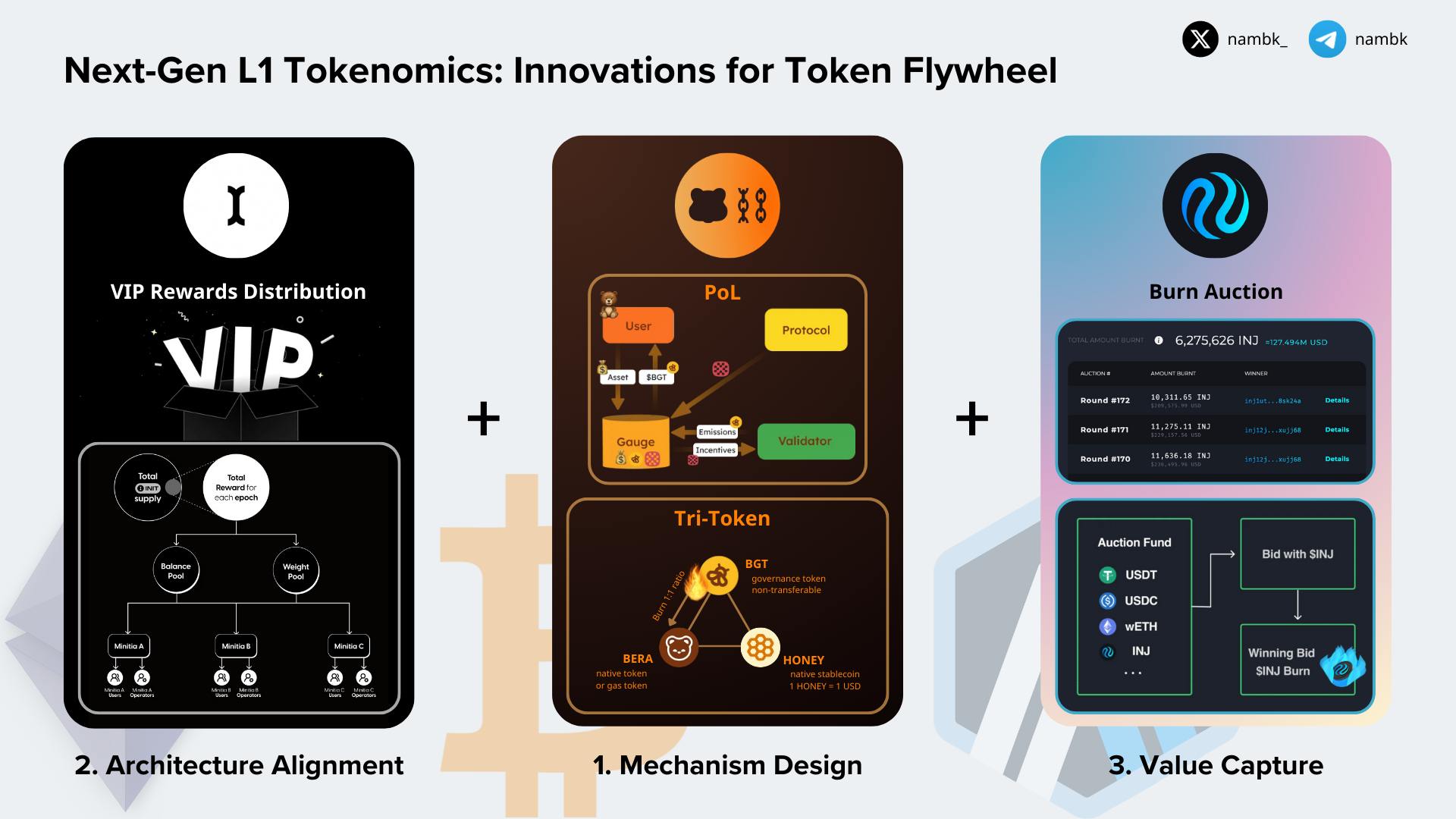
In this article, we explore the three foundational elements of designing effective Tokenomics for L1 blockchains:
Core Economic Mechanism
A solid economic mechanism is the backbone of a successful blockchain. Tokenomics must incentivize participants to act in their own best interest while simultaneously contributing to the network’s growth.
For example, Berachain implements the Proof of Liquidity (PoL) model, which balances liquidity and security by rewarding liquidity providers with $BGT tokens. These tokens can be staked or exchanged for $BERA, aligning liquidity provisioning with network security.
Architecture Alignment
Tokenomics must closely align with the blockchain’s technical architecture to maintain a sustainable ecosystem. A failure in this area can lead to weak demand for the native token.
Take Ethereum as an example: its Layer 2 (L2) solutions haven’t always created sustained demand for ETH. In contrast, Initia‘s Vested Interest Program (VIP) connects the economic activities of its L1 (Initia) and L2 (Minitia), ensuring that the $INIT token is integral to both layers, driving network-wide engagement.
Value Capture
Tokens should capture value from network activity, ensuring their long-term value and encouraging holding. Injective does this effectively with its Burn Auction system, where transaction fees lead to the burning of $INJ tokens. This reduces supply, creating a deflationary effect that increases the value of the remaining tokens over time.
How Top Layer 1s Apply These Principles
Let’s look at how three leading Layer 1 blockchains—Berachain, Initia, and Injective—are applying innovative Tokenomics strategies to secure their future.
Berachain: Liquidity Meets Security
Proof of Liquidity (PoL)
Berachain’s PoL model incentivizes users to provide liquidity, which secures the network. In return, participants earn $BGT tokens that can be staked or swapped for $BERA tokens, ensuring a balance between network security and liquidity provisioning.
Tri-token System
Berachain employs a tri-token system ($BERA, $BGT, $HONEY), ensuring diversified utility across governance, liquidity rewards, and ecosystem participation.
Initia: Bridging L1 and L2 Economically
Vested Interest Program (VIP)
Initia’s VIP program connects the L1 and L2 (Minitia) ecosystems economically by rewarding $INIT token holders and users across both layers. This integration strengthens the token’s role and enhances overall network engagement.
Solving Fragmentation
By closely aligning its L1 and L2 ecosystems, Initia ensures smooth economic interactions, solving the fragmentation issues commonly seen in multi-layer blockchains.
Injective: A Deflationary Model with Burn Auction
Burn Auction
Injective’s Burn Auction mechanism continually reduces the $INJ supply by burning tokens during transactions. This deflationary model ensures long-term value appreciation as the token supply decreases while network usage grows.
Financial Optimization
As a blockchain focused on financial applications, Injective is optimized for speed and scalability. Pre-built modules like decentralized order books and shared liquidity pools enhance its financial ecosystem, attracting DeFi users.
Conclusion
Tokenomics is still a vital component in building strong blockchain networks. Projects like Berachain, Initia, and Injective demonstrate how properly designed Tokenomics can foster network growth, security, and user engagement. Whether through innovative economic models, strategic alignment with technical architecture, or value capture mechanisms, Tokenomics remains key to sustaining Layer 1 blockchains in the long term. With the right Tokenomics design, these projects can lead the next wave of blockchain innovation and growth.