There has been a lot of discussion about projects that conducted TGE (Token Generation Event) in Q1 and Q2 of 2024, with many pointing out that good vesting schedules are driving their growth. While this is partially true, it’s not the whole story. Let’s dive deeper into why Saga’s growth has been so significant and what’s next for the project.
✅ The Truth Behind Good Vesting Schedules
Yes, it’s true that projects like Saga, which had their TGE during this period, typically have VCs and teams under a cliff vesting schedule that lasts between 6 to 12 months. For Saga specifically, this cliff lasts 12 months, with vesting for teams and investors starting in April 2024. This means there is no immediate sell pressure from major stakeholders, allowing for smoother market movements in the short term.
However, it’s essential to observe whether market makers (MMs) are accumulating tokens. If they aren’t, it could leave you without a good entry point, and any investment made could be stalled if the MMs don’t push liquidity into the token’s market.
📈 How Market Makers Influenced Saga’s Price
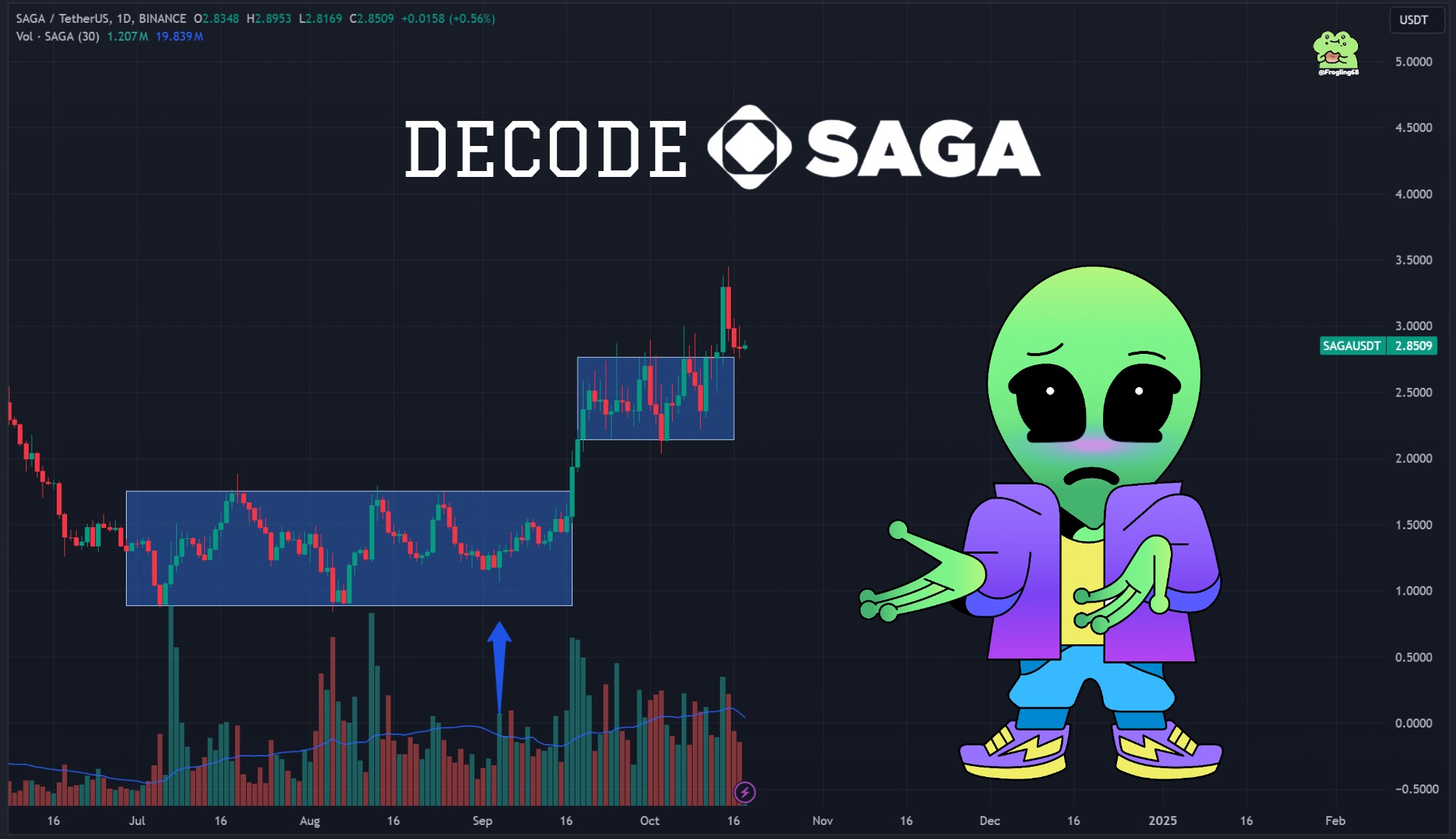
During the rough market conditions earlier in 2024, many users sold their SAGA tokens as airdrop recipients offloaded their tokens. However, starting in July 2024, the situation shifted. Market makers began aggressively accumulating Saga, with the price moving between $1 and $1.3.
This accumulation continued through August, a challenging month for most altcoins as many broke their support levels. Despite the bearish market, Saga managed to maintain a stable price with high trading volumes, attracting attention. After conducting some analysis, I found that the accumulation at these levels was far more significant than the prior sell-off, signaling that MMs had taken control of the supply.
That’s when I made the call to buy Saga, with many of us entering around the $1.2 to $1.3 range, just before the token’s significant price surge. This entry point allowed us to avoid holding stagnant assets, and the results speak for themselves.
🔍 Why Saga Has Strong Fundamentals
Besides market maker activity, Saga’s internal fundamentals supported the decision to invest confidently.
- Saga is a promising Layer 1 blockchain with a relatively low valuation at around $100M when I entered.
- Saga’s structure is similar to the Cosmos ecosystem, allowing other blockchains to build on top of it through what are called Chainlets. These chainlets communicate with each other using a Saga-built bridge, based on Cosmos’ IBC (Inter-Blockchain Communication Protocol).
- Saga has developed a shared liquidity model, where the Saga Liquidity Integration Layer (LIL) acts as the central hub for liquidity. The LIL also connects with other major blockchains like Ethereum and Solana, enabling smooth cross-chain interactions.
- Gasless user experience: The architecture allows Dapps to cover gas fees instead of users, which streamlines user experience significantly.
- Shared validators across all chainlets: This provides security and computational efficiency across the entire Saga ecosystem. The model is similar to EigenLayer’s AVS model, where shared security optimizes resources.
🚀 The Bull Case for Saga: More Chainlets, More Demand
The more chainlets and Dapps that join the Saga ecosystem, the greater the demand for the SAGA token. Validators need SAGA to maintain and power the chainlets, creating a feedback loop where increasing usage drives token demand.
Currently, over 100 chainlets are building on the Saga ecosystem, with the primary focus areas being Gaming, Entertainment, and Infrastructure.
🔄 Token Staking and Incentives
A major reason behind Saga’s price stability and growth is its loyalty-driven staking mechanism. According to a survey of OG participants, those who received airdrops and continued staking SAGA have seen their holdings increase by 3x after just 5 months of staking.
Saga’s airdrop program incentivizes loyalty through Saga Vaults. To maximize rewards, stakers must restake their previous airdrop rewards, and to qualify for better rewards in future vaults, they must increase their stake. For example, in Vault 5, stakers need to stake 1.21x the tokens they staked in Vault 4.
Additionally, staking SAGA also provides airdrop rewards from the chainlets running on the Saga network. With over 100 chainlets, this adds substantial value to holding and staking SAGA, contributing to price stability and growth.
🤝 Team Leadership and Responsibility
I’m also an Ambassador for Saga, which has allowed me to interact with the core team in meetings. I’ve found the team to be professional, with clear goals and a strong work ethic.
- Rebecca, the CEO, has extensive experience in both business and politics, having played pivotal roles in campaigns for Joe Biden and Hillary Clinton.
- Jin Kwon, the co-founder, is a former C-level executive at Tendermint, a key infrastructure component of Cosmos, which explains the architectural similarities between Saga and Cosmos.
The core team‘s expertise and proven track record are critical when evaluating any investment, and Saga has shown that it has a strong, committed leadership team.
Final Thoughts
At a time when many altcoins are struggling, I was fortunate to identify Saga as a promising project and shifted much of my portfolio from less promising investments to SAGA. As of now, I still hold all my SAGA tokens and see no reason to sell given its growth momentum and strong trading volumes. If you’re already on board, zoom out to the weekly chart to boost your confidence!