Ethereum’s Revenue Crisis
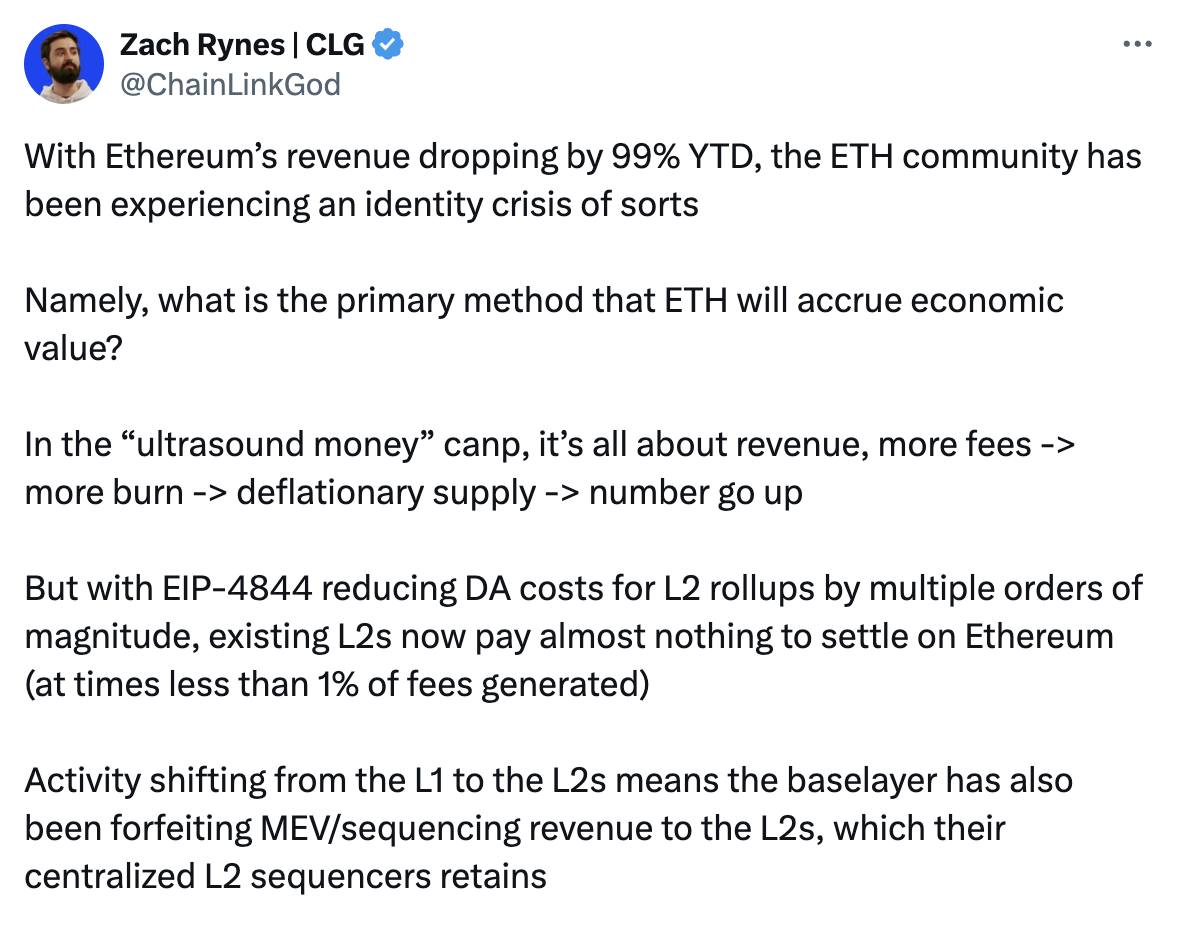
Ethereum has seen its revenue plummet by 99% this year, and the ETH community is facing an identity crisis. The central question is: how can ETH increase its economic value?
Proponents of the “ultrasound money” theory argue that the key lies in revenue: more transaction fees → more ETH tokens burned → deflationary supply → increased value. However, with EIP-4844 drastically reducing costs for Layer 2 (L2) solutions on Ethereum, L2s now pay almost negligible fees when settling on Ethereum (sometimes less than 1% of the total fees generated).
As activity shifts from Layer 1 (L1) to L2, Ethereum L1 loses revenue from MEV (Miner Extractable Value) and coordination fees, which are captured by the centralized coordinators of L2s.
The main problem with the “ultrasound money” theory is that while Ethereum has successfully scaled through L2, L1 is now optimized for the least profitable part of the chain (data availability – DA fees), while L2 captures the bulk of the revenue (congestion fees and MEV).
Meanwhile, other DA solutions like Celestia and EigenDA are becoming more commoditized and popular, further intensifying the competition.
The “Programmable Money” Theory
An opposing camp supports the “programmable money” theory, which argues that L1 revenue is not crucial. According to this theory, ETH will gain value through its role as a currency (used as gas fees in L2 and as collateral in DeFi). However, stablecoins have proven more effective and widely accepted, as they are less volatile than ETH and are still pegged to USD.
While ETH can still serve as censorship-resistant collateral in DeFi, this narrative struggles to surpass Bitcoin’s stronghold in the space. Furthermore, one of the weakest arguments for ETH’s value is its use as gas tokens. L2s are increasingly likely to accept other tokens besides ETH as gas.
For example, Base by Coinbase might support USDC as gas for its own economic benefit. This means users may prefer the more stable USDC over ETH for gas fees, allowing Coinbase to generate more revenue by holding USDC instead of ETH.
Ethereum’s Economic Story Moving Forward
Although ETH remains one of my largest investments, it’s disheartening to witness Ethereum struggle with its economic narrative. The question remains: can Ethereum adapt and find a sustainable value proposition that goes beyond its current revenue crisis?
While the community debates whether ETH should focus on revenue generation or its programmable money role, the future of Ethereum’s economic story remains uncertain. With the rise of alternative DA solutions and L2 dominance, Ethereum must rethink its approach to reclaim its standing in both the blockchain space and investor portfolios.
Additional Market Updates:
- Celestia and EigenDA continue gaining popularity as alternative DA solutions, further increasing competition for Ethereum’s L1.
- Base by Coinbase is considering using USDC as a gas token, potentially sidelining ETH in L2 ecosystems.
- Stablecoins have become the preferred choice for many DeFi projects due to their stability compared to ETH.