
In the fast-evolving world of crypto, Ethena has emerged as a game-changer with its new stablecoin, USDe. Unlike centralized stablecoins like USDT or USDC, which are pegged to fiat currency, USDe operates as a synthetic dollar backed by crypto assets and short futures positions. While algorithmic stablecoins like DAI, GHO, and the infamous UST have had mixed results (with UST and LUNA leaving a lasting scar on the market), Ethena’s unique mechanism has captured attention. Let’s dive into why USDe could be a revolutionary force in the stablecoin ecosystem and avoid the fate of its predecessors.
Ethena’s Impressive Start
Since launching in February 2024, Ethena has achieved remarkable milestones, including a TVL (Total Value Locked) exceeding $2 billion in just seven weeks. The protocol offers 30% interest on stablecoin deposits and introduced its token, $ENA, with a FDV (Fully Diluted Valuation) of $12 billion at the time of writing. These staggering numbers have drawn comparisons to the rise of UST under LUNA, sparking concerns: Will Ethena follow the same dangerous path?
Overview of the Stablecoin Market
Ethena operates within a $160 billion stablecoin market, currently dominated by USDT (68%) and USDC (20%). These centralized stablecoins are backed by USD and highly liquid assets like Treasury Bills and Government Bonds, but come with significant issues:
- Centralization: Managed by companies like Tether and Circle.
- Lack of Transparency: Users must trust that these companies won’t misuse their reserves.
- Censorship Risk: Governments can pressure these organizations to freeze or seize funds.
- No Sharing of Profits: Companies profit from investing user funds in Treasury Bills but don’t share the returns with stablecoin holders.
Even decentralized stablecoins like DAI, managed by MakerDAO, have begun allocating large portions of their collateral to Treasury Bills, making them increasingly similar to centralized stablecoins. Additionally, DAI faces scalability challenges.
The Ideal Stablecoin
An ideal stablecoin should:
- Be decentralized: Free from centralized control and trust-based systems.
- Offer liquidity and price stability: Ensuring users can buy or sell easily at $1.
- Provide yield generation: Offering substantial interest rates, ideally between 10%-30%.
- Be interoperable across blockchains: Easily transferable and usable in DeFi applications.
Ethena: A Unique Approach
Imagine you design a trading strategy that consistently generates a 20% annual return, immune to price volatility. Whether the market goes up or down, the strategy performs well. Now, if someone gives you $100, you could guarantee the return of the $100 plus the profit earned over time. What if you created a stablecoin using this strategy, where the initial capital remains intact, regardless of market conditions, while continuously generating profit? That’s essentially what Ethena offers.
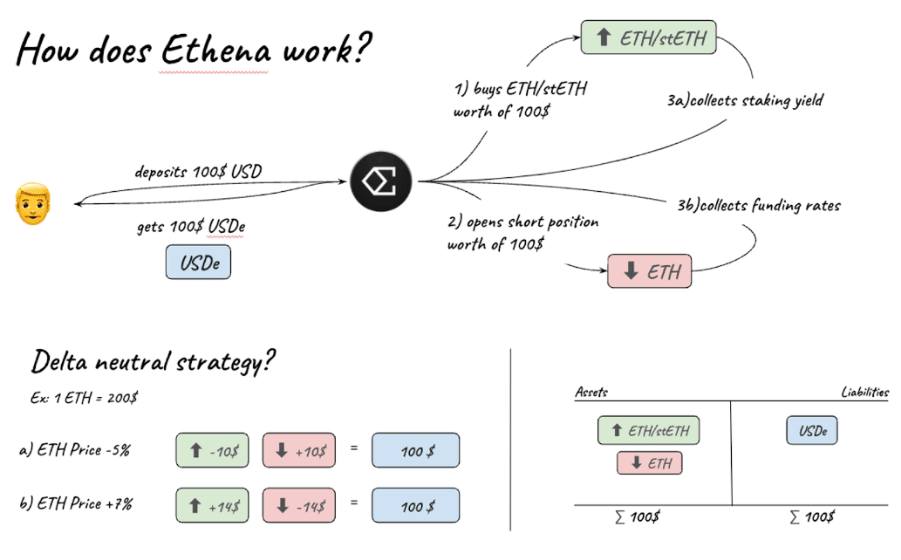
Ethena operates using a delta-neutral strategy, where each dollar deposited results in both a long and short position. Here’s how it works:
- Deposit: Users deposit $100.
- Conversion: The funds are converted into collateral assets like ETH or stETH.
- Leverage: The collateral is leveraged to open short positions on exchanges.
- Mint: Users receive 100 USDe, backed by both long and short positions, ensuring the $100 remains secure.
- Yield Generation: The long position earns staking rewards, while the short position benefits from funding rates.
This strategy allows Ethena to maintain stability and generate yields without relying on the fragile mint-burn mechanisms that caused the collapse of LUNA/UST.
Ethena vs. LUNA: A Safer Approach?
Ethena’s potential to mirror UST’s explosive growth is undeniable, thanks to its ponzinomics-style high returns. However, Ethena’s yield-earning strategy sets it apart from LUNA/UST’s unstable mint-burn model. The protocol’s focus on maintaining a delta-neutral position ensures that the USDe peg is safer, even in volatile markets.
Conclusion
Ethena is stepping into a massive and competitive stablecoin market, but it offers a unique solution that addresses many of the problems plaguing both centralized and decentralized stablecoins. With high yields, decentralization, and a more robust strategy for maintaining its peg, Ethena could be the breakthrough stablecoin we’ve been waiting for. While there are still risks, its model provides a promising alternative to the failures of the past, including the infamous collapse of LUNA/UST.
Is Ethena the next big thing in stablecoins, or will it face the same fate as LUNA? Only time will tell, but the USDe mechanism looks like a step in the right direction.