Picture someone in Mexico City pointing a small antenna out their apartment window. That antenna helps Movistar customers in the neighborhood connect to mobile data, and the owner earns crypto for keeping it online. It’s how Helium, one of the largest DePIN projects in the world, actually works today.
DePIN, short for Decentralized Physical Infrastructure Networks, uses blockchain and token rewards to coordinate ordinary people to build the real-world infrastructure that big companies usually monopolize: wireless networks, storage, mapping, GPU compute.
This guide explains what DePIN is, how the token incentive flywheel works, and which DePIN projects 2026 has put on the map. DePIN is one of two technologies reshaping the blockchain landscape right now – alongside AI blockchains, which we cover separately.
What Is DePIN?
DePIN, short for Decentralized Physical Infrastructure Networks, is a model that uses blockchain technology and token rewards to coordinate individuals and businesses to build and operate real-world infrastructure – like wireless networks, energy grids, storage, or compute power – without a central company in charge.
The contrast with traditional infrastructure is sharp. AT&T, Verizon, AWS, and Google Cloud spend tens of billions of dollars on towers, cables, and data centers, then charge customers for access. One company owns everything; one company captures the revenue. DePIN flips that. The network is owned and operated by thousands of independent contributors, each rewarded in tokens for the resources they provide.
Break the acronym down:
- Decentralized: no single company in control; the network runs through smart contracts and a distributed group of operators.
- Physical: real hardware doing real work: antennas, sensors, hard drives, GPUs, cameras.
- Infrastructure: the essential systems most of the economy depends on.
- Networks: value comes from coordination at scale, not isolated devices.
The term was popularized by research firm Messari in late 2022 to describe a wave of projects that had already been building for years. Filecoin launched in 2020. Helium opened its first hotspot program in 2019. By September 2025, CoinGecko was tracking nearly 250 DePIN projects with a combined market cap above $19 billion.
How Does DePIN Work?
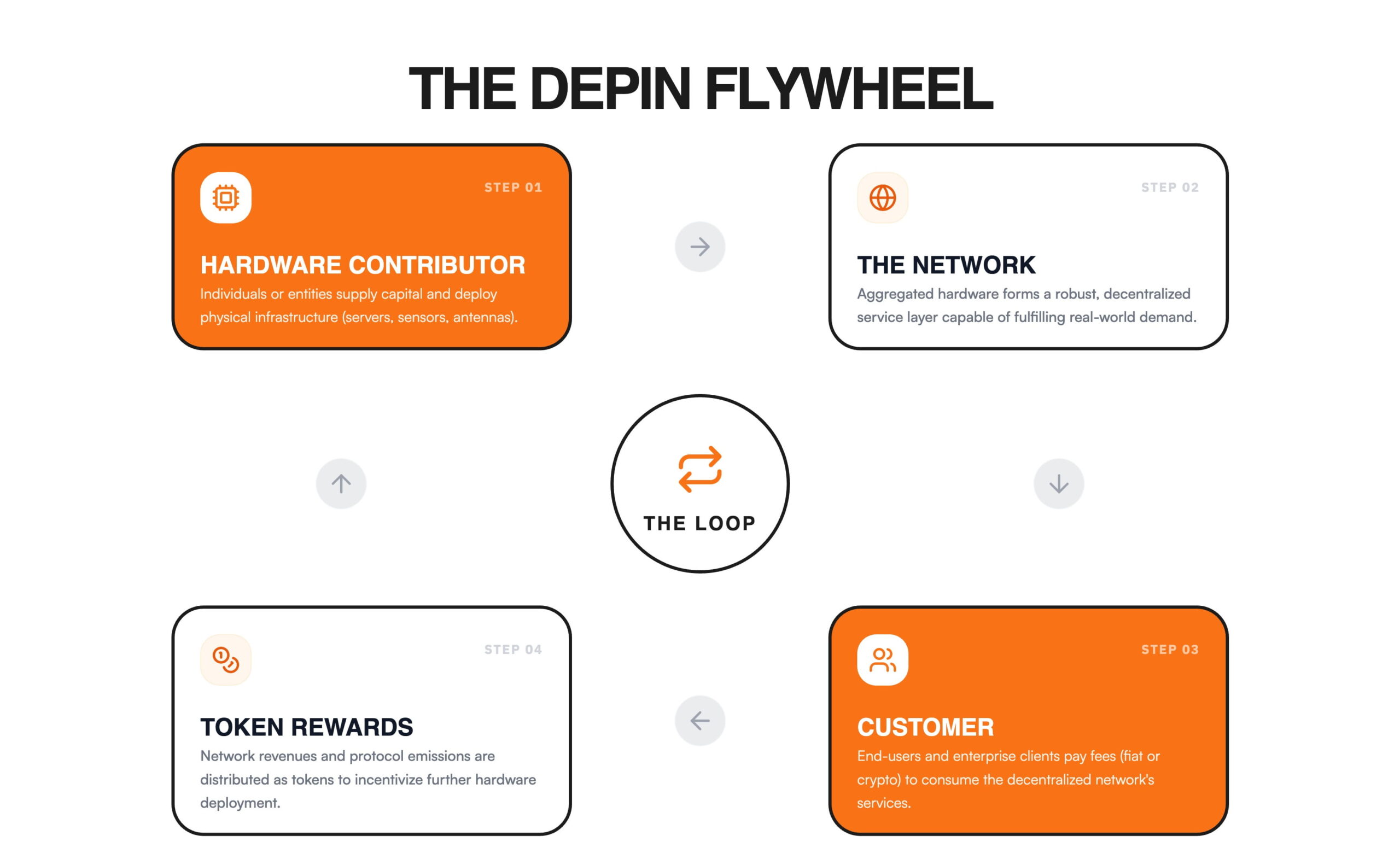
The mechanics are easier to grasp as a loop. Think of DePIN as Uber for a physical resource, except the drivers also own the company.
The hardware layer
Every DePIN starts with physical devices deployed by contributors – sometimes individuals at home, sometimes professional operators with racks of equipment. The hardware depends on the network: hotspots for wireless, GPUs for compute, hard drives for storage, dashcams for mapping, sensors for weather data.
The blockchain layer
A blockchain coordinates the network. Smart contracts log proofs of contribution – that a hotspot transmitted real signal, that a GPU completed a render job, that storage providers actually held the data they claimed. Anyone can verify those records.
The token incentive layer
Contributors earn the project’s native token in proportion to verified work. Tokens have value because the network has paying customers: telecoms buying offload capacity, AI startups buying GPU hours, archives paying for storage. As demand rises, the token strengthens, and operators have a stronger incentive to add hardware. New hardware expands coverage, which attracts more customers. This is sometimes called the token incentive flywheel.
The demand side
On the other end of the loop are users buying network services. They typically pay in the project’s token, a stablecoin, or fiat that’s converted on the back end. The closer real revenue gets to native token demand, the healthier the economic model, and that gap is the single biggest test for any DePIN.
The Two Types of DePIN Networks
Most DePIN projects fall into one of two buckets, a taxonomy first laid out by venture firm a16z.
Physical Resource Networks (PRNs) rely on location-specific hardware. A wireless hotspot in Madrid only helps people who walk past it. A weather sensor in Quito only measures weather in Quito. Coverage is the product. Examples: Helium (wireless), Hivemapper (mapping), WeatherXM (weather data), DIMO (vehicle data).
Digital Resource Networks (DRNs) deal in fungible digital resources. A GPU rendering a frame doesn’t care where the customer sits. A hard drive storing a file doesn’t either. Capacity is the product. Examples: Filecoin and Arweave (storage), Render, Akash, and io.net (GPU compute).
The distinction matters because the two scale very differently. PRNs win city-by-city; DRNs can globalize from day one. PRNs compete with telecom and utility incumbents; DRNs compete with hyperscale cloud providers.
TypeResourceExample ProjectCustomerPRNWireless coverageHeliumMobile carriers, IoT operatorsPRNMapping dataHivemapper / Bee MapsAutomotive, logisticsDRNStorageFilecoinArchives, AI labs, enterprisesDRNGPU computeRender, Akash, io.netCreative studios, AI developersTypePRNResourceWireless coverageExample ProjectHeliumCustomerMobile carriers, IoT operatorsTypePRNResourceMapping dataExample ProjectHivemapper / Bee MapsCustomerAutomotive, logisticsTypeDRNResourceStorageExample ProjectFilecoinCustomerArchives, AI labs, enterprisesTypeDRNResourceGPU computeExample ProjectRender, Akash, io.netCustomerCreative studios, AI developers
Best DePIN Projects to Know in 2026
The DePIN category has produced a lot of tokens and not nearly as many deployed networks. These are the projects with shipped hardware and paying users.
Wireless and Connectivity
Helium remains the flagship. The network runs on roughly 376,000 active hotspots and has signed carrier offload deals with T-Mobile in the U.S. and Telefónica’s Movistar in Mexico. More than 120,000 people use Helium Mobile as their phone plan, blending community hotspots with T-Mobile’s 5G. Smaller experiments like Pollen Mobile are testing similar models in specific cities.
Compute and GPU
This is where DePIN’s growth is loudest in 2026. Render Network processes around 1.5 million rendering jobs per month and recently added roughly 60,000 GPUs by integrating the Salad Network. Akash uses a reverse-auction model – providers bid for workloads, which keeps prices low – and crossed $5 million in compute spend in Q1 2026. io.net aggregates GPUs from data centers and individual operators across more than 130 countries, targeting AI inference.
Storage
Filecoin is the largest decentralized storage network in the world, with around 3 exabytes of committed capacity across more than 3,600 storage providers. Utilization has climbed to roughly 36% — meaning real customers, including the Internet Archive, MIT Open Learning, and the Smithsonian, are paying for real storage. Arweave takes a different angle: pay once, store forever.
Mapping and Sensors
Hivemapper (now operating as Bee Maps) has mapped more than 500 million kilometers of road – about 34% of the world’s roads – through dashcams in over 100,000 vehicles. Volkswagen’s autonomous-driving division is a customer. WeatherXM is building a similar model for hyperlocal weather stations, with thousands of devices online globally.
Copywriter note: Refresh all stats from each project’s official site or Messari report within 7 days of publish.
DePIN, AI, and What Comes Next
The most important story in DePIN in 2026 is AI. Generative AI has created a structural shortage of GPU compute. NVIDIA’s high-end chips are sold out months in advance, and the leading memory makers have said 2026 production is essentially spoken for.
Centralized clouds can’t add data centers fast enough. DePIN networks can, because their supply doesn’t depend on one company’s capex. Roughly 70% of GPU demand in 2026 is for AI inference rather than frontier-model training — and inference maps well to decentralized fleets. That’s why Render, Akash, io.net, and Bittensor have become the most-watched names in the DePIN ecosystem.
The honest trade-offs haven’t disappeared. Many DePIN tokens still trade on narrative rather than revenue. Hardware quality varies. Token-emission models can collapse if real demand never materializes. Regulators are still working out how decentralized infrastructure fits into telecom, data-protection, and securities law.
What to watch: institutional capital crossing from research to allocation (Grayscale has added DePIN tokens to its index products), AI-driven demand for compute and storage, and the first networks to prove sustainable economics without token subsidies.
Conclusion
DePIN (Decentralized Physical Infrastructure Networks) is what happens when blockchain and tokens coordinate real-world hardware instead of purely digital assets. After years of theoretical pitches, the category now has deployed networks earning real revenue: hundreds of thousands of hotspots, exabytes of storage, millions of rendered frames per month. It’s also where AI’s compute shortage is most likely to meet a credible decentralized answer.