
On almost any trading day in 2025 or 2026, you can pull up a Bitcoin chart next to the Nasdaq’s and notice something striking: the two often move in lockstep. When the Nasdaq prints a new high on AI optimism, Bitcoin tends to rally.
When a hot inflation print spooks tech stocks, crypto sells off in the same session. Five years ago this connection barely existed. Today, plenty of professional traders watch both screens at once, and a few have given up pretending the second screen is doing anything different from the first.
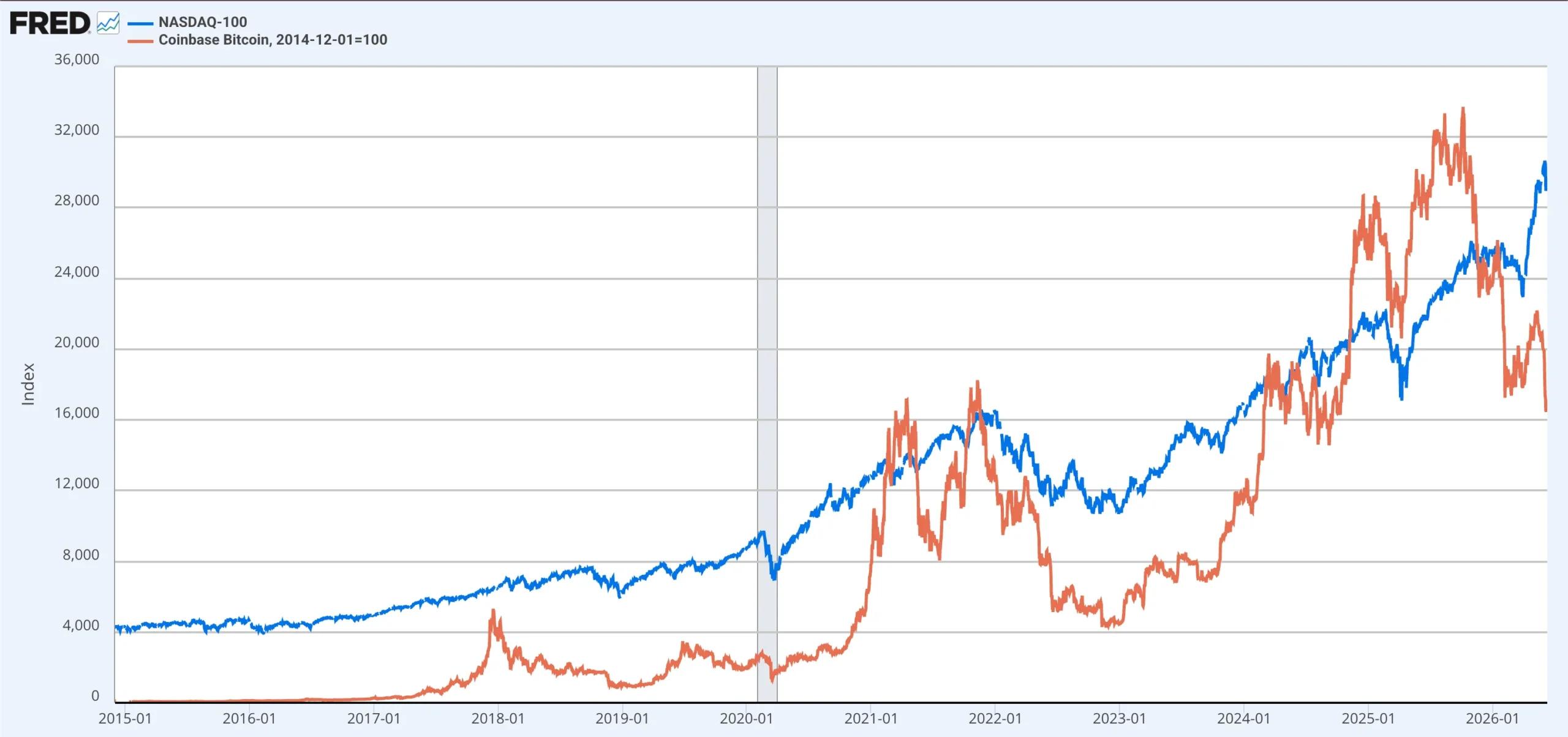
This article does two jobs. First, it answers the most basic question what is Nasdaq, exactly?, and untangles the several things that name actually refers to. Second, it walks through the tight correlation between Nasdaq and crypto: how strong it is, why it exists, when it breaks down, and what it means if you hold both Bitcoin and tech-heavy ETFs.
Key Takeaways
- “Nasdaq” means several different things: an exchange, a broad index, a narrower tech-heavy index, or an ETF that tracks that index.
- The Nasdaq-100 is the cleanest proxy for tech-heavy growth exposure. It excludes financials and is dominated by mega-cap technology and communication-services stocks.
- It is not the S&P 500. The Nasdaq-100 is narrower, more concentrated, and more growth-oriented; the S&P 500 is broader and is treated as the main benchmark for US large-cap stocks.
- The Dow is different again — only 30 blue-chip companies, price-weighted, and less useful for understanding crypto’s relationship with growth and liquidity.
- Bitcoin’s correlation with the Nasdaq-100 has risen sharply since 2020, especially during the COVID liquidity shock, the 2022 rate-hike cycle, and the post-ETF era.
- Both respond to the same macro signals: Fed decisions, inflation data, liquidity conditions, and shifts in risk appetite.
- Holding both Bitcoin and QQQ may diversify less than investors assume. In risk-off periods, the two can behave like one connected risk bucket.
- The relationship is real, but not permanent. Crypto-specific shocks, equity-specific news, or major regime shifts can weaken or break it.
What Is Nasdaq?
Nasdaq is the largest US electronic stock exchange and the second-largest exchange in the world by the market capitalization of its listed companies, after the New York Stock Exchange. Founded in 1971, it was the world’s first all-electronic stock market and is home to many of the planet’s largest technology companies: Apple, Microsoft, Amazon, Alphabet, Meta, and Nvidia all trade here.
The name originally stood for the National Association of Securities Dealers Automated Quotations, a mouthful so cumbersome the company eventually retired it and now simply calls itself Nasdaq.
The structural difference between Nasdaq and the NYSE matters more than most people realize. NYSE has a physical trading floor at 11 Wall Street; Nasdaq has none, all trading is electronic. They also run different market models. Nasdaq operates a dealer market, where multiple market makers post bid and ask prices and trade against their own inventory to provide liquidity. NYSE traditionally used a single designated market maker per stock, though both have converged toward similar electronic systems in practice.
As of mid-2026, Nasdaq lists roughly 4,000 companies across its US, Nordic, and Baltic exchanges, with the combined market capitalization of its US-listed firms running into the tens of trillions of dollars. Nasdaq is also itself a publicly traded company, listed on its own exchange under the ticker NDAQ.
Nasdaq became “the tech exchange” in the 1980s and 1990s, when its electronic-first, lower-cost listing structure attracted high-growth firms (e.g.: Microsoft, Apple, Intel, and Cisco all chose Nasdaq) cementing its identity as the home of US innovation companies. It also set the stage for a cautionary tale worth remembering. On March 10, 2000, at the height of dot-com mania, the Composite hit 5,048.62. Fed chairman Alan Greenspan had floated a now-legendary warning more than three years earlier, in December 1996, and a near-tripling too early:
How do we know when irrational exuberance has unduly escalated asset values? | Alan Greenspan, Federal Reserve chairman, December 1996
The market didn’t wait for an answer: it then fell roughly 78%, took names like Pets.com to zero, and didn’t reclaim that high until 2015. Keep that fifteen-year round trip in mind. The theme of this article is that tech-heavy indices, and the assets that move with them, are exquisitely sensitive to the same forces in both directions.
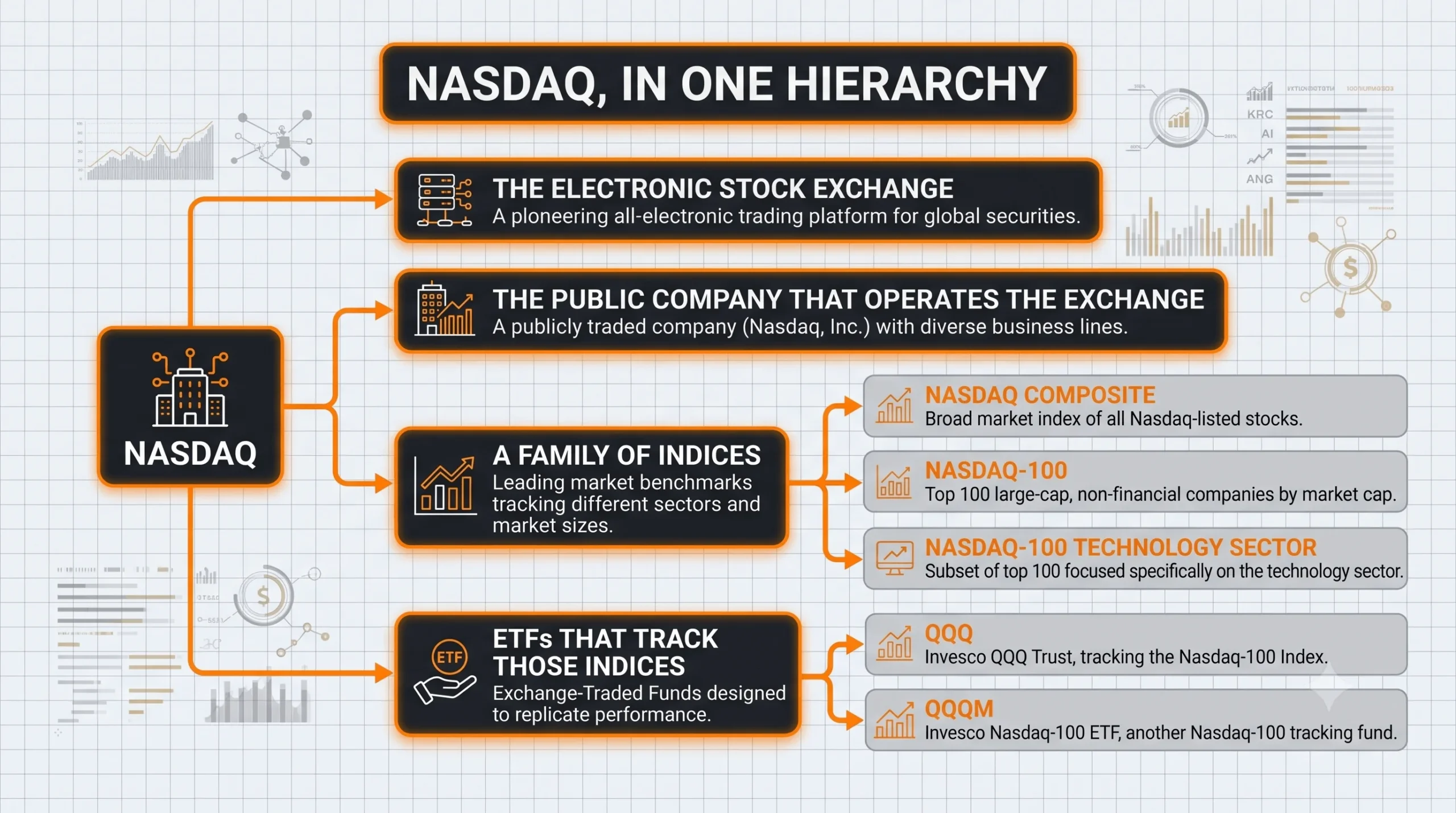
When the news says “the Nasdaq closed up 1.2%,” it isn’t talking about the exchange. It means an index, and there are several. In short: Nasdaq is not one thing. It can refer to the exchange, the company, a family of indices, or ETFs that track them; most headlines use “the Nasdaq” to mean the Composite or the Nasdaq-100.
Nasdaq Composite vs. Nasdaq-100 vs. NDXT: What’s the Difference?
The term “Nasdaq” can refer to several related but different things, so here’s a quick breakdown of the exchange, the company, the major indices, and the ETFs investors commonly use.
TermTickerWhat it actually isWhat it tracksWhy it mattersNasdaq Stock Market—The electronic exchangeCompanies listed and traded on NasdaqThe marketplace where stocks tradeNasdaq, Inc.NDAQThe publicly traded companyThe exchange operator itselfNasdaq is also a listed businessNasdaq CompositeIXIC / COMPBroad stock indexNearly all stocks listed on NasdaqBroadest measure of Nasdaq-listed equitiesNasdaq-100NDXLarge-cap stock index100 largest non-financial Nasdaq listingsMain tech-heavy benchmark investors followNasdaq-100 Tech SectorNDXTSector indexTech companies inside the Nasdaq-100A narrower pure-play tech benchmarkInvesco QQQ TrustQQQExchange-traded fundThe Nasdaq-100The most common way investors “buy the Nasdaq”Invesco NASDAQ 100 ETFQQQMExchange-traded fundThe Nasdaq-100Lower-fee sister product to QQQTermNasdaq Stock MarketTicker—What it actually isThe electronic exchangeWhat it tracksCompanies listed and traded on NasdaqWhy it mattersThe marketplace where stocks tradeTermNasdaq, Inc.TickerNDAQWhat it actually isThe publicly traded companyWhat it tracksThe exchange operator itselfWhy it mattersNasdaq is also a listed businessTermNasdaq CompositeTickerIXIC / COMPWhat it actually isBroad stock indexWhat it tracksNearly all stocks listed on NasdaqWhy it mattersBroadest measure of Nasdaq-listed equitiesTermNasdaq-100TickerNDXWhat it actually isLarge-cap stock indexWhat it tracks100 largest non-financial Nasdaq listingsWhy it mattersMain tech-heavy benchmark investors followTermNasdaq-100 Tech SectorTickerNDXTWhat it actually isSector indexWhat it tracksTech companies inside the Nasdaq-100Why it mattersA narrower pure-play tech benchmarkTermInvesco QQQ TrustTickerQQQWhat it actually isExchange-traded fundWhat it tracksThe Nasdaq-100Why it mattersThe most common way investors “buy the Nasdaq”TermInvesco NASDAQ 100 ETFTickerQQQMWhat it actually isExchange-traded fundWhat it tracksThe Nasdaq-100Why it mattersLower-fee sister product to QQQ
A few practical translations:
- The Nasdaq Composite is the broadest measure, capturing essentially everything on the exchange : large caps, small caps, biotech, financials.
- The Nasdaq-100 is the more focused index: the 100 largest non-financial Nasdaq listings, weighted by market cap. Because it excludes financials and is dominated by mega-cap tech, it’s the index most retail and foreign investors actually track, and the one ETFs are usually built around.
- QQQ is the Invesco ETF tracking it, one of the most heavily traded ETFs in the world, with assets in the hundreds of billions; QQQM is its lower-fee sibling.
- NDXT is a narrower subset of only those Nasdaq-100 constituents classified as technology under the Industry Classification Benchmark. This is pure-play tech exposure, excluding the consumer, healthcare, and industrial names that also live in the Nasdaq-100.
From here on, when this article says “the Nasdaq,” it means the broad story across these indices. For the correlation analysis, the Nasdaq-100, and QQQ as its tradeable proxy, is the cleanest reference.
Nasdaq vs. S&P 500: What’s the Difference?
Nasdaq itself is an exchange, while the S&P 500 is an index; the Nasdaq-100 is what investors actually mean when they line “Nasdaq” up against it. The Nasdaq-100 tracks 100 of the largest non-financial Nasdaq companies, heavily weighted toward technology, communication services, consumer internet, semiconductors, cloud software, AI infrastructure, and other growth businesses.
The S&P 500 tracks 500 large US companies across a far wider range. Technology, yes, but also financials, healthcare, industrials, energy, consumer staples, utilities, real estate, and materials. This makes it a broader benchmark for the US large-cap market.
FeatureNasdaq-100S&P 500Main index tickerNDXSPXCommon ETF proxyQQQ / QQQMSPY / VOO / IVVNumber of companies100500Exchange requirementMust be listed on NasdaqNasdaq or NYSEFinancials included?NoYesSector profileTech-, growth-, innovation-heavyBroad US large-capWeighting styleModified market-cap weightedMarket-cap weightedTypical useGrowth and technology benchmarkBroad US stock-market benchmarkCrypto relevanceMore directly comparable to Bitcoin’s risk-on behaviorUseful for broad context, less concentrated in the themes that drive cryptoFeatureMain index tickerNasdaq-100NDXS&P 500SPXFeatureCommon ETF proxyNasdaq-100QQQ / QQQMS&P 500SPY / VOO / IVVFeatureNumber of companiesNasdaq-100100S&P 500500FeatureExchange requirementNasdaq-100Must be listed on NasdaqS&P 500Nasdaq or NYSEFeatureFinancials included?Nasdaq-100NoS&P 500YesFeatureSector profileNasdaq-100Tech-, growth-, innovation-heavyS&P 500Broad US large-capFeatureWeighting styleNasdaq-100Modified market-cap weightedS&P 500Market-cap weightedFeatureTypical useNasdaq-100Growth and technology benchmarkS&P 500Broad US stock-market benchmarkFeatureCrypto relevanceNasdaq-100More directly comparable to Bitcoin’s risk-on behaviorS&P 500Useful for broad context, less concentrated in the themes that drive crypto
The key difference is concentration. The Nasdaq-100 is narrower and more exposed to mega-cap technology and growth; the S&P 500 is broader and is the default benchmark for “the US stock market.” That matters for crypto investors: Bitcoin’s correlation is usually discussed against the Nasdaq-100 rather than the S&P 500 because Bitcoin often behaves more like a high-beta, liquidity-sensitive growth asset than a broad diversified benchmark.
When rates fall, liquidity improves, or AI-driven risk appetite returns, the Nasdaq-100 and Bitcoin respond more aggressively; when rates rise or investors de-risk, both can sell off together. The S&P 500 still reflects broad risk appetite, but the Nasdaq-100 gives a cleaner read on the same growth, liquidity, and speculative-risk forces that move crypto.
How Nasdaq Differs from the Dow
The Dow Jones Industrial Average is another major US benchmark, but very different from both. It tracks only 30 large blue-chip companies, and it is price-weighted. This means that companies with higher share prices carry more influence regardless of total market value, whereas the Nasdaq-100 and S&P 500 are weighted primarily by market capitalization.
So: the Dow is a narrow blue-chip index, the S&P 500 a broad large-cap index, and the Nasdaq-100 a concentrated technology-and-growth index. For crypto correlation, the Nasdaq-100 is usually the most useful comparison; the Dow still reflects broad market sentiment but isn’t as tied to the tech, AI, long-duration growth, and liquidity themes that drive Bitcoin.
Why Nasdaq Is “the Tech Index”
Three structural features explain why the Nasdaq’s main indices behave the way they do.
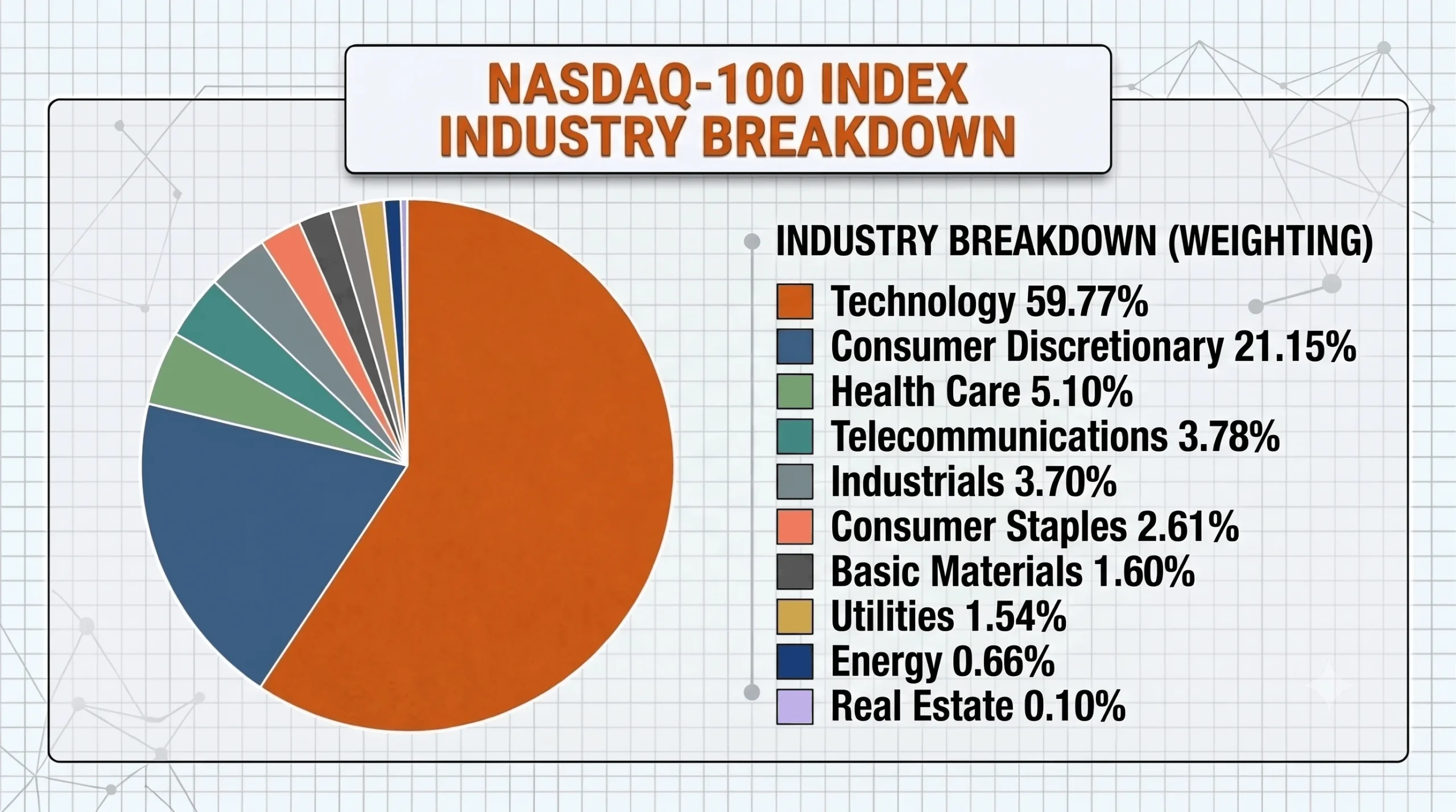
1. Sector concentration is heavy
Information technology and communication services together make up well over half of the Nasdaq-100 by weight. Per Invesco’s QQQ documentation, the information-technology allocation alone runs above 50%, so a handful of themes (semiconductors, cloud, digital advertising, AI infrastructure) drive most of the movement.
2. Mega-cap concentration is even heavier
As of May 2026, the top five QQQ holdings, Nvidia, Apple, Microsoft, Amazon, and Alphabet Class A, account for roughly 30% of the entire fund, and the top 10 for approximately 47%–50%. A single Nvidia earnings call or Microsoft guidance change can move the whole index.
3. Tech stocks are long-duration assets
The most important point. Technology and growth companies earn most of their expected cash flows far in the future; discount those back to the present, and even small interest-rate changes have an outsized effect on valuations. Bond traders call this duration, and tech stocks behave like very long-duration assets, even though they aren’t fixed income.
Nasdaq featureWhat it meansWhy it matters for crypto correlationHeavy tech weightingSoftware, semis, cloud, AI, and digital platforms drive the indexThese sectors are highly sensitive to rates, liquidity, and growth expectationsMega-cap concentrationA few companies account for a large share of index weightMarket-wide risk appetite can turn on a handful of earnings reports or AI narrativesLong-duration profileMuch of the valuation depends on future cash flowsHigher rates hit valuations hard; easier liquidity supports themGlobal investor baseQQQ is widely owned by retail, advisors, hedge funds, institutionsMany of the same investors now also own Bitcoin via exchanges or ETFsNarrative sensitivityAI, innovation, disruption, future-growth stories dominateSimilar narratives also drive parts of the crypto marketNasdaq featureHeavy tech weightingWhat it meansSoftware, semis, cloud, AI, and digital platforms drive the indexWhy it matters for crypto correlationThese sectors are highly sensitive to rates, liquidity, and growth expectationsNasdaq featureMega-cap concentrationWhat it meansA few companies account for a large share of index weightWhy it matters for crypto correlationMarket-wide risk appetite can turn on a handful of earnings reports or AI narrativesNasdaq featureLong-duration profileWhat it meansMuch of the valuation depends on future cash flowsWhy it matters for crypto correlationHigher rates hit valuations hard; easier liquidity supports themNasdaq featureGlobal investor baseWhat it meansQQQ is widely owned by retail, advisors, hedge funds, institutionsWhy it matters for crypto correlationMany of the same investors now also own Bitcoin via exchanges or ETFsNasdaq featureNarrative sensitivityWhat it meansAI, innovation, disruption, future-growth stories dominateWhy it matters for crypto correlationSimilar narratives also drive parts of the crypto market
Put the first three together and you get an index unusually reactive to AI narratives, interest-rate moves, liquidity conditions, and any shift in market-wide risk appetite. That reactivity, not some shared technology, is precisely what links it to crypto. The Nasdaq-100 is not just “the stock market”; it’s a concentrated, tech-heavy, liquidity-sensitive growth index, which makes it far more likely to move alongside Bitcoin than a broad, defensive benchmark would.
The Nasdaq–Crypto Correlation Story
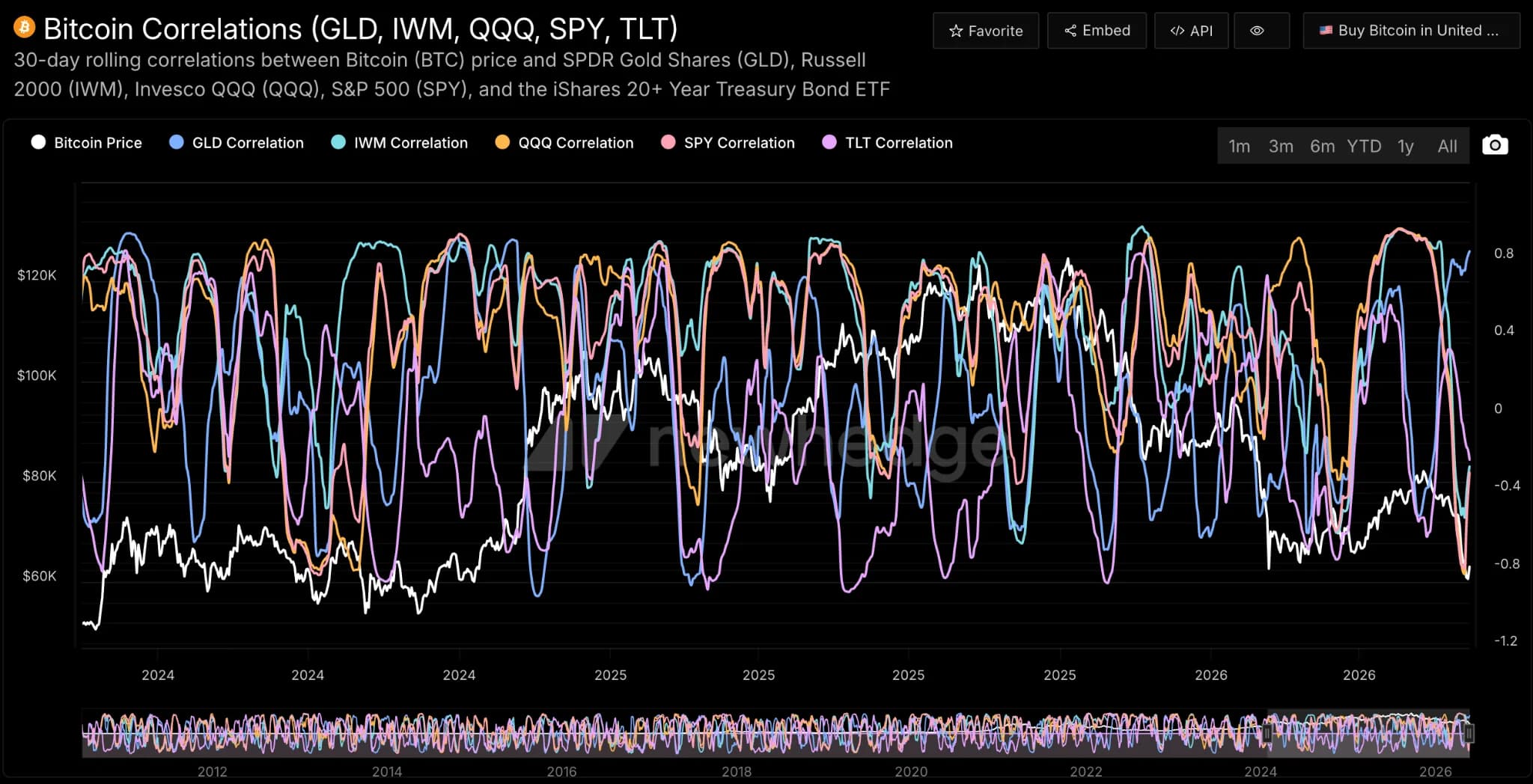
The empirical observation is straightforward: the rolling correlation between Bitcoin and the Nasdaq-100 has trended sharply higher since 2020. Before then, the two moved largely independently, with correlations frequently near zero or even slightly negative.
According to LSEG data, Bitcoin’s correlation with the Nasdaq-100 averaged 0.52 in 2025, more than double the 0.23 recorded in 2024, and Bloomberg data cited by The Kobeissi Letter showed the 30-day correlation reaching roughly 0.80 in November 2025, the highest reading since 2022. The five-year average has settled around 0.54.
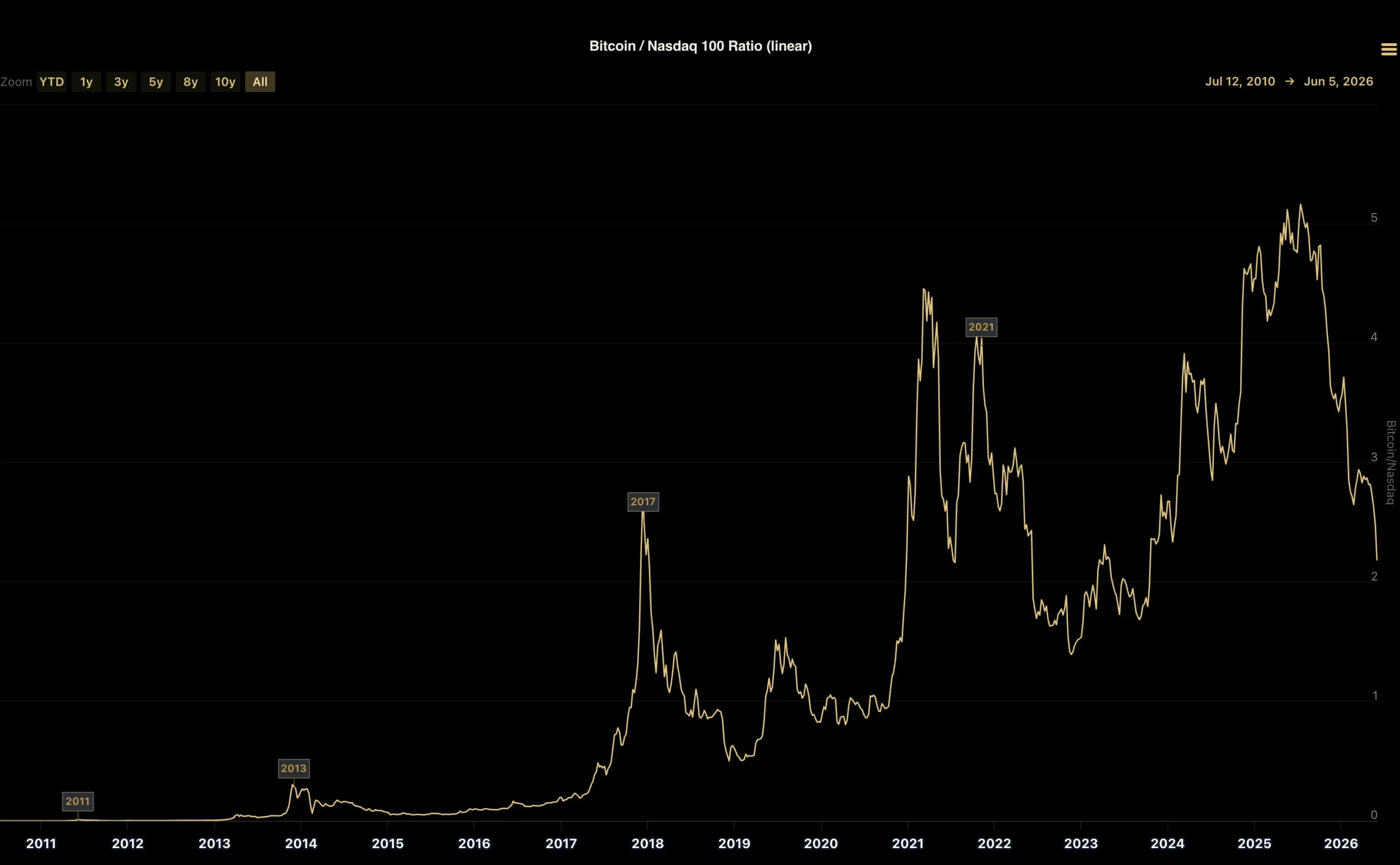
Three inflection points stand out:
- March 2020, the COVID crash: Bitcoin and the Nasdaq collapsed together in a global liquidity shock as investors sold everything to raise cash, then rallied together as central banks rolled out unprecedented stimulus. The correlation strengthened sharply and stayed there.
- The 2022 rate-hike cycle: As the Fed raised rates aggressively to fight inflation, both sold off in tandem: Bitcoin fell roughly 65% from its November 2021 peak; the Nasdaq-100 fell more than 30% over the same window. The framing of Bitcoin as a “risk asset” rather than “digital gold” took hold among mainstream investors.
- January 2024, the spot Bitcoin ETF approval: The SEC approved the first spot Bitcoin ETFs, and the structural connection to traditional markets deepened immediately. As of May 2026, cumulative inflows into US spot Bitcoin ETFs total approximately $58.7 billion since launch, with BlackRock’s iShares Bitcoin Trust capturing the largest share.
The later has an irony worth savoring here. Six years before those wrappers existed, Warren Buffett had dismissed Bitcoin in the bluntest terms:
[Bitcoin is] probably rat poison squared. | Warren Buffett, Berkshire Hathaway annual meeting, 2018
By 2024, that same “rat poison” was sitting in regulated ETFs held by the very advisors who own QQQ, right next to the tech stocks Buffett does like. With Bitcoin in those wrappers, its behavior has converged further with tech-heavy equity indices.
Correlation Regimes: How the Relationship Changed
Bitcoin’s relationship with the Nasdaq-100 has shifted through several distinct market regimes, from mostly independent pre-2020 price action to much stronger macro-driven correlation after the COVID shock and ETF approval.
PeriodBTC–Nasdaq relationshipWhat changedReader takeawayPre-2020Weak, inconsistent, often near zeroCrypto was still isolated from traditional portfoliosBitcoin looked more diversifying than it does todayMarch 2020 COVID shockCorrelation jumpedBoth sold off in a liquidity panic, then rallied on stimulusMacro liquidity became the dominant driver2022 rate-hike cycleStrong risk-off correlationHigher rates crushed long-duration growth and speculative cryptoBitcoin traded like high-beta tech, not digital gold2024 spot ETF eraInstitutional overlap increasedBitcoin entered regulated wrappers used by advisorsTraditional portfolios began holding BTC alongside QQQ2025–26 decoupling windowsCorrelation broke temporarilyCrypto- or equity-specific catalysts took overCorrelation is a regime, not a lawPeriodPre-2020BTC–Nasdaq relationshipWeak, inconsistent, often near zeroWhat changedCrypto was still isolated from traditional portfoliosReader takeawayBitcoin looked more diversifying than it does todayPeriodMarch 2020 COVID shockBTC–Nasdaq relationshipCorrelation jumpedWhat changedBoth sold off in a liquidity panic, then rallied on stimulusReader takeawayMacro liquidity became the dominant driverPeriod2022 rate-hike cycleBTC–Nasdaq relationshipStrong risk-off correlationWhat changedHigher rates crushed long-duration growth and speculative cryptoReader takeawayBitcoin traded like high-beta tech, not digital goldPeriod2024 spot ETF eraBTC–Nasdaq relationshipInstitutional overlap increasedWhat changedBitcoin entered regulated wrappers used by advisorsReader takeawayTraditional portfolios began holding BTC alongside QQQPeriod2025–26 decoupling windowsBTC–Nasdaq relationshipCorrelation broke temporarilyWhat changedCrypto- or equity-specific catalysts took overReader takeawayCorrelation is a regime, not a law
Institutional research lines up with the market data. The IMF’s Global Financial Stability Note 2022/01 documented the post-2020 rise in crypto-equity correlations and attributed it largely to common macro factors; a 2023 IMF working paper, New Evidence on Spillovers Between Crypto Assets and Financial Markets (Iyer and Popescu), found that crypto assets transmit meaningful spillovers to traditional markets, especially during risk-off episodes.
The Bank for International Settlements, the Federal Reserve Bank of New York, and firms like Coin Metrics, Kaiko, Glassnode, and NYDIG have published analyses pointing the same way.
The practical takeaway is simple: if your portfolio includes both Bitcoin and Nasdaq-heavy ETFs, you may have less diversification than the surface allocation suggests, because the two often respond to the same macro signals (e.g.:Fed decisions, CPI prints, liquidity conditions) in the same direction at the same time. But correlation only measures how two assets have moved together; it does not guarantee how they’ll behave in the next shock. Treat the link as a feature of the current macro regime, not a permanent law of markets.
Why the Correlation Exists: Four Macro Mechanisms
The link isn’t mysterious. It comes from a few overlapping forces that push both assets the same way.
1. Shared sensitivity to interest rates and liquidity
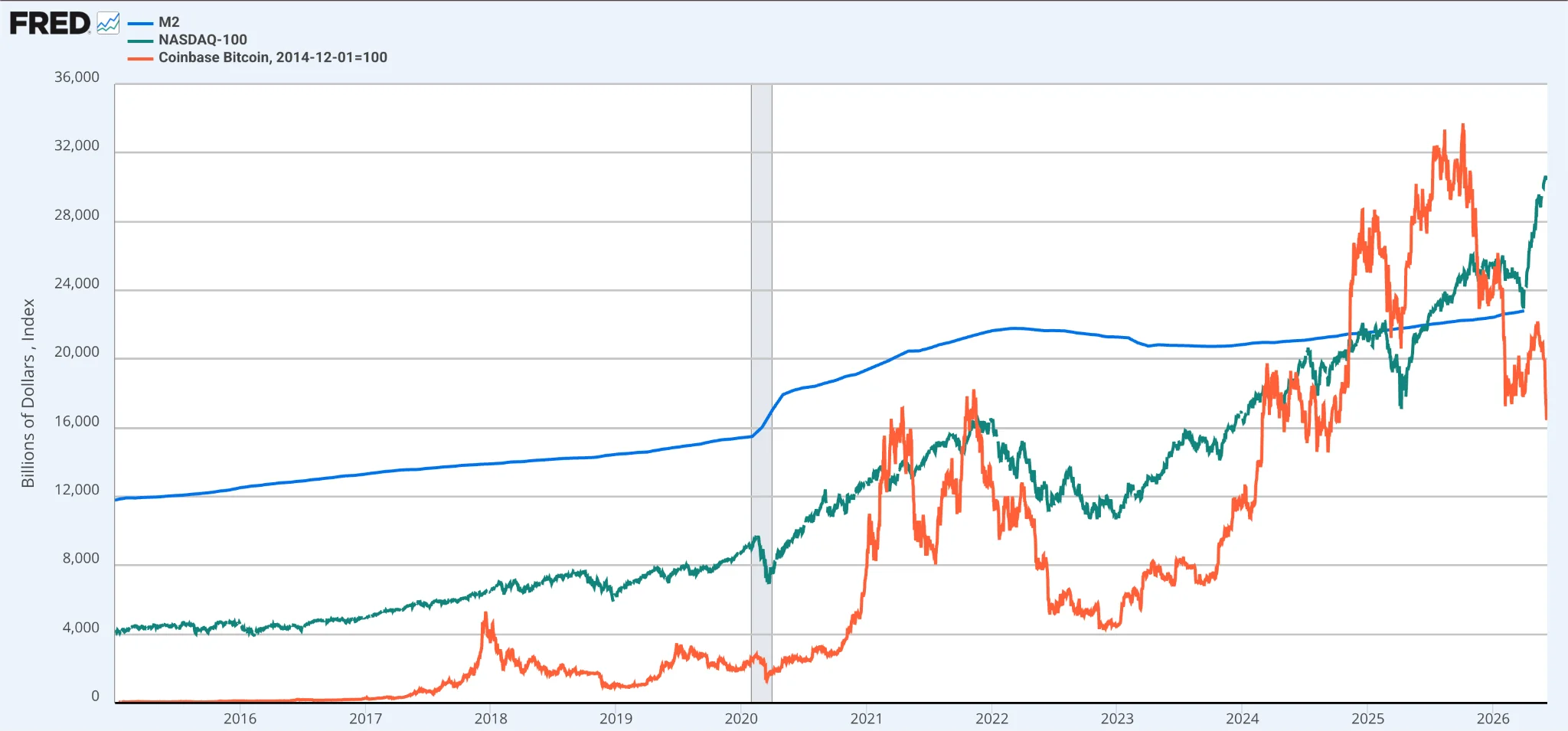
The biggest mechanism. Both long-duration tech stocks and Bitcoin behave like liquidity-sensitive risk assets: when central banks tighten and pull liquidity out, both fall; when liquidity expands via rate cuts, balance-sheet expansion, or fiscal stimulus, both rise. Anyone who has tracked M2 money supply against crypto prices over the past five years will recognize the pattern.
2. Common holder base
Increasingly, the same institutional and retail investors own both. Wealth managers, hedge funds, family offices, and brokerage-app users now treat Bitcoin and Nasdaq exposure as adjacent positions in a single “growth” allocation, and cut both at once when risk appetite turns (say, after a hawkish FOMC meeting). The 2024 ETF approval deepened this overlap structurally.
3. Common narrative drivers
AI optimism lifts both Nasdaq mega-caps and AI-adjacent crypto narratives (decentralized physical infrastructure networks, decentralized AI tokens, GPU-rental protocols); Fed rate cuts lift both. These narratives now flow across asset classes within hours, spread by retail trading apps and crypto Twitter.
4. Algorithmic and macro-fund flows
Systematic strategies, quant funds, risk-parity portfolios, trend-followers, treat Bitcoin and equity indices as components of the same risk-asset basket. When volatility spikes they cut across the basket; when it falls they re-engage across the basket.
What Moves Both Markets?
Those mechanisms show up most clearly around macro events, earnings shocks, ETF flows, and sudden changes in market-wide risk appetite.
TriggerTypical Nasdaq reactionTypical crypto reactionWhy it mattersHot CPI printOften sells offOften sells offHigher inflation can mean higher-for-longer ratesDovish Fed signalOften ralliesOften ralliesEasier policy supports risk assetsRate-cut expectations riseOften ralliesOften ralliesLower discount rates support long-duration assetsTreasury yields spikeOften sells offOften sells offHigher yields compete with speculative growth assetsAI optimismMega-cap tech may rallyAI-adjacent crypto may rallyThe “innovation” story spreads across marketsSpot Bitcoin ETF inflowsLimited direct effectOften supportive for BTCCrypto-specific demand enters via regulated wrappersNvidia earnings shockCan move the whole Nasdaq-100Usually indirectEquity-specific catalystCrypto exchange failureLimited direct effectOften negative for cryptoCrypto-specific trust and liquidity shockRisk-off volatility spikeOften sells offOften sells offFunds and traders cut exposure across risk assetsTriggerHot CPI printTypical Nasdaq reactionOften sells offTypical crypto reactionOften sells offWhy it mattersHigher inflation can mean higher-for-longer ratesTriggerDovish Fed signalTypical Nasdaq reactionOften ralliesTypical crypto reactionOften ralliesWhy it mattersEasier policy supports risk assetsTriggerRate-cut expectations riseTypical Nasdaq reactionOften ralliesTypical crypto reactionOften ralliesWhy it mattersLower discount rates support long-duration assetsTriggerTreasury yields spikeTypical Nasdaq reactionOften sells offTypical crypto reactionOften sells offWhy it mattersHigher yields compete with speculative growth assetsTriggerAI optimismTypical Nasdaq reactionMega-cap tech may rallyTypical crypto reactionAI-adjacent crypto may rallyWhy it mattersThe “innovation” story spreads across marketsTriggerSpot Bitcoin ETF inflowsTypical Nasdaq reactionLimited direct effectTypical crypto reactionOften supportive for BTCWhy it mattersCrypto-specific demand enters via regulated wrappersTriggerNvidia earnings shockTypical Nasdaq reactionCan move the whole Nasdaq-100Typical crypto reactionUsually indirectWhy it mattersEquity-specific catalystTriggerCrypto exchange failureTypical Nasdaq reactionLimited direct effectTypical crypto reactionOften negative for cryptoWhy it mattersCrypto-specific trust and liquidity shockTriggerRisk-off volatility spikeTypical Nasdaq reactionOften sells offTypical crypto reactionOften sells offWhy it mattersFunds and traders cut exposure across risk assets
None of these is permanent, but together they explain why Nasdaq and crypto have become so tightly linked since 2020, and why the link has, if anything, strengthened since ETF approval. Bitcoin does not need to be a tech stock to trade like one: when the same macro forces, the same investors, and the same risk models drive both markets, the price action converges.
How a Fed Decision Can Reach Bitcoin
One simple way to see the relationship is to follow the chain from monetary policy to portfolio risk:
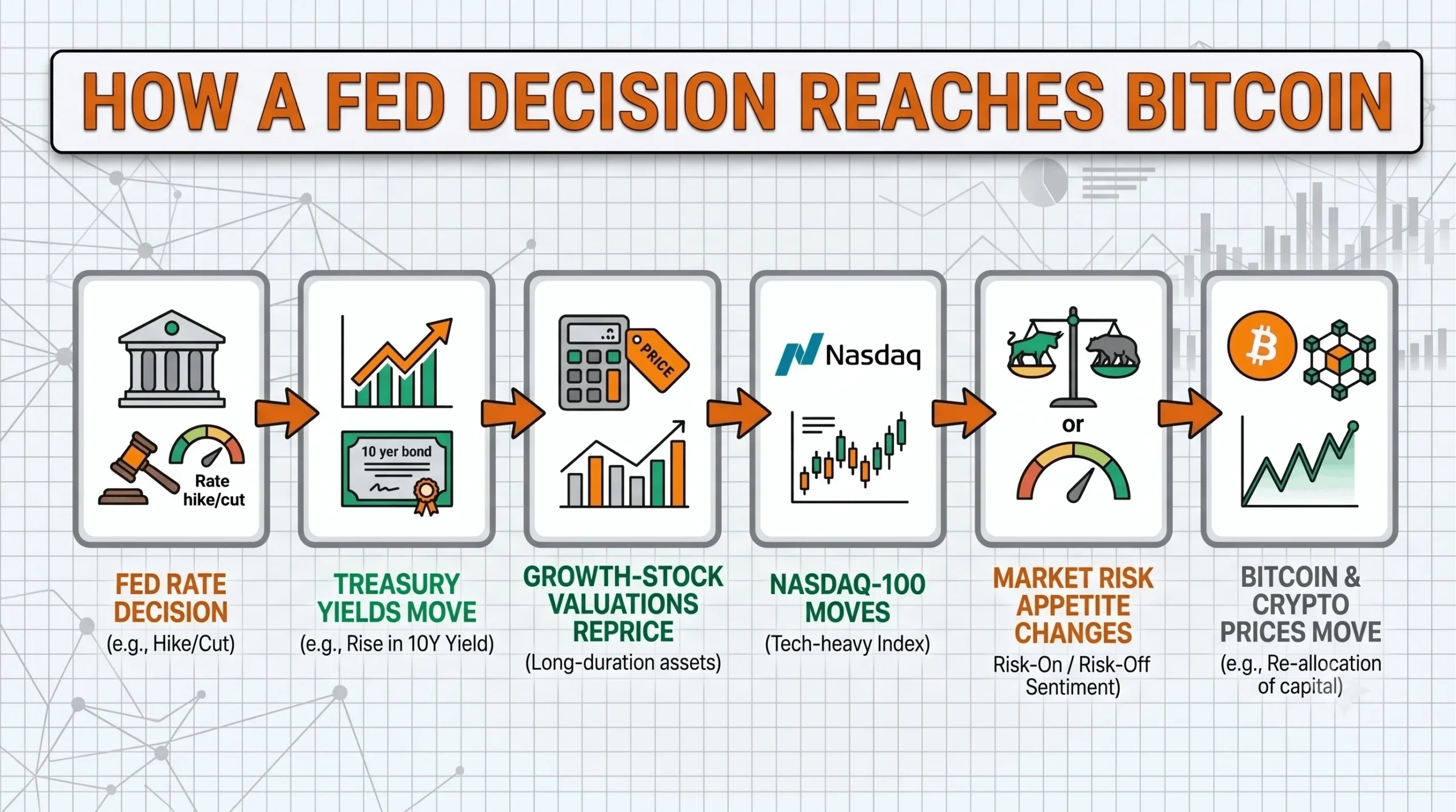
It doesn’t happen mechanically every time. But in the post-2020 market structure it’s common enough that crypto traders now watch the same macro calendar as equity traders: CPI, payrolls, Fed meetings, Treasury yields, liquidity data, and the dollar.
When the Correlation Breaks Down
The relationship is real, but not constant. Several conditions can decouple Bitcoin from the Nasdaq, sometimes for extended periods.
Crypto-specific events
Halvings, major exchange failures, regulatory shocks, and surges in spot ETF flows can send crypto off on its own internal dynamics. In late 2025, Bitcoin diverged sharply from the Nasdaq for several weeks after its October peak, even as the Nasdaq-100 traded near record highs.
Equity-specific shocks
A blow-out Nvidia report, a guidance miss at Apple, or an antitrust ruling against Alphabet can move the Nasdaq dramatically without touching Bitcoin — single-stock news has no analogue in crypto.
Regime shifts
If the Fed pivots abruptly, or inflation expectations reset, the direction of the correlation can flip. In brief windows of acute equity stress, gold and Bitcoin have behaved more like safe-haven hedges than risk assets.
The long-run question
Some analysts argue that as Bitcoin matures and is held more as digital gold than as a high-beta tech proxy, its correlation with equities should fall over time. So far the data hasn’t shown this clearly, but it’s the structural debate worth watching.
When Nasdaq and Bitcoin Are Most Likely to Move Together
Bitcoin and the Nasdaq-100 tend to move together most strongly when the main driver is macro (rates, inflation, liquidity, or broad risk appetite) and less reliably when the driver is specific to crypto or equities.
Market conditionCorrelation likelyWhyFed meeting weekHigherBoth react to rate and liquidity expectationsHot inflation surpriseHigherRisk assets often sell off togetherBroad market panicHigherInvestors sell liquid assets to raise cashStrong ETF inflow periodLower / mixedBitcoin may move on crypto-specific demandMajor tech earnings weekLower / mixedNasdaq may move on company-specific resultsCrypto regulatory shockLower / mixedBitcoin may decouple from equitiesBitcoin halving cycle eventLower / mixedCrypto-native supply and narrative effects dominateQuiet macro environmentLower / unstableAsset-specific catalysts matter moreMarket conditionFed meeting weekCorrelation likelyHigherWhyBoth react to rate and liquidity expectationsMarket conditionHot inflation surpriseCorrelation likelyHigherWhyRisk assets often sell off togetherMarket conditionBroad market panicCorrelation likelyHigherWhyInvestors sell liquid assets to raise cashMarket conditionStrong ETF inflow periodCorrelation likelyLower / mixedWhyBitcoin may move on crypto-specific demandMarket conditionMajor tech earnings weekCorrelation likelyLower / mixedWhyNasdaq may move on company-specific resultsMarket conditionCrypto regulatory shockCorrelation likelyLower / mixedWhyBitcoin may decouple from equitiesMarket conditionBitcoin halving cycle eventCorrelation likelyLower / mixedWhyCrypto-native supply and narrative effects dominateMarket conditionQuiet macro environmentCorrelation likelyLower / unstableWhyAsset-specific catalysts matter more
A Simple Decision Tree
Ask one question first: Is the main shock macro-driven?
- Yes → Bitcoin and the Nasdaq are more likely to move together.
- No → the relationship is more likely to break down.
Then ask: Is the shock crypto-specific or equity-specific?
- Crypto-specific → Bitcoin may decouple from the Nasdaq.
- Equity-specific → the Nasdaq may move without Bitcoin.
- Broad liquidity shock → both may move together sharply.
In other words, the correlation is strongest when macro dominates and weakest when asset-specific events take over.
What This Means for Investors
The main point is not that Bitcoin and the Nasdaq always move together. They don’t, especially in 2026 when AI is the hottest bubble in the economy. It’s that the diversification benefit may be smaller than it looks during the moments when diversification matters most.
A portfolio holding both QQQ and Bitcoin may appear to own two very different assets (one a regulated equity ETF, the other a decentralized crypto asset) but in practice both may be exposed to liquidity cycles, rate expectations, risk appetite, speculative growth narratives, institutional positioning, and macro-driven deleveraging. That doesn’t make either asset “bad”; it just means the risk overlap should be understood.
Portfolio-Risk Translation
The table below translates common portfolio combinations into the hidden exposures investors may actually be taking.
HoldingWhat the investor thinks they ownHidden exposureQQQLarge-cap innovation and tech growthRates, AI cycle, mega-cap concentrationBitcoinDigital gold or crypto exposureLiquidity, risk appetite, ETF flowsQQQ + BitcoinDiversified growth plus alternative assetPotentially one correlated risk bucket in stressQQQ + Bitcoin + goldGrowth, crypto, and defensive ballastBetter mix, but still regime-dependentQQQ + Bitcoin + T-billsRisk assets plus cash-like stabilityMore explicit liquidity bufferBroad equity index + BitcoinStocks plus cryptoLess Nasdaq concentration, still macro-exposedHoldingQQQWhat the investor thinks they ownLarge-cap innovation and tech growthHidden exposureRates, AI cycle, mega-cap concentrationHoldingBitcoinWhat the investor thinks they ownDigital gold or crypto exposureHidden exposureLiquidity, risk appetite, ETF flowsHoldingQQQ + BitcoinWhat the investor thinks they ownDiversified growth plus alternative assetHidden exposurePotentially one correlated risk bucket in stressHoldingQQQ + Bitcoin + goldWhat the investor thinks they ownGrowth, crypto, and defensive ballastHidden exposureBetter mix, but still regime-dependentHoldingQQQ + Bitcoin + T-billsWhat the investor thinks they ownRisk assets plus cash-like stabilityHidden exposureMore explicit liquidity bufferHoldingBroad equity index + BitcoinWhat the investor thinks they ownStocks plus cryptoHidden exposureLess Nasdaq concentration, still macro-exposed
Portfolio takeaway: If Bitcoin and QQQ both fall when liquidity tightens, they aren’t acting as true diversifiers in that moment. They may serve different long-term purposes, but their short-term risk can overlap.
Signals to Watch
These are the signals that help show whether Bitcoin is trading on crypto-native fundamentals or as part of the broader risk-asset complex.
- 30-day and 90-day BTC–Nasdaq correlation
- Federal Reserve rate decisions
- CPI and inflation expectations
- Treasury yields
- US dollar strength
- M2 money supply and global liquidity
- Spot Bitcoin ETF net flows
- Nasdaq-100 top-10 concentration
- Nvidia, Apple, Microsoft, Amazon, and Alphabet earnings
- Crypto-specific shocks: regulation, exchange failures, halvings, ETF flow reversals
These help answer the most important question: is Bitcoin currently trading on crypto-native fundamentals, or as part of the broader risk-asset complex?
The Bottom Line
Nasdaq is the largest US electronic exchange and home to several distinct indices: the broad Composite, the focused Nasdaq-100, the technology subset NDXT, and the dominant QQQ ETF. When investors compare “Nasdaq vs. S&P 500,” they’re usually comparing the Nasdaq-100 with the S&P 500, and that comparison matters:
- Nasdaq-100: a concentrated growth and innovation benchmark.
- S&P 500: a broader US large-cap benchmark.
- Dow: a narrow blue-chip benchmark.
- Bitcoin: increasingly held inside traditional portfolios.
Both Bitcoin and the Nasdaq-100 respond strongly to liquidity, interest rates, and risk appetite, which is why the Nasdaq-100 is often the cleanest equity-market comparison for crypto. For any investor holding both, understanding this correlation is critical to understanding actual portfolio risk: two positions that look like diversification on paper can act as one in practice, especially during the macro events (Fed decisions, CPI prints, liquidity shocks) that matter most. The correlation can break, but it cannot be ignored.