The NYSE, the New York Stock Exchange, is one of the world’s largest and most influential financial/stock exchanges, pairing modern electronic trading with a historic trading floor.
Most people still picture the NYSE as a frantic room of shouting traders, an image kept alive by old news footage and a few good movies. The reality is quieter: today it runs as a high-speed electronic marketplace, and the physical floor survives mostly for the opening bell, the symbolism, and a specialized role in the day’s biggest auctions.
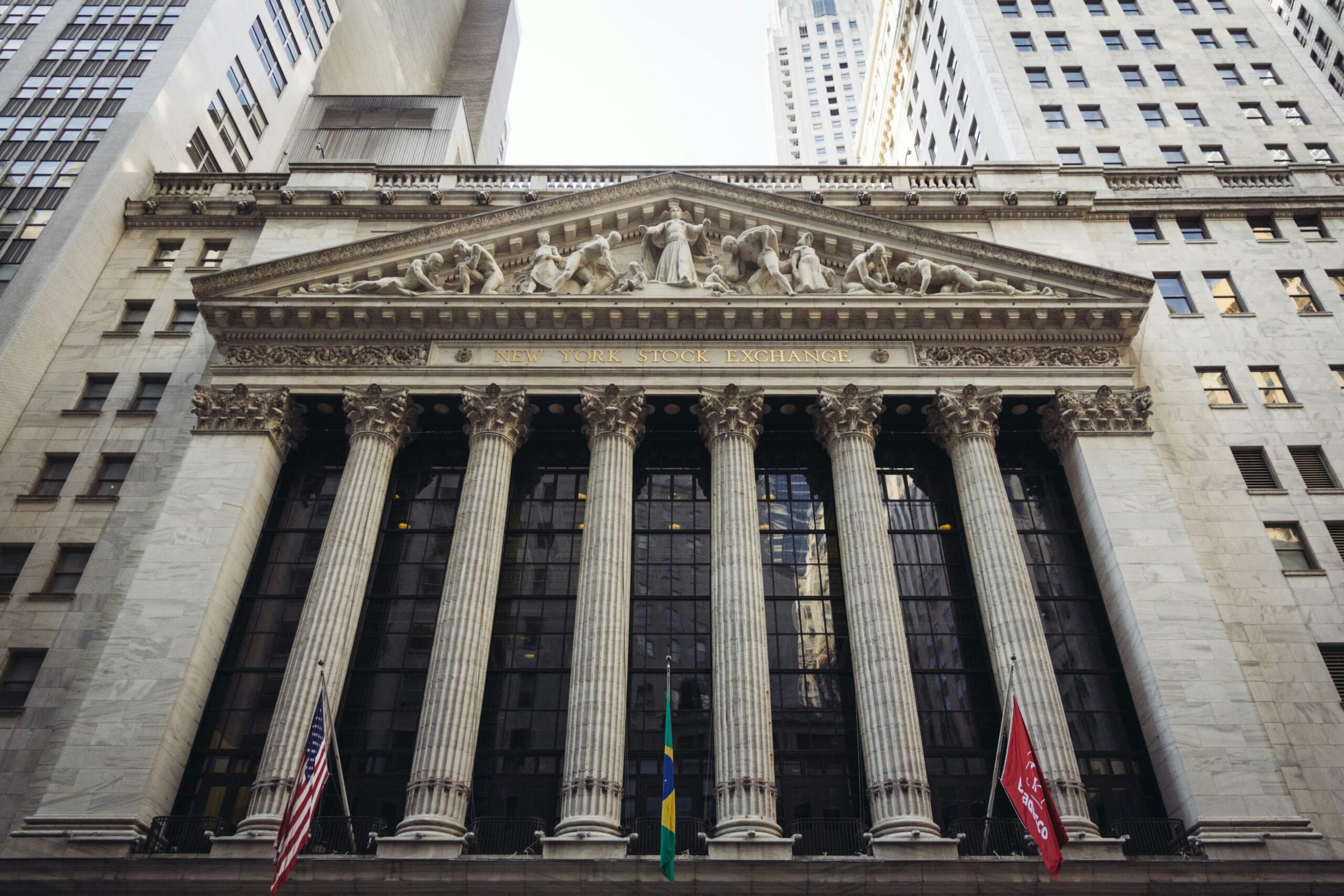
This guide explains what the NYSE is, how a trade actually happens, why companies list there, how it differs from Nasdaq, and where it sits in the wider financial system. It also covers how the NYSE connects to crypto through Bitcoin ETPs, crypto-related public companies, extended trading hours, and early work on tokenized securities.
Key Takeaways
- The NYSE is one stock exchange within the larger stock market.
- It is where shares of listed public companies are bought and sold, almost always through a broker.
- It combines electronic trading with a historic trading floor.
- Companies list to raise capital, create liquidity, and gain visibility.
- The NYSE and Nasdaq are both major U.S. exchanges built on different market models.
- Indexes like the Dow Jones and S&P 500 track stocks; they do not trade them.
- Bitcoin does not trade on the NYSE as an ordinary stock, but Bitcoin-linked exchange-traded products trade on NYSE Arca.
- The NYSE is not a crypto exchange, though its parent company, ICE, is building tokenized-securities infrastructure that points toward a more blockchain-connected future for traditional markets.
NYSE Quick Facts
Before getting into how the exchange works, here are the basic facts that define the NYSE: what it is, where it is based, when it trades, and who oversees it.
FactAnswerFull nameNew York Stock ExchangeAbbreviationNYSELocation11 Wall Street, New York CityMain functionMarketplace for buying and selling listed stocks and other securitiesRegular trading hours9:30 a.m. to 4:00 p.m. Eastern Time, Monday–Friday, excluding exchange holidaysFoundedTraces its origins to the Buttonwood Agreement, signed May 17, 1792Regulated byU.S. Securities and Exchange Commission; the NYSE also operates as a self-regulatory organizationParent companyIntercontinental Exchange, Inc. (ICE)FactFull nameAnswerNew York Stock ExchangeFactAbbreviationAnswerNYSEFactLocationAnswer11 Wall Street, New York CityFactMain functionAnswerMarketplace for buying and selling listed stocks and other securitiesFactRegular trading hoursAnswer9:30 a.m. to 4:00 p.m. Eastern Time, Monday–Friday, excluding exchange holidaysFactFoundedAnswerTraces its origins to the Buttonwood Agreement, signed May 17, 1792FactRegulated byAnswerU.S. Securities and Exchange Commission; the NYSE also operates as a self-regulatory organizationFactParent companyAnswerIntercontinental Exchange, Inc. (ICE)
What Is the NYSE?
The NYSE is a stock exchange: a regulated marketplace that connects buyers and sellers of shares in publicly listed companies. A share is a unit of ownership in a company; an exchange is the organized venue where those shares change hands at agreed prices.
Two sides use it for different reasons. Companies list on the NYSE to turn private ownership into publicly tradable shares, raising money and creating a market for their stock. Investors use it, almost always through a broker rather than directly, to buy and sell those shares during market hours. The exchange sits in the middle, setting the rules, matching orders, and publishing prices so everyone trades on the same terms.
What Does the NYSE Do?
A stock exchange does far more than host trades. The NYSE lists public companies, runs the marketplace where their shares trade, supports price discovery, sets and enforces listing standards, and publishes the market data investors rely on.
The listing role matters most. To trade on the NYSE, a company must meet thresholds for size, share price, profitability or revenue, and corporate governance, and keep meeting them to stay listed. Those standards are part of what a NYSE listing signals.
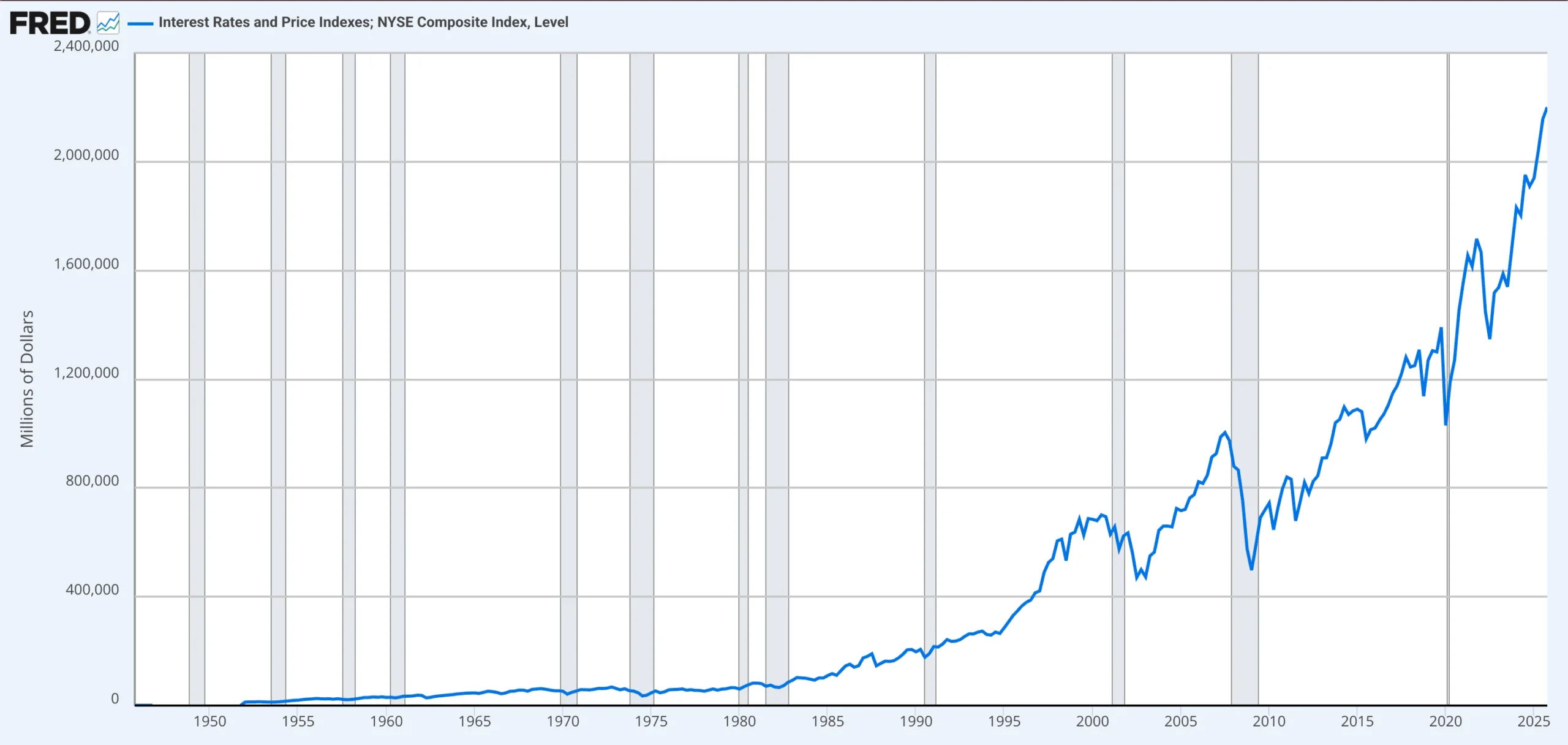
At its core, the exchange is a matching engine. When one investor wants to buy and another wants to sell at a compatible price, the NYSE pairs them and the trade executes. Multiply that across millions of orders a day and you get a continuous, liquid market. Every executed trade updates the stock’s price, so the quote reflects the latest balance of supply and demand. This process is called price discovery, and is one of an exchange’s most important functions.
As the value investor Benjamin Graham put it, in the short run the market behaves like a “voting machine” driven by sentiment, while over the long run it acts more like a “weighing machine” that settles toward underlying value.
How Does the NYSE Work?
Follow a single trade from start to finish and the system becomes clear. A trade is executed the moment a buyer and seller are matched, but the deal is only complete once clearing and settlement move the shares and cash behind the scenes.
StagePlain-English meaningWho is involvedOrder entryInvestor decides to buy or sellInvestor and brokerRoutingBroker sends the order to a market venueBroker and exchange or venueMatchingCompatible buy and sell orders meetExchange systemsExecutionTrade is completed at a priceBuyer and sellerReportingPrice and trade data updateExchange and market-data systemsClearingTrade details are confirmedClearinghouseSettlementShares and cash transferBroker, clearing system, investor accountsStageOrder entryPlain-English meaningInvestor decides to buy or sellWho is involvedInvestor and brokerStageRoutingPlain-English meaningBroker sends the order to a market venueWho is involvedBroker and exchange or venueStageMatchingPlain-English meaningCompatible buy and sell orders meetWho is involvedExchange systemsStageExecutionPlain-English meaningTrade is completed at a priceWho is involvedBuyer and sellerStageReportingPlain-English meaningPrice and trade data updateWho is involvedExchange and market-data systemsStageClearingPlain-English meaningTrade details are confirmedWho is involvedClearinghouseStageSettlementPlain-English meaningShares and cash transferWho is involvedBroker, clearing system, investor accounts
A company lists its shares. An investor who wants a piece of it opens a brokerage account and places an order to buy or sell a set number of shares; the broker handles access to the market, so the investor never walks onto the floor.
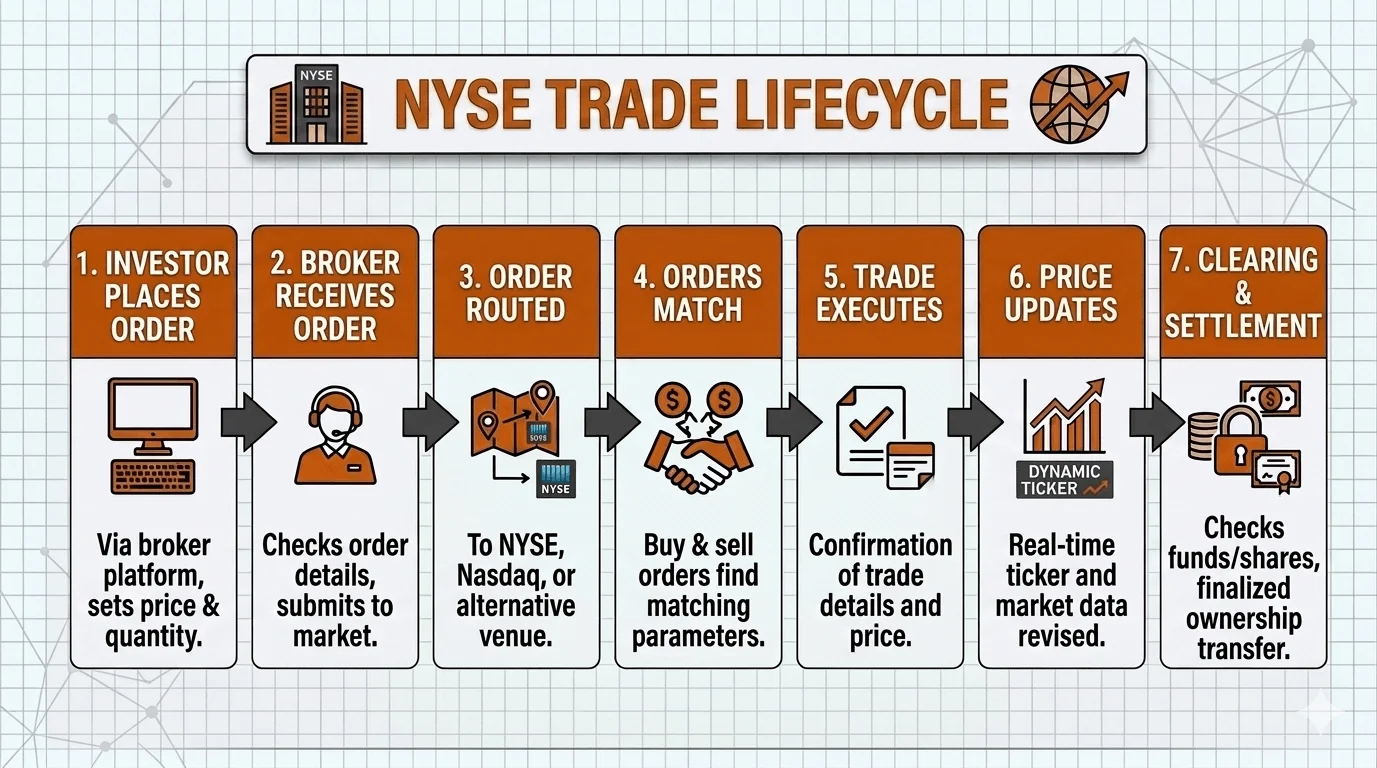
Orders flow in electronically and are matched by price. The NYSE runs a continuous auction (buyers bid, sellers offer, trades execute where the two meet) alongside large opening and closing auctions that concentrate liquidity at the start and end of each day.
Execution is not the end. After a trade, the transaction moves to clearing and settlement: the behind-the-scenes process that confirms the deal, delivers shares to the buyer, and moves money to the seller. For most U.S. securities, the standard settlement cycle moved to T+1 in May 2024, meaning settlement generally happens one business day after the trade.
A simple example: one investor wants to buy 10 shares of a NYSE-listed company; another wants to sell 10. Their brokers send the orders into the market. If the prices line up, the trade executes, the reported price updates, and the transaction settles a day later.
Why Do Companies List on the NYSE?
Going public is a major decision with real advantages and real obligations. Companies list to raise capital, improve visibility, create liquidity for shareholders, establish a public market value, fund acquisitions with stock, and make employee equity easier to value and sell. For a growing company, public-market access can fund expansion, hiring, product development, or debt repayment.
The trade-off is cost and scrutiny: ongoing regulatory reporting, public disclosure, listing fees, governance standards, and constant attention from shareholders and analysts. The usual path is an initial public offering (IPO), after which the company becomes answerable to outside investors.
Who Owns and Regulates the NYSE?
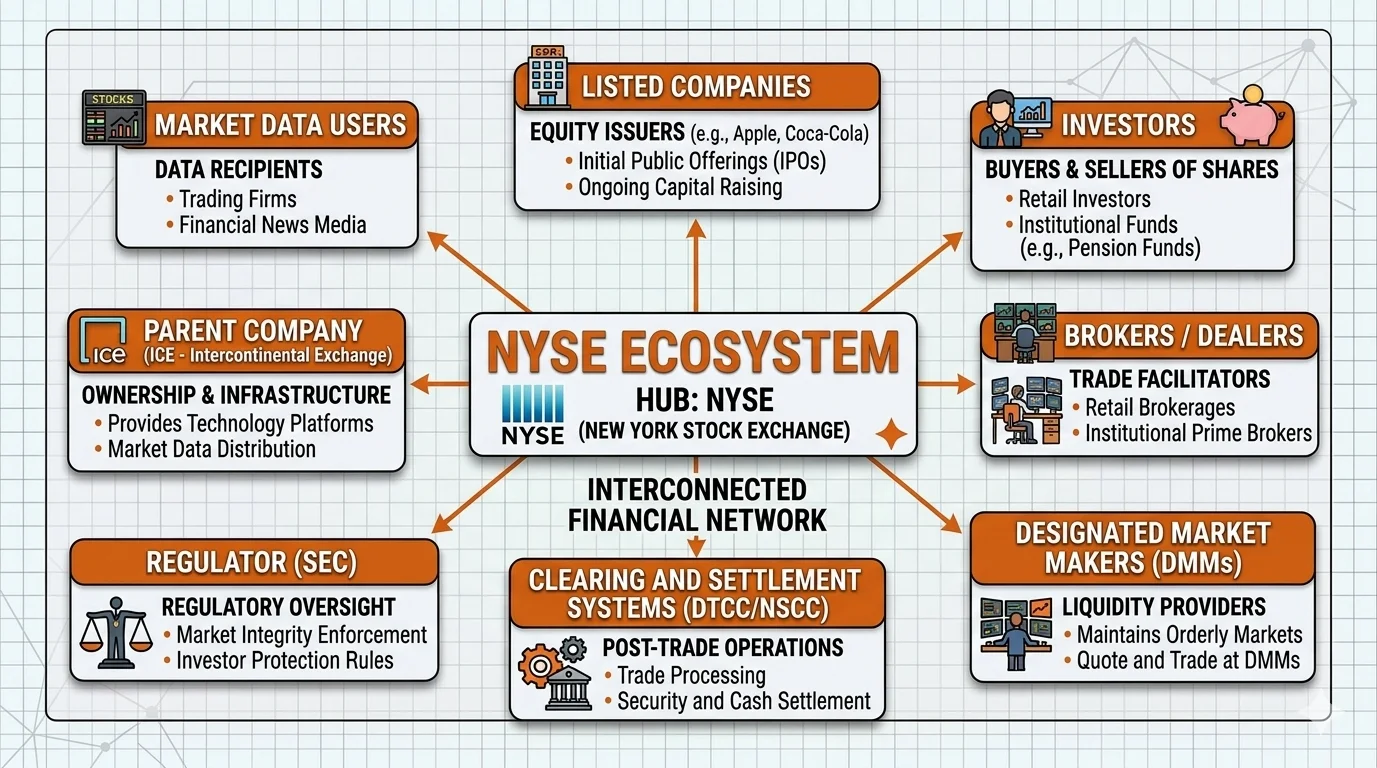
The NYSE is itself a business. It is owned by Intercontinental Exchange, Inc. (ICE), a publicly traded company that acquired NYSE Euronext in 2013; the exchange operates as New York Stock Exchange LLC.
It is overseen by the U.S. Securities and Exchange Commission (SEC) and also functions as a self-regulatory organization, meaning it writes and enforces its own market rules within the framework of federal securities law. That dual role makes it both a marketplace operator and a rule-setting body inside the broader U.S. securities system.
The exchange sits within a larger ecosystem:
NYSE Trading Hours
The regular session runs from 9:30 a.m. to 4:00 p.m. Eastern Time, Monday through Friday, excluding exchange holidays. On select days around major U.S. holidays, the exchange may close early, often at 1:00 p.m. ET.
Outside the core session, some platforms offer pre-market and after-hours trading. These sessions usually carry thinner liquidity, wider spreads, and sharper price swings than regular hours.
A bigger shift is coming. NYSE Arca, the NYSE’s fully electronic exchange, has been moving toward longer weekday trading. It received SEC approval in February 2025 to extend hours, and the NYSE’s May 2026 FAQ describes a target model of nearly continuous trading: 23 hours a day, five days a week, from 9:00 p.m. to 8:00 p.m. ET, with a one-hour break for clearing and maintenance. NYSE Arca is targeting December 6, 2026 for launch, subject to remaining approvals, Securities Information Processor availability, and DTCC modernization work.
That matters because crypto has trained many investors to expect near-continuous access. Bitcoin trades around the clock, while U.S. equities have historically revolved around the New York business day. Arca’s extended-hours push does not put stocks on a blockchain, but it moves traditional markets closer to the always-on expectations crypto created.
For the current schedule and any holiday closures, check the official NYSE calendar or your broker, since dates and early closes vary year to year.
What Is the NYSE Trading Floor?
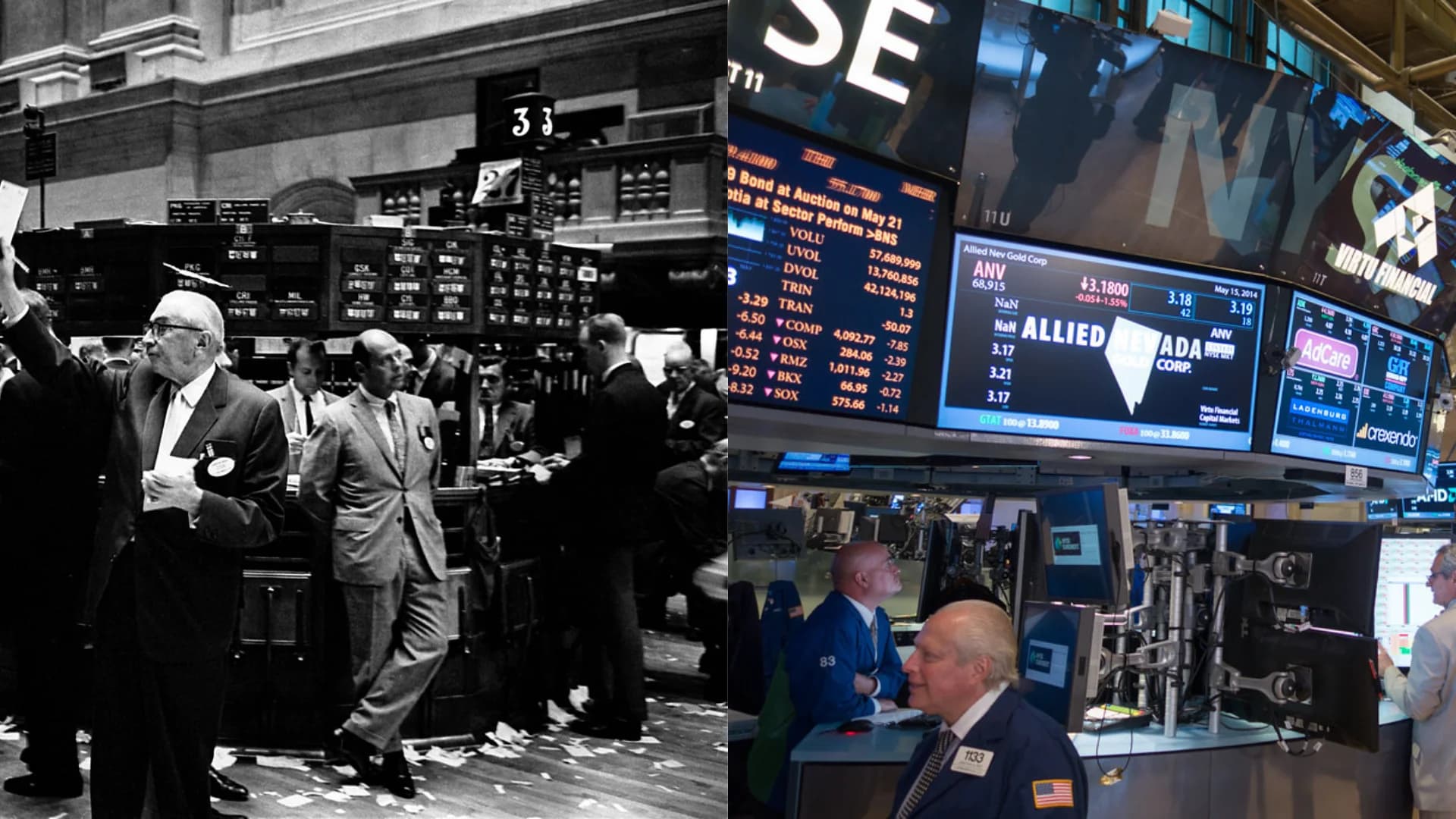
The trading floor is the physical space at 11 Wall Street where shares were once traded face to face, and its role has changed completely. In the open-outcry era, brokers shouted orders in person, floor specialists handled much of the action, and the floor was the visible center of the market. Today most order flow is electronic.
The human role that survives belongs to designated market makers (DMMs): firms obligated to provide liquidity and keep trading orderly in their assigned stocks, especially during the opening and closing auctions that are the highest-volume moments of the day.
The opening and closing bells, meanwhile, have become a global ritual of finance. Rung over the years by CEOs, athletes, entertainers, founders, nonprofit leaders, and the occasional costumed mascot to mark a company milestone. The floor today is part operational, part symbolic, and busiest around those daily auctions.
NYSE History: From Buttonwood Agreement to Global Exchange
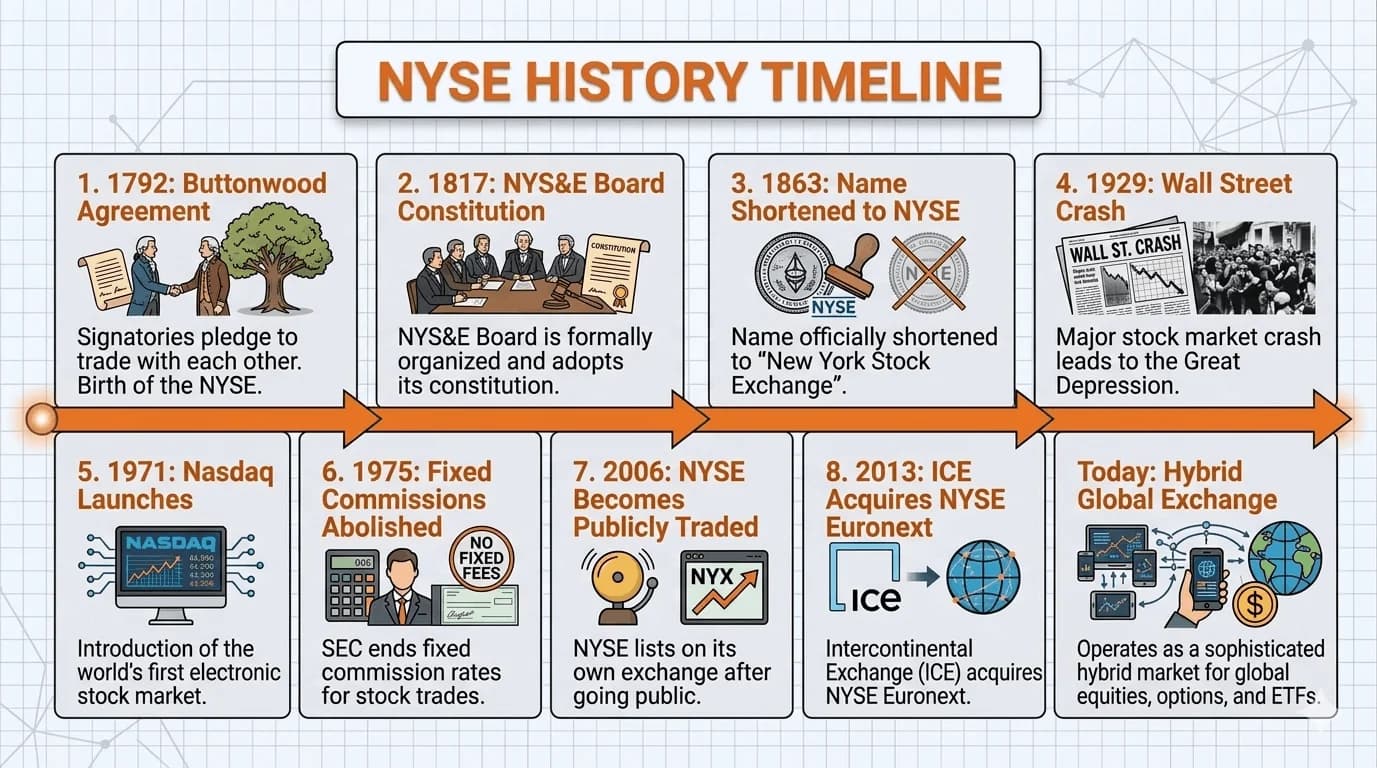
The NYSE began under a tree. In 1792, 24 brokers signed the Buttonwood Agreement (a document of just a few sentences, named for the buttonwood tree on Wall Street where they reportedly met) to bring a little order and trust to securities trading in New York. The world’s most powerful exchange started, in effect, as a handshake deal in the shade.
Markets have a long memory for October jitters, and few captured the mood better than Mark Twain, himself a famously unlucky speculator. In Pudd’nhead Wilson he warned: “October. This is one of the peculiarly dangerous months to speculate in stocks.”
The joke arrives in the next line, where he lists every other month as equally dangerous. The lesson holds: the calendar is not what makes the market risky.
NYSE vs Nasdaq: What’s the Difference?
The two big U.S. exchanges are often confused. They compete for listings but run on different models.
FeatureNYSENasdaqFull nameNew York Stock ExchangeNasdaq Stock MarketTrading modelHybrid: electronic trading plus a physical floorFully electronicHistorical imageWall Street floor, opening bell, blue-chip listingsTechnology-focused electronic marketCommon perceptionLarge, established companiesMany technology and growth companiesMarket makersDesignated market makers on the NYSEMultiple market makers competing electronicallyFoundedOrigins in 1792Launched in 1971FeatureFull nameNYSENew York Stock ExchangeNasdaqNasdaq Stock MarketFeatureTrading modelNYSEHybrid: electronic trading plus a physical floorNasdaqFully electronicFeatureHistorical imageNYSEWall Street floor, opening bell, blue-chip listingsNasdaqTechnology-focused electronic marketFeatureCommon perceptionNYSELarge, established companiesNasdaqMany technology and growth companiesFeatureMarket makersNYSEDesignated market makers on the NYSENasdaqMultiple market makers competing electronicallyFeatureFoundedNYSEOrigins in 1792NasdaqLaunched in 1971
What separates them is market structure, listing requirements, fees, company preference, and investor perception, not which one is “better.” Plenty of large technology firms list on the NYSE, and plenty of established names trade on Nasdaq, so the old stereotypes only go so far. Ordinary investors can reach both through a broker.
NYSE vs Stock Market: Are They the Same?
The NYSE is one exchange among several that make up the U.S. stock market. That broader market includes multiple exchanges and trading venues (the NYSE, Nasdaq, and others) plus indexes that measure groups of stocks rather than trade them.
TermMeaningExampleStock marketThe broad system for issuing, trading, pricing, and tracking stocksU.S. equity marketStock exchangeA marketplace where listed securities tradeNYSE, NasdaqStock indexA benchmark that tracks a group of stocksDow Jones, S&P 500Listed stockA company’s shares approved for exchange tradingA NYSE-listed companyBrokerage accountThe investor-facing account used to buy and sellOnline broker appTermStock marketMeaningThe broad system for issuing, trading, pricing, and tracking stocksExampleU.S. equity marketTermStock exchangeMeaningA marketplace where listed securities tradeExampleNYSE, NasdaqTermStock indexMeaningA benchmark that tracks a group of stocksExampleDow Jones, S&P 500TermListed stockMeaningA company’s shares approved for exchange tradingExampleA NYSE-listed companyTermBrokerage accountMeaningThe investor-facing account used to buy and sellExampleOnline broker app
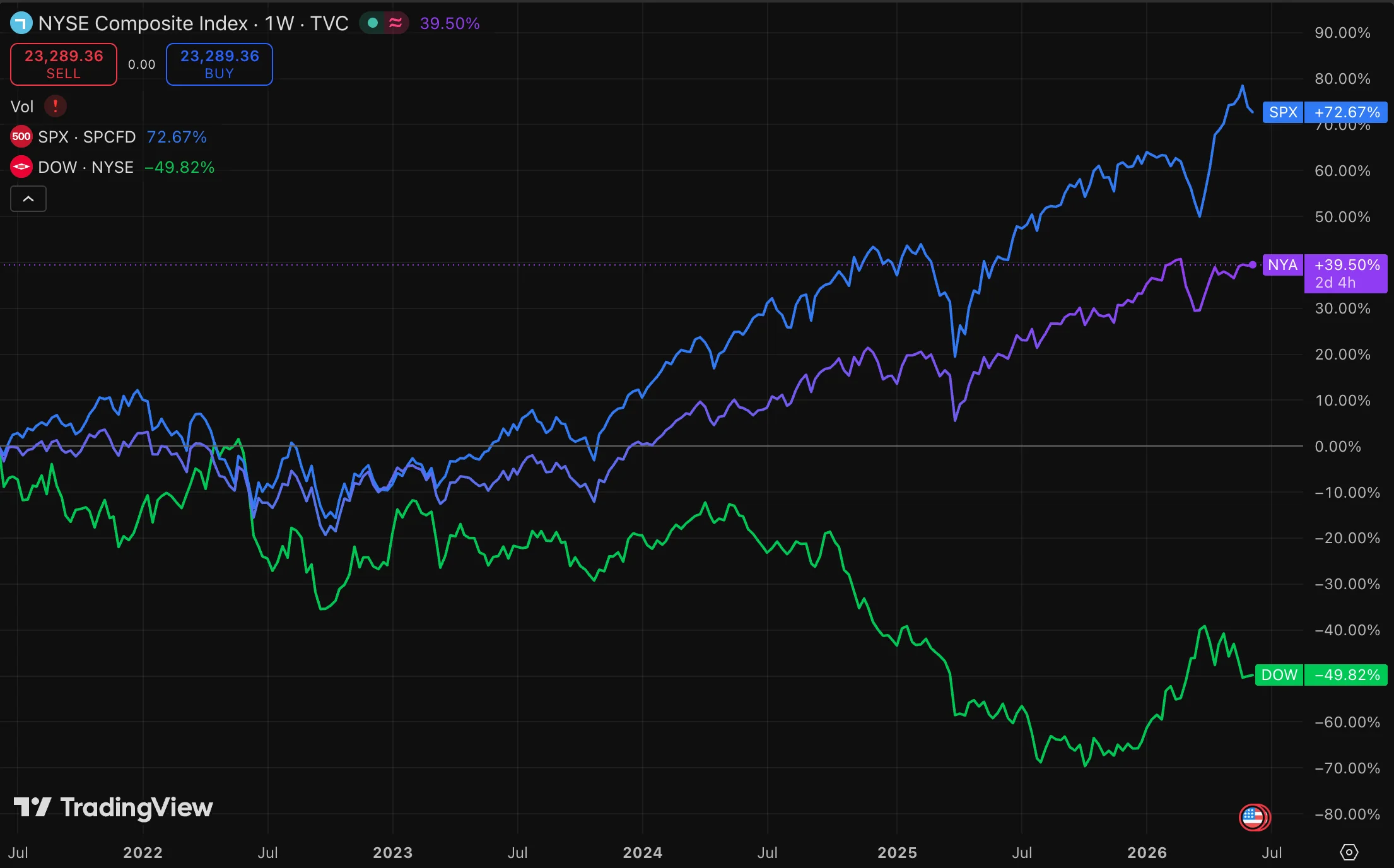
This is where beginners get tripped up. The Dow Jones Industrial Average and the S&P 500 are scoreboards that track baskets of stocks; they do not host trading. The NYSE is one of the venues where the underlying shares actually change hands. Exchanges are marketplaces; indexes are scoreboards.
What Companies Are Listed on the NYSE?
NYSE-listed companies are publicly traded firms whose shares meet the exchange’s listing standards. Many are large, well-known names, but the list spans nearly every industry: banks, insurers, manufacturers, logistics firms, retailers, food brands, energy companies, healthcare, software, infrastructure, and more.
Because the specific companies and their market values change constantly, the authoritative source is the official NYSE listings directory rather than any static list. For a beginner, the point is simply that “NYSE-listed” describes a quality bar a company has cleared, not a single type of business.
NYSE and Crypto: Bitcoin ETFs, Tokenized Securities, and 24-Hour Trading
The NYSE is not a crypto exchange. Bitcoin, ether, and other cryptoassets do not trade on it as ordinary company shares. Yet the NYSE is increasingly connected to crypto: through exchange-traded products, crypto-related public companies, extended trading hours, and early work on tokenized securities.
The two worlds remain distinct: the NYSE is part of the regulated securities market, while crypto exchanges and blockchain networks are separate systems. But the gap is shrinking as traditional finance experiments with crypto-style features: longer trading windows, faster settlement, fractional access, stablecoin-based funding, and blockchain-based ownership records.
Does Bitcoin Trade on the NYSE?
Bitcoin itself does not trade on the NYSE like a stock. What investors can buy through an ordinary brokerage account are Bitcoin-linked exchange-traded products. In January 2024, the SEC approved rule changes from NYSE Arca, Nasdaq, and Cboe BZX to list and trade Bitcoin-based commodity trust shares, the products commonly called spot Bitcoin ETFs or ETPs. The order covered NYSE Arca proposals tied to the Grayscale Bitcoin Trust, Bitwise Bitcoin ETF, and Hashdex Bitcoin ETF.
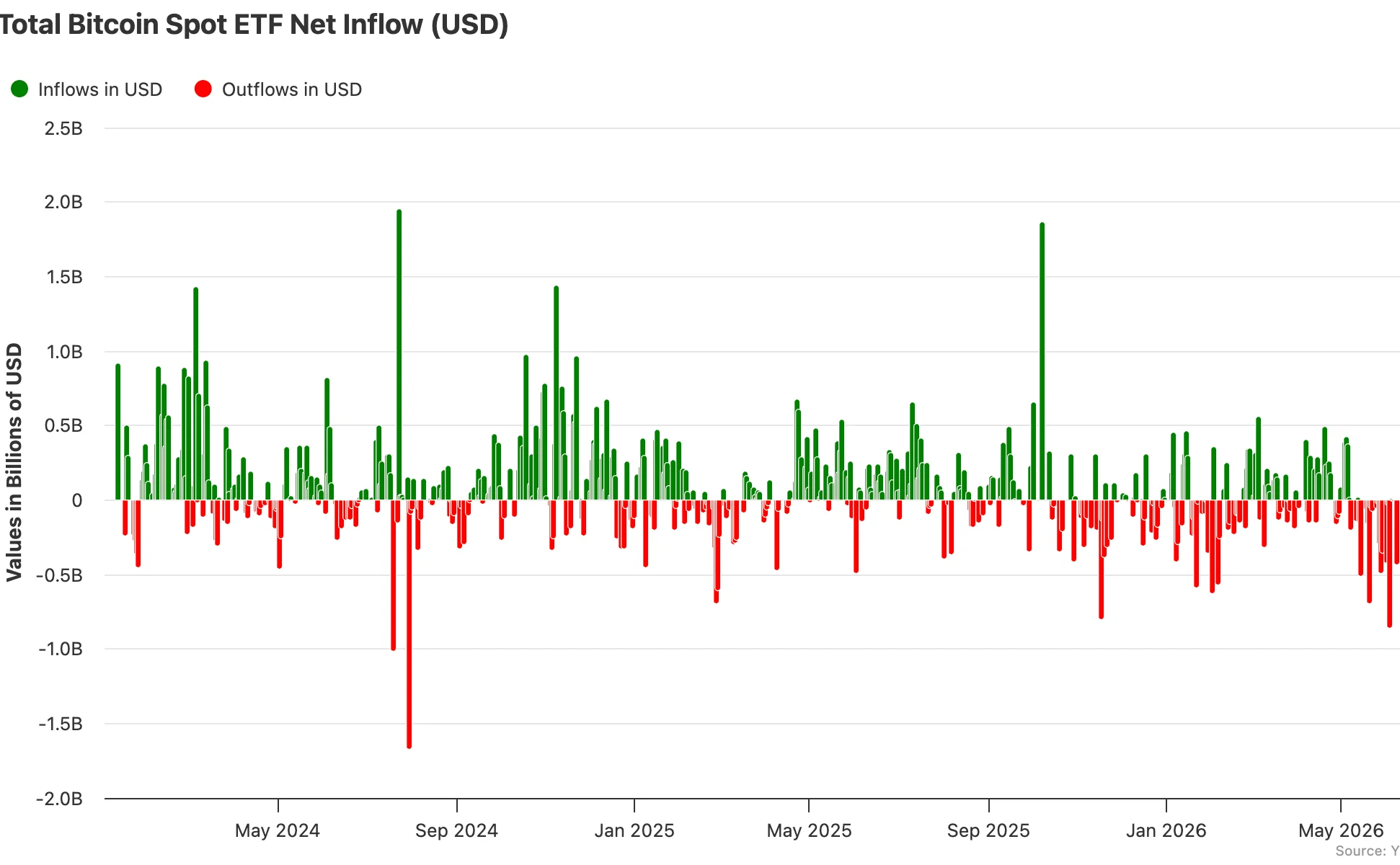
A Bitcoin ETP is a regulated market product that delivers price exposure through a brokerage account. Native Bitcoin is a cryptoasset held through a wallet, custodian, or crypto trading platform. The NYSE can connect investors to Bitcoin exposure, but Bitcoin is not a NYSE-listed stock.
Are Any Crypto Companies Listed on the NYSE?
Yes. The NYSE lists a number of public companies tied to crypto and digital assets: businesses in stablecoins, mining, infrastructure, and digital-asset services. Examples include Circle Internet Group, the company behind the USDC stablecoin, which trades as CRCL; Bakkt, which trades as BKKT; and BitMine Immersion Technologies, which uplisted to the NYSE under BMNR in April 2026.
A crypto-related stock is a different thing from cryptocurrency. A share represents ownership in a business: with revenue, expenses, management, regulation, and shareholder obligations. A cryptocurrency is a digital asset that trades in its own market. The two can move together (a crypto company’s stock often reacts to Bitcoin or Ether prices) but they are not the same investment.
Is the NYSE Moving Toward Tokenized Securities?
This is the most consequential crypto-related development for the NYSE itself. In January 2026, ICE announced that the NYSE was developing a tokenized-securities platform designed to support crypto-style features: 24/7 operations, instant settlement, orders sized in dollar amounts, and stablecoin-based funding. The design combines the NYSE’s Pillar matching engine with blockchain-based post-trade systems, including support for multiple chains for settlement and custody.
The key qualifier is that this work is being built around regulated securities-market structure, not an unregulated parallel market. A May 2026 Federal Register notice shows the same approach in motion: NYSE National proposed rules to trade securities in tokenized form during a DTC pilot. Eligible tokenized securities would need to be fungible with the traditional security, share the same CUSIP and trading symbol, and carry the same rights, such as dividends and voting.
So tokenized securities amount to more than “stocks on a blockchain.” In a regulated exchange setting, they still require ownership records, shareholder rights, custody, clearing, settlement, compliance, and market surveillance.
Securitize and the NYSE Digital Trading Platform
A key partner in the NYSE’s tokenization push is Securitize. In March 2026, the two signed a memorandum of understanding covering digital transfer-agent infrastructure and broker-dealer participation for issuer-sponsored tokenized securities on the NYSE’s Digital Trading Platform. The announcement named Securitize as the first digital transfer agent eligible to mint blockchain-native securities for corporate or ETF issuers on the upcoming platform.
That matters because transfer agents maintain official ownership records and support corporate actions. In the traditional market, dividends, voting rights, splits, and shareholder records are core to what makes a share a share. The genuine challenge of tokenization lies there, fitting a token into the legal and operational machinery of public markets. Minting it is the easy part.
24-Hour Stock Trading vs Crypto’s 24/7 Market
Crypto markets never close: Bitcoin trades 24 hours a day, seven days a week, across global venues. U.S. equities have usually centered on the weekday session. That difference shaped investor expectations. A trader in New York, London, Dubai, or Singapore can buy or sell Bitcoin at almost any hour, while a stock investor often faces core-session limits and thinner, broker-dependent access before and after hours.
NYSE Arca’s extended-hours plan is part of the traditional market’s response. Its near-continuous weekday model is narrower than crypto’s true 24/7 structure, but it moves U.S. equities toward a global schedule. Three related trends are easy to confuse:
TrendWhat it meansNYSE Arca extended hoursLonger trading windows for traditional securities on an electronic exchangeNYSE tokenized securities platformA separate digital platform concept involving blockchain-based post-trade systemsCrypto 24/7 tradingNative cryptoassets trading continuously across global crypto venuesTrendNYSE Arca extended hoursWhat it meansLonger trading windows for traditional securities on an electronic exchangeTrendNYSE tokenized securities platformWhat it meansA separate digital platform concept involving blockchain-based post-trade systemsTrendCrypto 24/7 tradingWhat it meansNative cryptoassets trading continuously across global crypto venues
Stablecoins, Settlement, and Chainlink’s Role
Stablecoins and blockchain settlement are also part of the picture. ICE’s tokenized-securities announcement names stablecoin-based funding and instant settlement as planned features, subject to approval. The ambition is familiar from crypto: move value and records on-chain instead of waiting for traditional banking and settlement windows. Today a trade can execute instantly on screen, but the final transfer of shares and cash still runs through clearing and settlement; a tokenized system aims to make some of that faster and more programmable.
Chainlink fits this picture, but its role should be described precisely. Official NYSE and ICE materials describe the platform as using the Pillar matching engine, blockchain-based post-trade systems, and Securitize’s transfer-agent infrastructure. They do not name Chainlink as the technology powering it. Chainlink provides oracle infrastructure: systems that bring external data, such as asset prices or market status, onto blockchains.
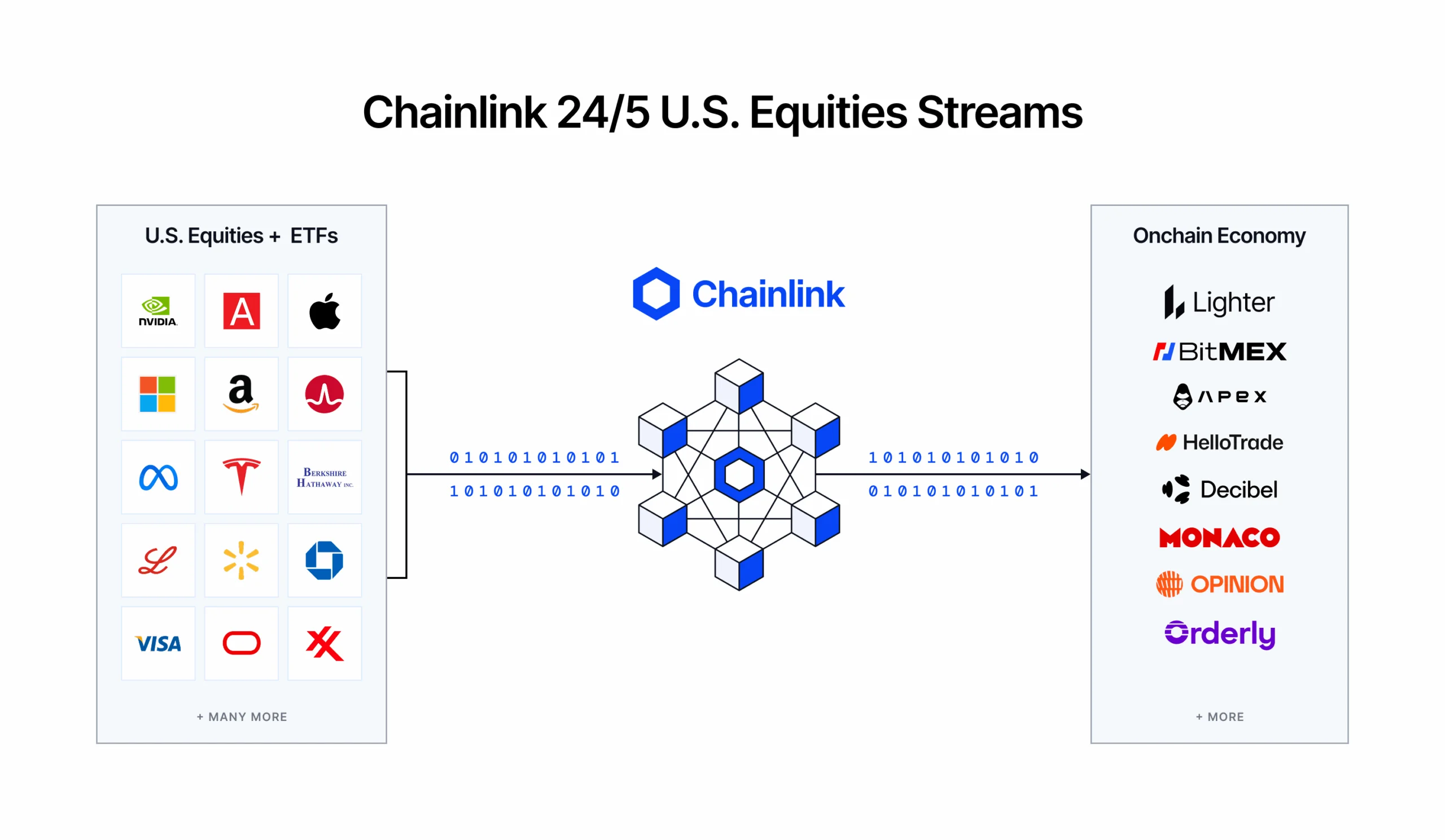
In January 2026, it launched 24/5 U.S. Equities Streams, which it says deliver market data for major U.S. equities and ETFs across regular, after-hours, and overnight sessions. There is also a direct Chainlink product on NYSE Arca: the Bitwise Chainlink ETF, ticker CLNK, which SEC filings describe as providing exposure to the Chainlink held by the trust.
Stated accurately: NYSE Arca is expanding traditional trading hours, ICE is building tokenized-securities infrastructure, and Chainlink is part of the broader on-chain market-data layer that could support tokenized asset markets. The three are related, but Chainlink is not powering the NYSE’s move toward longer hours.
Traditional NYSE Stock vs Bitcoin vs Tokenized Security
FeatureTraditional NYSE stockBitcoinTokenized securityWhat it representsOwnership in a public companyA decentralized digital assetA security represented using blockchain or digital-ledger technologyTrading venueRegulated stock exchange or trading venueCrypto exchanges and blockchain-based marketsRegulated digital-securities platform or pilot structureTrading hoursMainly weekday sessions, with some extended-hours access24/7Potentially longer or 24/7, depending on platform and rulesSettlementTraditional clearing and settlement, generally T+1 for most U.S. securitiesBlockchain settlementPotential blockchain-based or tokenized post-trade processInvestor accessBrokerage accountCrypto exchange, custodian, or walletLikely broker-dealer or regulated-platform accessMain risksBusiness, market, liquidity, and regulatory riskVolatility, custody, protocol, and exchange riskRegulation, custody, smart contracts, liquidity, and market-structure riskFeatureWhat it representsTraditional NYSE stockOwnership in a public companyBitcoinA decentralized digital assetTokenized securityA security represented using blockchain or digital-ledger technologyFeatureTrading venueTraditional NYSE stockRegulated stock exchange or trading venueBitcoinCrypto exchanges and blockchain-based marketsTokenized securityRegulated digital-securities platform or pilot structureFeatureTrading hoursTraditional NYSE stockMainly weekday sessions, with some extended-hours accessBitcoin24/7Tokenized securityPotentially longer or 24/7, depending on platform and rulesFeatureSettlementTraditional NYSE stockTraditional clearing and settlement, generally T+1 for most U.S. securitiesBitcoinBlockchain settlementTokenized securityPotential blockchain-based or tokenized post-trade processFeatureInvestor accessTraditional NYSE stockBrokerage accountBitcoinCrypto exchange, custodian, or walletTokenized securityLikely broker-dealer or regulated-platform accessFeatureMain risksTraditional NYSE stockBusiness, market, liquidity, and regulatory riskBitcoinVolatility, custody, protocol, and exchange riskTokenized securityRegulation, custody, smart contracts, liquidity, and market-structure risk
This is why the NYSE matters to crypto investors: the world’s most recognizable stock exchange is experimenting with ideas crypto helped popularize (always-on markets, tokenized ownership, stablecoin-based money movement, and faster settlement) while staying inside the regulated securities system.
How Investors Buy Stocks on the NYSE
Here is how a regular person actually interacts with the exchange. Individual investors do not trade directly with the NYSE. They open a brokerage account, and the broker routes their orders to the exchange or another trading venue, a stock can be NYSE-listed even when a particular order executes elsewhere. On screen, the investor sees the ticker symbol, the current quote, the bid and ask, and a choice of order types.
Order typeBeginner explanationMarket orderBuy or sell right away at the best available priceLimit orderBuy or sell only at a specified price or betterStop orderBecomes active once a trigger price is reachedDay orderExpires if not filled by the end of the trading dayGood-til-canceled orderStays open until filled, canceled, or expired by broker rulesOrder typeMarket orderBeginner explanationBuy or sell right away at the best available priceOrder typeLimit orderBeginner explanationBuy or sell only at a specified price or betterOrder typeStop orderBeginner explanationBecomes active once a trigger price is reachedOrder typeDay orderBeginner explanationExpires if not filled by the end of the trading dayOrder typeGood-til-canceled orderBeginner explanationStays open until filled, canceled, or expired by broker rules
Choosing between a market order and a limit order is one of the first practical decisions a new investor makes: speed versus price control. Temperament matters too. As Warren Buffett observed, the market tends to transfer “money from the impatient to the patient.” When you buy a NYSE-listed stock in a brokerage app, you are not personally trading on the floor; your broker routes the order to a venue where it can be executed.
Why the NYSE Matters
The NYSE is a load-bearing part of the U.S. and global financial system. It helps companies raise capital, gives investors a liquid place to trade, supports real-time price discovery, and strengthens market transparency through regulated public trading. When a company can raise money by selling shares and investors can sell those shares whenever they like, capital flows to where it is most useful. This is a mechanism that’s repeated millions of times a day, and a large part of why NYSE and market capitalization figures make headlines far beyond Wall Street.
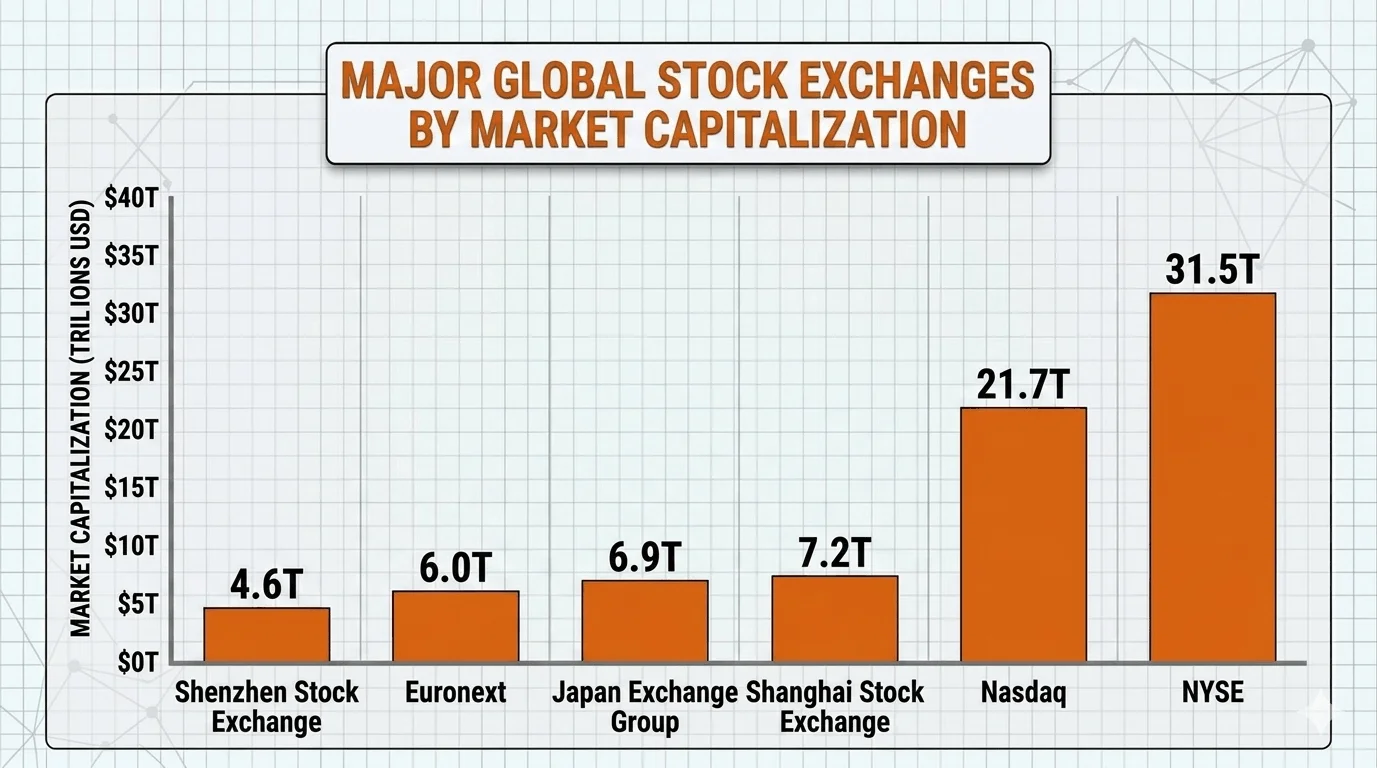
Its role is also shifting. For most of its history, the NYSE represented the center of traditional equity markets. Today it also sits at the edge of a newer question: how much of the stock market’s future will borrow from crypto market structure?
The answer is still unfolding, but the direction is clear enough to matter. Longer trading hours, Bitcoin-linked products, crypto-related public companies, tokenized securities, stablecoin-based funding, and blockchain settlement are no longer fringe topics; they are part of the conversation about how major exchanges evolve.
Common Misconceptions About the NYSE
MisconceptionRealityThe NYSE is the entire stock marketIt is one exchange within a much larger marketYou must go to Wall Street to buy NYSE stocksAlmost everyone uses an online brokerThe trading floor handles all tradesThe large majority of trading is electronicNYSE and Nasdaq list the same kinds of companiesThey overlap but differ in history, listing models, and structureA stock exchange sets stock pricesPrices come from supply and demand among buyers and sellersThe Dow is the NYSEThe Dow is an index; the NYSE is an exchangeBitcoin trades on the NYSEBitcoin itself does not trade on the NYSE as an ordinary stockTokenized securities mean the NYSE is a crypto exchangeTokenization can use blockchain technology while still operating under securities-market rulesChainlink powers NYSE 24/7 tradingChainlink is relevant to on-chain data markets, but official NYSE/ICE materials do not describe it as powering NYSE’s platformMisconceptionThe NYSE is the entire stock marketRealityIt is one exchange within a much larger marketMisconceptionYou must go to Wall Street to buy NYSE stocksRealityAlmost everyone uses an online brokerMisconceptionThe trading floor handles all tradesRealityThe large majority of trading is electronicMisconceptionNYSE and Nasdaq list the same kinds of companiesRealityThey overlap but differ in history, listing models, and structureMisconceptionA stock exchange sets stock pricesRealityPrices come from supply and demand among buyers and sellersMisconceptionThe Dow is the NYSERealityThe Dow is an index; the NYSE is an exchangeMisconceptionBitcoin trades on the NYSERealityBitcoin itself does not trade on the NYSE as an ordinary stockMisconceptionTokenized securities mean the NYSE is a crypto exchangeRealityTokenization can use blockchain technology while still operating under securities-market rulesMisconceptionChainlink powers NYSE 24/7 tradingRealityChainlink is relevant to on-chain data markets, but official NYSE/ICE materials do not describe it as powering NYSE’s platform
The Bottom Line
The NYSE is a regulated stock exchange where the shares of public companies trade. It lets companies tap public capital and gives investors a liquid marketplace, blending fast electronic trading with a historic Wall Street floor that now serves mostly symbolic and auction-related roles. Think of it as one powerful piece of a much larger machine, a single exchange reached through brokers, while indexes like the S&P 500 simply keep score.
The crypto connection adds a modern twist. Bitcoin does not trade on the NYSE as a stock, but Bitcoin-linked products trade on NYSE Arca; crypto companies can list as public stocks; NYSE Arca is moving toward longer trading windows; ICE is building tokenized-securities infrastructure; and data networks like Chainlink are helping build the broader on-chain market-data layer. The NYSE is still traditional finance, but traditional finance is no longer ignoring the market-structure ideas crypto introduced.