

Mt. Gox was a Tokyo-based Bitcoin exchange that, at its 2013 peak, handled roughly 70% of all Bitcoin trading worldwide. It collapsed in February 2014 after losing approximately 850,000 BTC to a years-long hack, one of the largest cryptocurrency thefts in history.
More than a decade later, the bankruptcy trustee is still repaying creditors: roughly 19,500 customers have received distributions through Kraken and Bitstamp since 2024, with about 34,500 BTC (worth over $2.4 billion at recent prices) still held in the rehabilitation trust. The current repayment deadline is October 31, 2026.
This is the full Mt. Gox story: how a trading site became the dominant Bitcoin exchange, how it lost most of its customers’ funds, what happened to the people responsible, and where the decade-long repayment process stands today.
What was Mt. Gox?
Mt. Gox was a Tokyo-based cryptocurrency exchange that operated from 2010 to 2014 and, at its peak, was effectively the front door of Bitcoin – the era’s equivalent of Coinbase, Binance, or Kraken today. Its name was a holdover from its origin as a card-trading site: short for “Magic: The Gathering Online Exchange.”
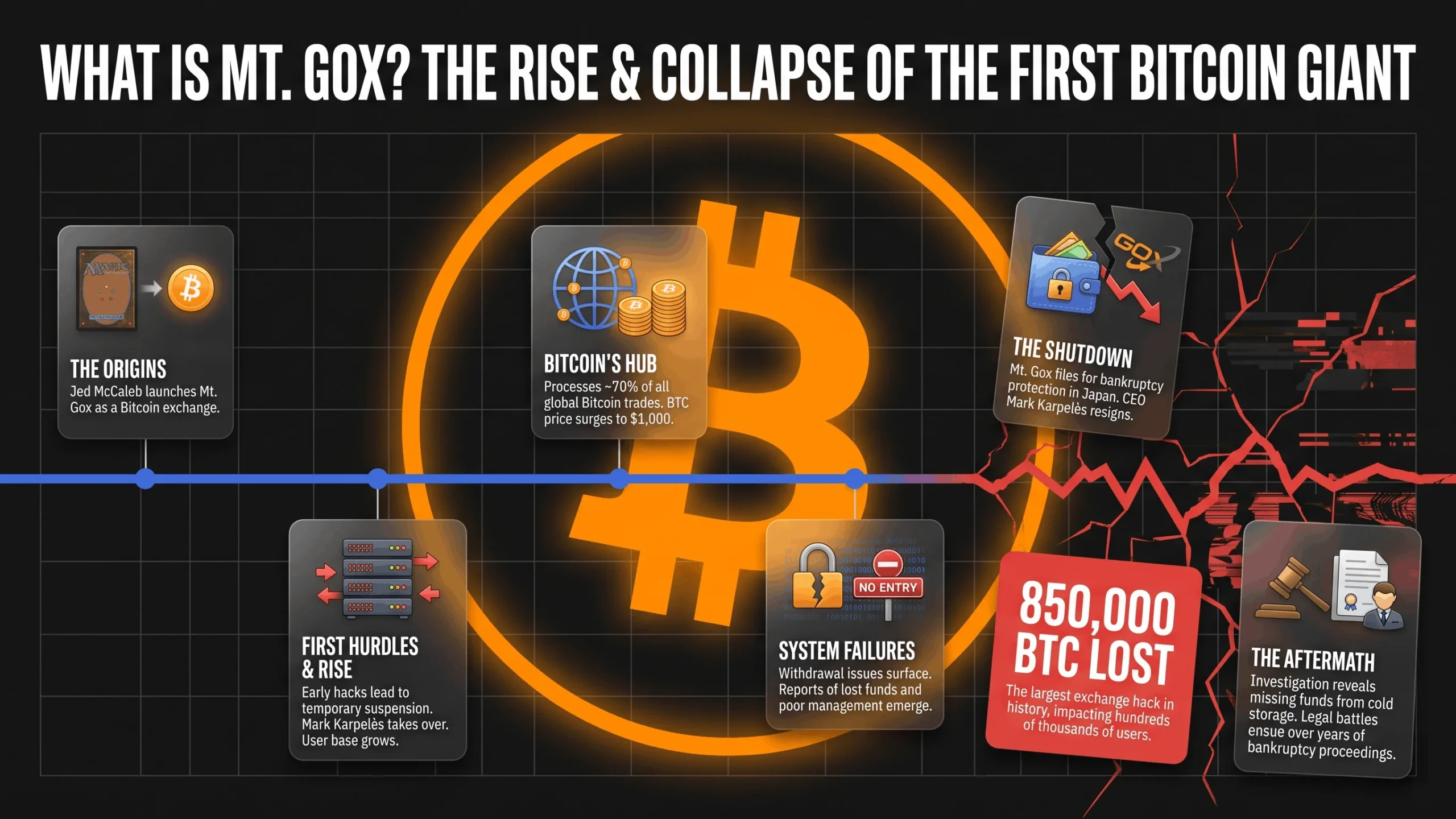
The exchange collapsed in February 2014 after years of undetected losses to attackers, and it has never reopened. What remains is a legal entity in civil rehabilitation under Japanese law, repaying former customers, a process still in motion in 2026.
From Magic cards to Bitcoin dominance (2010–2013)
The site that became Mt. Gox was originally launched by US developer Jed McCaleb as a trading venue for Magic: The Gathering Online cards. (Sources vary slightly on the founding year, most cite 2007.) It never took off, and McCaleb shelved it.
In July 2010, McCaleb relaunched the domain as a Bitcoin exchange, one of the very first. Timing was everything: Bitcoin was just starting to attract attention beyond cryptography mailing lists, and there were almost no usable places to buy it. Mt. Gox filled that gap.
In March 2011, McCaleb sold the exchange to French developer Mark Karpeles, who relocated operations to Tokyo and ran the company through its collapse. (McCaleb’s later career is worth noting: he went on to co-found Ripple and then Stellar.)
Under Karpeles, Mt. Gox grew aggressively into the dominant venue for Bitcoin trading worldwide. By 2013, it handled roughly 70% of all Bitcoin transactions globally. For most early users, the price of bitcoin was whatever Mt. Gox said it was.
The Mt. Gox hack: what actually happened
The most common misconception about Mt. Gox is that it was brought down by a single 2014 hack. It wasn’t. The losses were a slow bleed that began years earlier and went largely undetected.
A first significant breach occurred in June 2011, when attackers compromised an auditor’s account and made off with around 2,000 BTC, also briefly manipulating prices on the exchange. That incident is widely treated as the visible start of Mt. Gox’s security problems, but the real damage was happening quietly elsewhere.
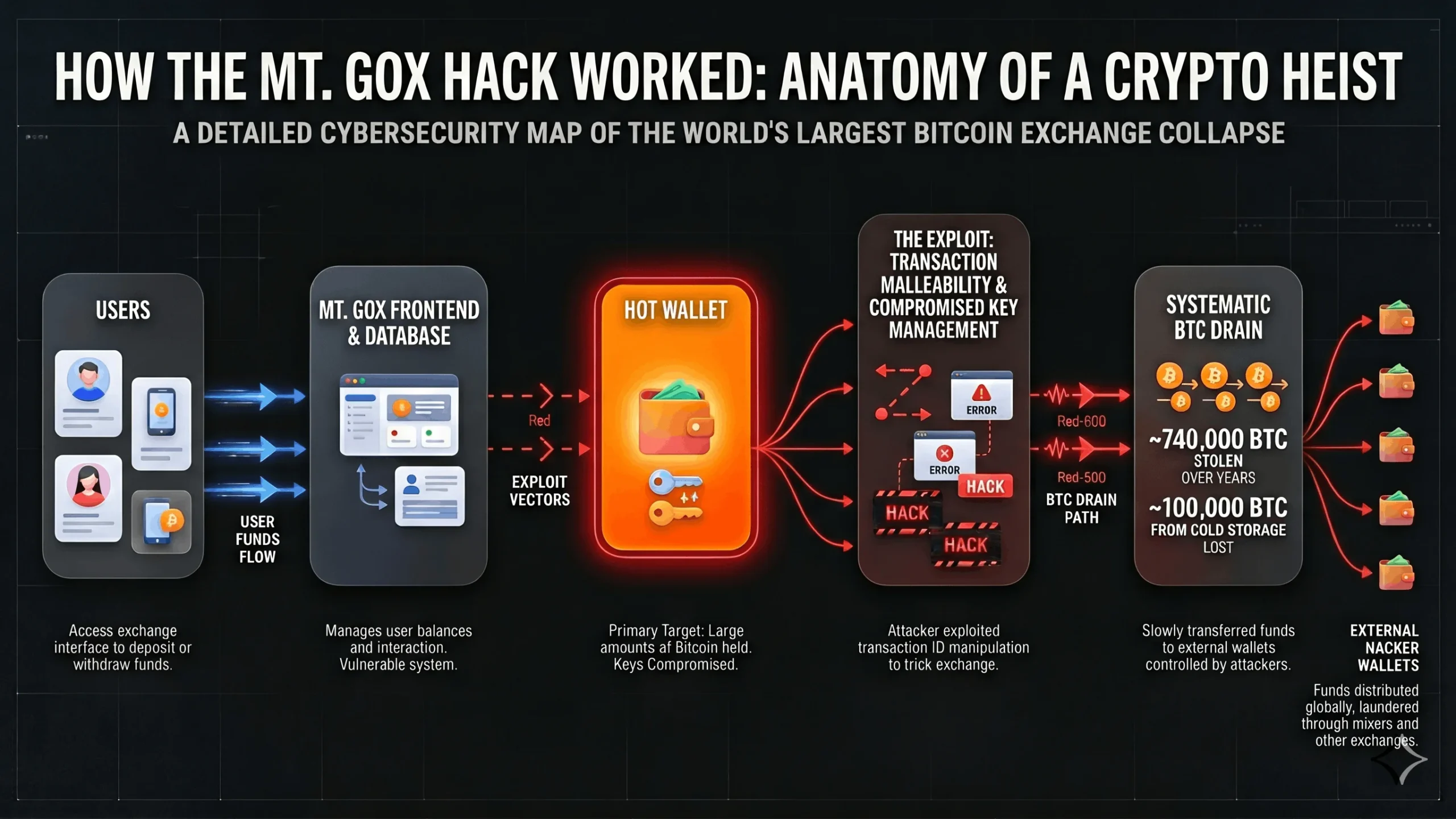
From late 2011 onward, attackers were steadily draining bitcoin from Mt. Gox’s hot wallets, exploiting weak internal controls and the exchange’s notoriously poor accounting. The difference between what Mt. Gox claimed to hold and what was actually in its wallets grew year over year. The full scale of the loss, roughly 850,000 BTC, wasn’t reconciled internally until early 2014.
Investigators later linked a portion of the stolen funds to BTC-e, a Russia-linked exchange, and its operator Alexander Vinnik, who was arrested in Greece in 2017 and later convicted on money-laundering charges in the US.
The collapse of February 2014
The end came quickly:
- February 7, 2014: Mt. Gox halts all Bitcoin withdrawals, blaming a “transaction malleability” bug in Bitcoin itself. The explanation was met with skepticism almost immediately.
- February 24, 2014: Trading is suspended entirely. Mt. Gox’s website goes blank.
- February 28, 2014: Mt. Gox files for bankruptcy protection in the Tokyo District Court, disclosing the loss of approximately 850,000 BTC, about 750,000 belonging to customers and 100,000 belonging to the exchange.
- March 2014: Roughly 200,000 BTC is unexpectedly recovered from an old wallet, reducing the net loss to about 650,000 BTC.
Bitcoin’s price dropped sharply in the weeks around the collapse, trust in centralized exchanges took years to rebuild, and the term “getting Goxxed” entered the crypto vocabulary as shorthand for losing funds to an insolvent custodian.
Mt. Gox creditor repayments in 2026
A decade after the collapse, the Mt. Gox story is still being written through the rehabilitation trust administered by Japanese attorney Nobuaki Kobayashi.
Distributions to verified creditors began in July 2024. After years of legal proceedings, claims verification, and multiple deadline extensions, the trustee started returning Bitcoin and Bitcoin Cash to former Mt. Gox users via two regulated exchanges: Kraken and Bitstamp. By the end of 2024, approximately 19,500 creditors had received distributions.
The trust still holds roughly 34,500 BTC, worth somewhere north of $2.4 billion at recent prices – the residue of the ~200,000 BTC recovered in 2014, minus what’s already been paid out. The trust’s wallets are tracked publicly on-chain through tools like Arkham Intelligence.
The repayment deadline has been extended three times, most recently to October 31, 2026, to allow the trustee to finish distributions to remaining creditors held up by KYC issues, inheritance claims, or identity-verification problems for original 2014 account holders.
Markets initially feared the distributions would unleash massive sell pressure as creditors offloaded coins acquired at sub-$1,000 prices. The actual selling has been more muted — many creditors, having waited more than ten years to get their bitcoin back, have chosen to hold rather than dump.
How Mt. Gox changed crypto
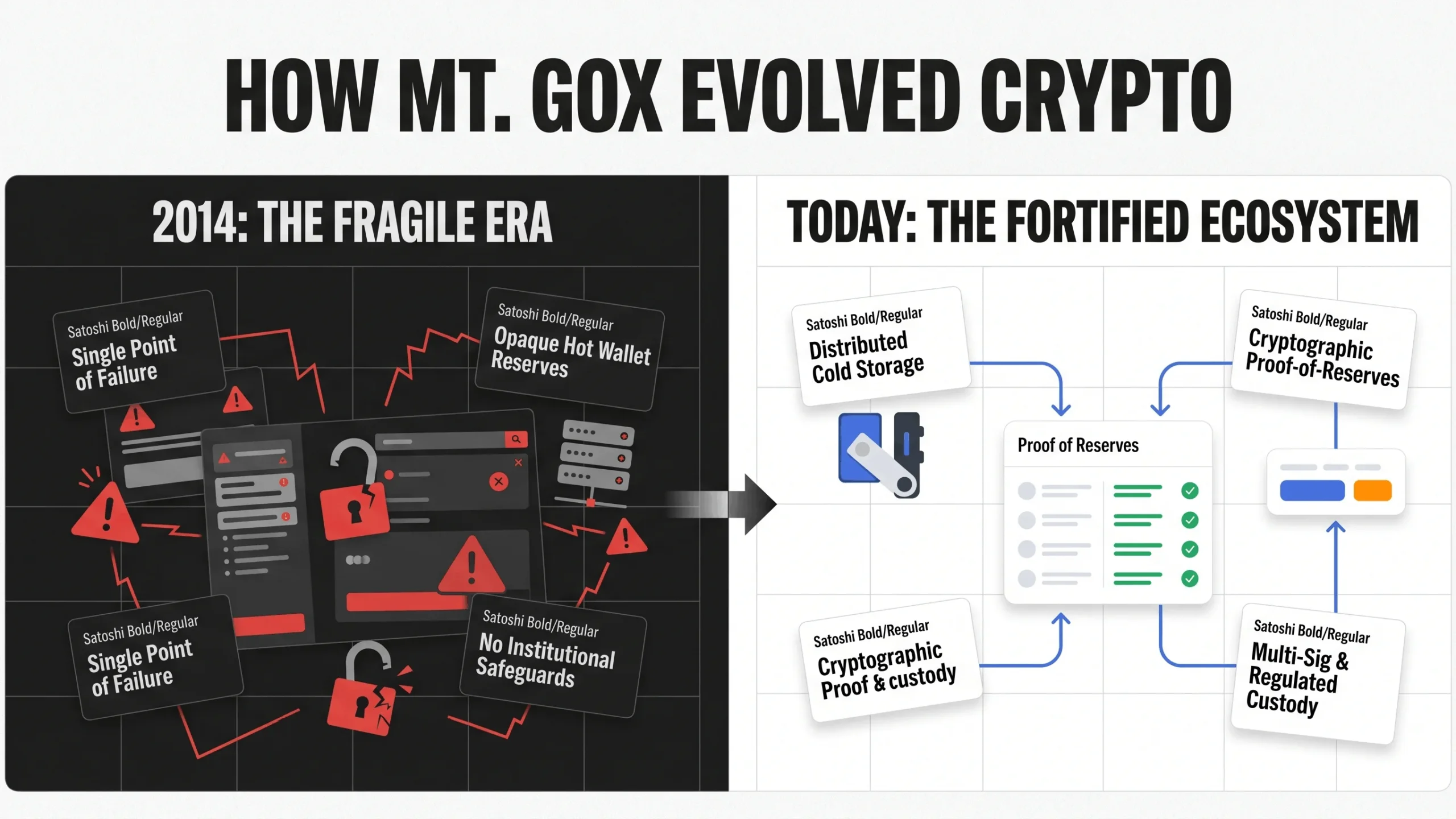
Mt. Gox’s collapse left a permanent imprint on how the industry thinks about custody, security, and regulation:
- Cold storage became standard: Before Mt. Gox, hot-wallet practices at exchanges were casual. After, offline storage with strict withdrawal controls became table stakes.
- Self-custody gained mainstream traction: The phrase “not your keys, not your coins” spread out of cypherpunk circles largely as a direct response to Mt. Gox. Non-custodial wallets saw sustained growth.
- Regulators moved: Mt. Gox accelerated KYC and AML enforcement against crypto exchanges worldwide.
- DEXs got a real opening: Decentralized exchanges gained credibility as alternatives to custodial platforms, with the argument that smart-contract trading sidesteps Mt. Gox-style custody risk.
- Proof-of-reserves became a baseline: After FTX’s 2022 collapse echoed many of the same patterns, exchanges that won’t publish verifiable reserves attestations face hard scrutiny.
Closing thoughts
More than a decade on, Mt. Gox isn’t quite history yet. The trust still holds tens of thousands of Bitcoin, and distributions are still going out. But the lessons baked into modern exchange practice (cold storage, proof of reserves, self-custody as a real option) all trace back to the months in 2014 when Mt. Gox’s wallets quietly emptied. For crypto users today, the practical takeaway is simple: regulation and exchange security have come a long way since 2014, but holding your own keys remains the only fully Mt. Gox-proof option.