Gold Sees Sharpest Weekly Loss in Years
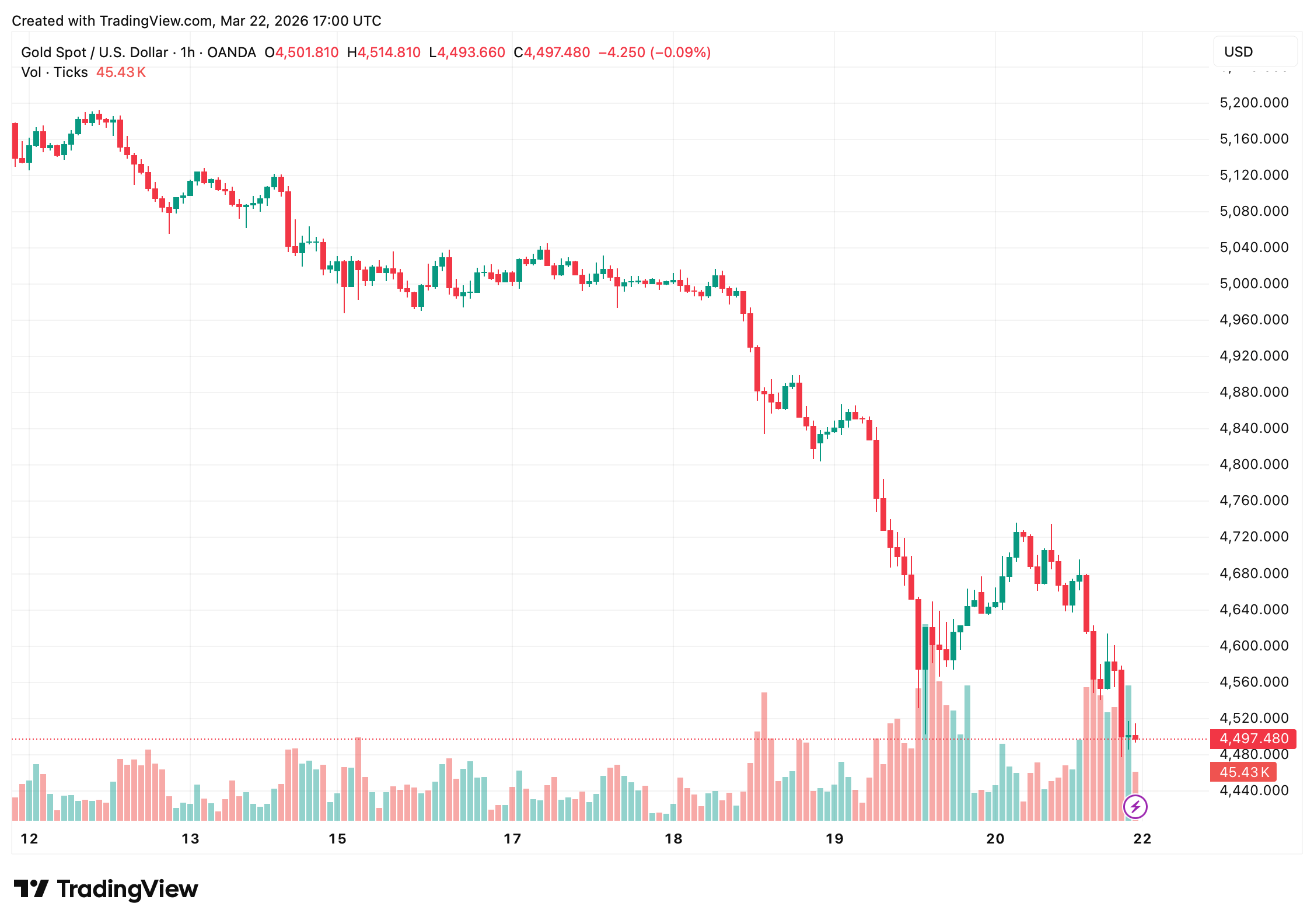
Precious metals took a sharp step lower this past week, with gold and silver logging their most punishing declines in over a decade as traders unwound crowded positions and recalibrated expectations. By the March 20 close, gold was bidding around $4,490 per ounce while silver hovered near $67.69, both well off their recent highs.
The drop capped a week that saw gold fall roughly 9.6% to 10.5%, marking its worst weekly showing since September 2011. Prices began the week near $5,019 before sliding steadily through successive sessions, with notable declines last Wednesday and Thursday accelerating the move lower.
By the end of the week, gold had settled into a narrow band around $4,489 to $4,492, suggesting some early signs of stabilization. Even with the pullback, the metal remains modestly higher on the year after a powerful run through 2025 and early 2026.
Silver followed a steeper trajectory, dropping more than 14% over the same period and extending its losing streak to three consecutive weeks. The metal started near the $80 to $85 range before sliding to the high-$60s, reflecting both speculative unwinding and its sensitivity to broader economic expectations.
Daily volatility in silver outpaced gold, with sharp intraday swings highlighting its higher beta to both industrial demand narratives and leveraged positioning. By Friday’s close, prices had touched levels not seen since late 2025 in some measures.
At the center of the sell-off sits an unusual macro combination that upended the typical safe-haven playbook. Instead of geopolitical tension lifting metals, the escalation tied to the U.S.-Iran conflict pushed oil prices above $110 per barrel, feeding inflation concerns rather than defensive buying.
That shift carried consequences. Higher energy costs strengthened expectations that the Federal Reserve would keep rates elevated, reinforcing the appeal of yield-bearing assets while raising the opportunity cost of holding non-yielding metals like gold and silver.
The Fed’s stance, paired with firm inflation data, helped lift the U.S. dollar, adding another layer of pressure. A stronger dollar makes metals more expensive for international buyers, dampening demand at the margin and amplifying downside moves.
At the same time, positioning played a decisive role. After a prolonged rally that saw gold and silver attract heavy inflows from retail traders, hedge funds, and systematic strategies, the market was primed for a shakeout. When momentum turned, margin calls and profit-taking cascaded through futures and exchange-traded products.
Market strategists pointed to the exit of short-term participants—often labeled “tourist” capital—as a necessary reset. One market observer noted that such flows are rarely committed to long-term positioning, making them quick to leave when conditions shift.
Institutional rebalancing added to the pressure, with portfolios rotating away from metals following outsized gains. Meanwhile, physical demand—from central banks and retail buyers—remained intact, offering a degree of underlying support even as paper markets absorbed the brunt of the selling.
Looking ahead, short-term direction may hinge on the same forces that drove the decline. Charts show key levels sit near $4,400 to $4,500 for gold and around $67 to $68 for silver, with traders watching oil prices, dollar strength, and geopolitical developments for cues.
Longer term, the broader thesis for precious metals remains largely unchanged. Central bank accumulation, persistent fiscal deficits, and geopolitical friction continue to provide a foundation, while silver’s role in solar, electric vehicles, and artificial intelligence (AI) infrastructure keeps its industrial narrative in play.
For now, the latest move reads less like a structural break and more like a forceful clearing of excess positioning. Whether that reset sets the stage for the next advance will depend on how quickly inflation pressures ease and whether macro conditions begin to tilt back in metals’ favor.
FAQ 🔎
- Why did gold and silver fall despite geopolitical tensions?
Rising oil prices fueled inflation fears, reducing expectations for rate cuts and weakening demand for non-yielding metals. - How much did gold and silver drop this week?
Gold fell roughly 10% while silver declined more than 14% during the March 16–20 period. - Is this the end of the metals bull market?
Most analysts view the move as a correction driven by positioning rather than a long-term trend reversal. - What should traders watch next for metals prices?
Key factors include oil prices, Federal Reserve policy signals, and U.S. dollar strength.