This article first appeared in Miner Weekly, Blocksbridge Consulting’s weekly newsletter curating the latest news in bitcoin mining and data analysis from Theminermag.
Now, the U.S. AI compute boom is running into a familiar obstacle.
As hyperscalers and AI developers race to secure power-dense data center capacity, community resistance is emerging as a material constraint, echoing the pushback that once slowed, reshaped or outright stopped bitcoin mining projects.
Across the country, local governments and residents are no longer waiting passively for assurances that AI infrastructure will be different.
From crypto backlash to AI scrutiny
The migration of bitcoin mining to the U.S. revealed a recurring pattern: large, energy-intensive facilities promised jobs and tax revenue, but do not always deliver long-term employment while introducing new stresses on local grids and land use.
AI data centers—despite being quieter and more politically palatable—are now triggering many of the same concerns.
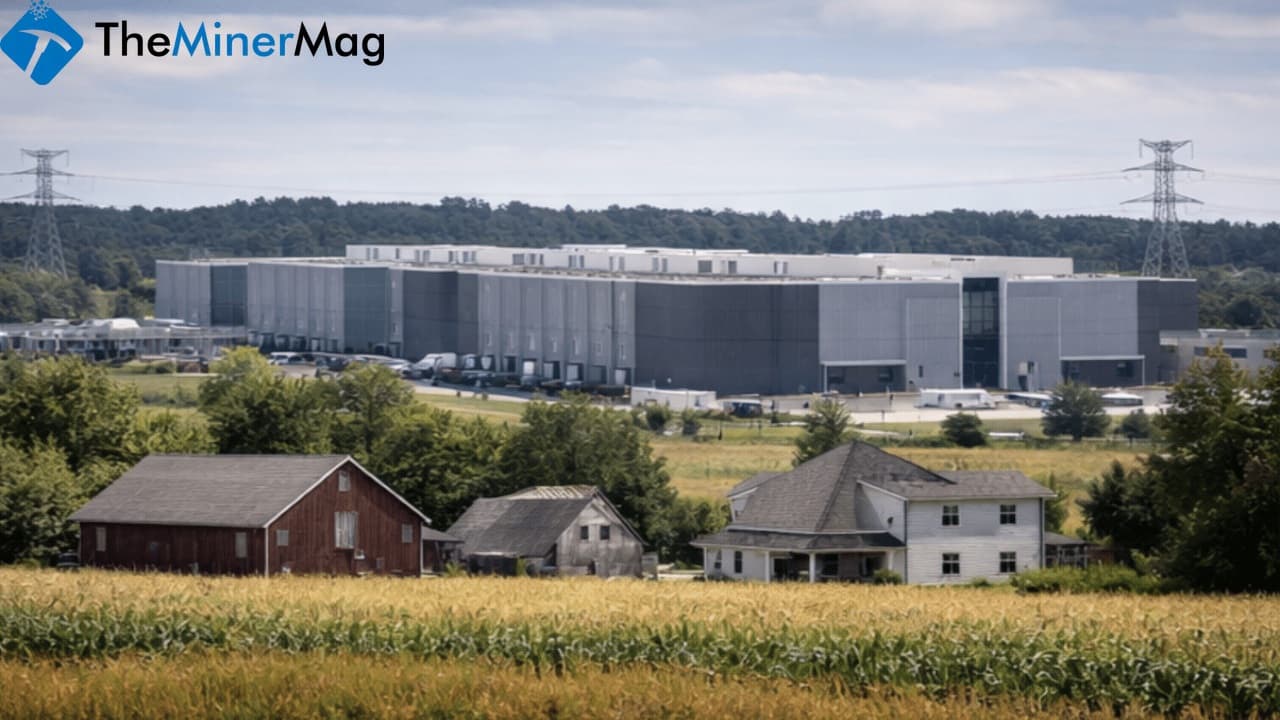
In Texas, Illinois, Georgia and Mississippi, local news outlets have reported packed hearings, zoning disputes and calls for moratoriums as residents question water consumption, backup generation, transmission upgrades and whether rising electricity costs will ultimately be passed on to households.
This week, commissioners in Thomas County, Georgia, voted to temporarily halt new AI data center developments while officials study the long-term impacts on infrastructure and public services. The move reflects a growing trend: communities are slowing approvals not to reject AI outright, but to avoid being locked into consequences they do not yet fully understand.
Industry trackers estimate that $64 billion in U.S. data center projects have already been delayed or blocked by local opposition—an increasingly hard figure for investors to ignore.
Big Tech responds: “paying its own way”
The industry response is starting to change.
Earlier this month, Microsoft rolled out its “Community-First AI Infrastructure” framework, pledging that its data centers would cover the full cost of new generation, transmission and grid upgrades rather than shifting those expenses onto residential ratepayers. The company also committed to water replenishment, transparency and workforce investment in host communities.
Now, OpenAI has taken a similar stance.
OpenAI has committed to “paying its own way” for energy costs tied to its AI data center expansion, signaling that the company recognizes community acceptance and power-market credibility as strategic priorities—not afterthoughts. The move aligns OpenAI more closely with utilities and regulators wary of socializing infrastructure costs driven by private AI demand.
For veterans of the bitcoin mining sector, the language is familiar. Miners that survived local pushback often did so only after renegotiating power contracts, investing in mitigation measures or agreeing to clearer community benefit structures—frequently after costly delays.
There are, however, important operational differences. Bitcoin miners, by design, can curtail power usage or shut down entirely during periods of peak demand or extreme weather, allowing utilities to rebalance load in real time. In several U.S. markets, this flexibility has been used as a grid-management tool, with miners participating in demand-response programs that reduce strain during emergencies. Proponents argue this has helped offset infrastructure costs by supporting grid expansion while lowering energy prices for residential customers during peak periods. AI data centers, by contrast, are built to serve continuous computing workloads and are generally less amenable to rapid curtailment, limiting their usefulness as flexible load in times of grid stress.
Policymakers draw firmer lines
State governments are also recalibrating.
New York Governor Kathy Hochul has proposed stricter safeguards to ensure large data centers pay higher charges tied to grid upgrades and reliability. While framed as a consumer-protection measure, the policy is inseparable from surging AI-driven electricity demand.
New York’s posture is shaped by experience. The state spent years navigating backlash against bitcoin mining facilities, particularly those tied to fossil-fuel generation. AI data centers may wear a different label, but from a grid-planning perspective, they pose many of the same challenges: large, inflexible loads seeking rapid interconnection.
For bitcoin miners pivoting toward AI or HPC colocation, the implications are significant.
Capital markets have largely rewarded AI data center narratives with higher multiples and cheaper capital, often assuming smoother permitting and stronger political support than crypto mining ever enjoyed. Community resistance complicates that thesis.
The AI compute boom is real. The power demand behind it is even more real. But local consent—long treated as a secondary consideration—is reasserting itself as a gating factor.
Bitcoin mining learned this lesson the hard way after 2021. AI infrastructure builders are now discovering that, even in the age of trillion-dollar valuations, local communities may still not buy it.