
CME Group is the world’s largest derivatives marketplace, where futures and options trade across interest rates, stock indexes, energy, metals, agriculture, currencies and cryptocurrencies.
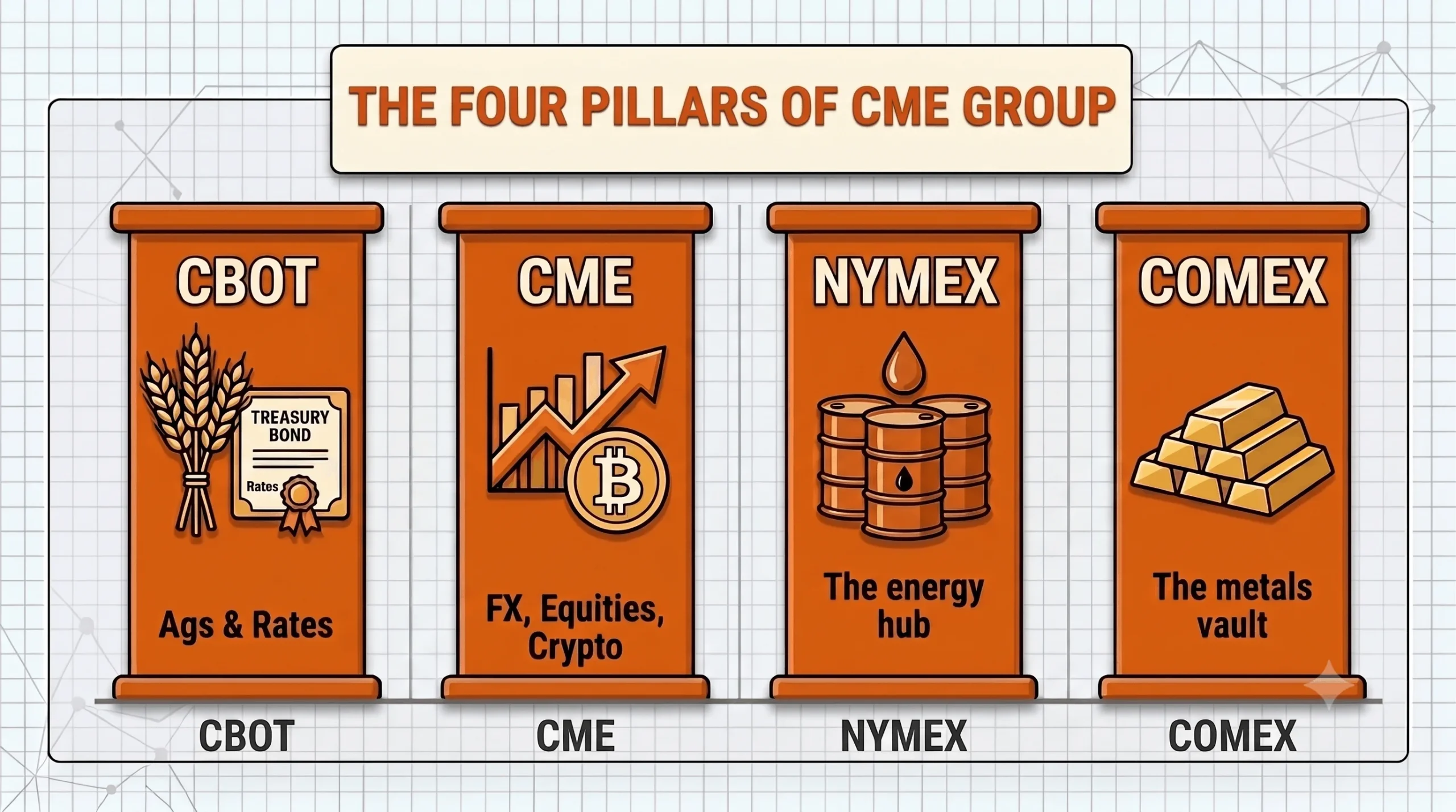
It is the parent company of four exchanges (CME, CBOT, NYMEX and COMEX) and rather than listing company shares, it hands businesses, institutions and traders standardized contracts for managing price risk or taking a market view without ever owning the underlying asset.
One idea ties the whole operation together: transferring risk from those who want to shed it to those willing to take it on, whether the contract tracks a barrel of crude oil, a basket of S&P 500 stocks, or the price of Bitcoin.
Key Takeaways
- CME Group is the world’s largest derivatives exchange operator, running four markets (CME, CBOT, NYMEX and COMEX) under one roof.
- It lists futures and options across rates, equities, energy, metals, agriculture, currencies and crypto, rather than company shares.
- “CME” stands for the Chicago Mercantile Exchange, the historic exchange at the company’s core (and an acronym easily confused with continuing medical education).
- Its real product is risk transfer: hedging, price discovery and central clearing that let two strangers trade without trusting each other.
- CME Bitcoin and Ether futures are regulated, cash-settled contracts that track crypto prices without anyone holding a coin, and since May 2026, they trade 24/7.
- It is regulated by the CFTC and, fittingly for an institution this contrarian, trades as a stock on Nasdaq under the ticker CME.
CME Quick Facts
Before getting into how CME works, here are the basic facts that define CME Group: what it is, where it is based, what markets it runs, and how it fits into regulated derivatives trading.
CME Group at a glanceDetailFull nameCME Group Inc.What CME originally stood forChicago Mercantile ExchangeMain businessFutures, options, clearing, market data and risk managementCore exchangesCME, CBOT, NYMEX, COMEXMajor marketsRates, equities, energy, metals, agriculture, FX, cryptoHeadquartersChicago, IllinoisListingPublic company; trades under the ticker CME on NasdaqRegulatorU.S. Commodity Futures Trading Commission (CFTC)Crypto productsBitcoin, Micro Bitcoin, Ether and Micro Ether futures, plus crypto options and newer altcoin contractsCME Group at a glanceFull nameDetailCME Group Inc.CME Group at a glanceWhat CME originally stood forDetailChicago Mercantile ExchangeCME Group at a glanceMain businessDetailFutures, options, clearing, market data and risk managementCME Group at a glanceCore exchangesDetailCME, CBOT, NYMEX, COMEXCME Group at a glanceMajor marketsDetailRates, equities, energy, metals, agriculture, FX, cryptoCME Group at a glanceHeadquartersDetailChicago, IllinoisCME Group at a glanceListingDetailPublic company; trades under the ticker CME on NasdaqCME Group at a glanceRegulatorDetailU.S. Commodity Futures Trading Commission (CFTC)CME Group at a glanceCrypto productsDetailBitcoin, Micro Bitcoin, Ether and Micro Ether futures, plus crypto options and newer altcoin contracts
What Is CME Group?
CME Group is a financial exchange operator that runs regulated markets for derivatives , contracts whose value comes from an underlying asset, with futures and options as its two flagship products.
Traders use these contracts to lock in prices, hedge against losses, speculate on price moves, or gain exposure to an asset class without buying it outright. The company is built from four Designated Contract Markets, the regulatory term for a fully approved U.S. futures exchange, each with its own history and product focus, all operating as a single marketplace.
In its 2025 financial year CME Group reported revenue of roughly $4.1 billion, a figure that hints at how much of the world’s hedging and price discovery flows through its order books. It sits in the S&P 500 and ranks among the largest exchange operators on earth by the value of contracts it handles.
What Does CME Stand For?
In financial markets, CME stands for the Chicago Mercantile Exchange, and by extension for CME Group, the parent company that grew out of it.
Worth clarifying, because the acronym is genuinely slippery. Search “CME” and you’ll also turn up continuing medical education, a completely unrelated meaning from healthcare. This article sticks to the financial CME: the exchange operator behind some of the world’s largest futures and options markets.
CME meaningContextChicago Mercantile ExchangeFinancial markets, the original exchangeCME GroupParent company and derivatives marketplace operatorCME (ticker)CME Group’s publicly traded stockContinuing Medical EducationHealthcare and professional training (unrelated)CME meaningChicago Mercantile ExchangeContextFinancial markets, the original exchangeCME meaningCME GroupContextParent company and derivatives marketplace operatorCME meaningCME (ticker)ContextCME Group’s publicly traded stockCME meaningContinuing Medical EducationContextHealthcare and professional training (unrelated)
CME Group vs. the Chicago Mercantile Exchange
The two names get used interchangeably, but they describe different things. The Chicago Mercantile Exchange is one specific exchange and the historical root of the CME name; CME Group is the larger company, formed in 2007, that owns it alongside three other exchanges.
TermWhat it isChicago Mercantile Exchange (CME)The historic exchange, nicknamed “the Merc”CME GroupThe parent company and exchange operatorCBOTChicago Board of Trade, the oldest of the fourNYMEXNew York Mercantile Exchange (energy)COMEXCommodity Exchange (metals)CME GlobexThe electronic platform on which most CME markets now tradeTermChicago Mercantile Exchange (CME)What it isThe historic exchange, nicknamed “the Merc”TermCME GroupWhat it isThe parent company and exchange operatorTermCBOTWhat it isChicago Board of Trade, the oldest of the fourTermNYMEXWhat it isNew York Mercantile Exchange (energy)TermCOMEXWhat it isCommodity Exchange (metals)TermCME GlobexWhat it isThe electronic platform on which most CME markets now trade
Put simply: the Chicago Mercantile Exchange is one exchange inside CME Group. CME Group is the company that runs it.
What Does CME Group Do?
CME Group designs and lists standardized contracts, operates the regulated venues where they trade, clears those trades so neither side has to trust the other, and publishes the resulting prices as market data and benchmarks. Each function reinforces the others.
CME Group functionWhat it meansLists futures contractsStandardized agreements tied to assets like oil, gold, rates, stock indexes and BitcoinLists options contractsContracts giving traders defined rights linked to futures or benchmarksOperates exchangesProvides regulated marketplaces for buyers and sellersClears tradesSteps in as central counterparty to reduce default riskPublishes market dataDistributes prices, quotes and benchmarks used across global financeSupports risk managementLets businesses and institutions hedge against changing pricesCME Group functionLists futures contractsWhat it meansStandardized agreements tied to assets like oil, gold, rates, stock indexes and BitcoinCME Group functionLists options contractsWhat it meansContracts giving traders defined rights linked to futures or benchmarksCME Group functionOperates exchangesWhat it meansProvides regulated marketplaces for buyers and sellersCME Group functionClears tradesWhat it meansSteps in as central counterparty to reduce default riskCME Group functionPublishes market dataWhat it meansDistributes prices, quotes and benchmarks used across global financeCME Group functionSupports risk managementWhat it meansLets businesses and institutions hedge against changing prices
Standardization is the thread running through all of it. Because every contract of a given type carries identical terms (size, expiry, settlement method) anyone can trade with anyone else instead of haggling over one-off deals. That uniformity is what makes deep, liquid futures markets possible in the first place.
Futures vs. Options: What’s the Difference?
Futures and options are CME Group’s two flagship products, and beginners routinely mix them up. The difference comes down to a single word: obligation.
FeatureFutures contractOptions contractThe core conceptAn obligation to buy or sell at a set date.The right, but not the obligation, to buy or sell at a set date.Upfront costRequires posting initial margin.Buyer pays a premium upfront.Risk profileSymmetrical: gains and losses can both be magnified.Asymmetrical for buyers: risk is capped at the premium paid.FeatureThe core conceptFutures contractAn obligation to buy or sell at a set date.Options contractThe right, but not the obligation, to buy or sell at a set date.FeatureUpfront costFutures contractRequires posting initial margin.Options contractBuyer pays a premium upfront.FeatureRisk profileFutures contractSymmetrical: gains and losses can both be magnified.Options contractAsymmetrical for buyers: risk is capped at the premium paid.
A futures trader is locked in; an options buyer has paid for the right to walk away. That one distinction shapes how each instrument is priced, margined and used.
How CME Group Works
A CME trade moves through a predictable sequence, from contract design to final settlement.
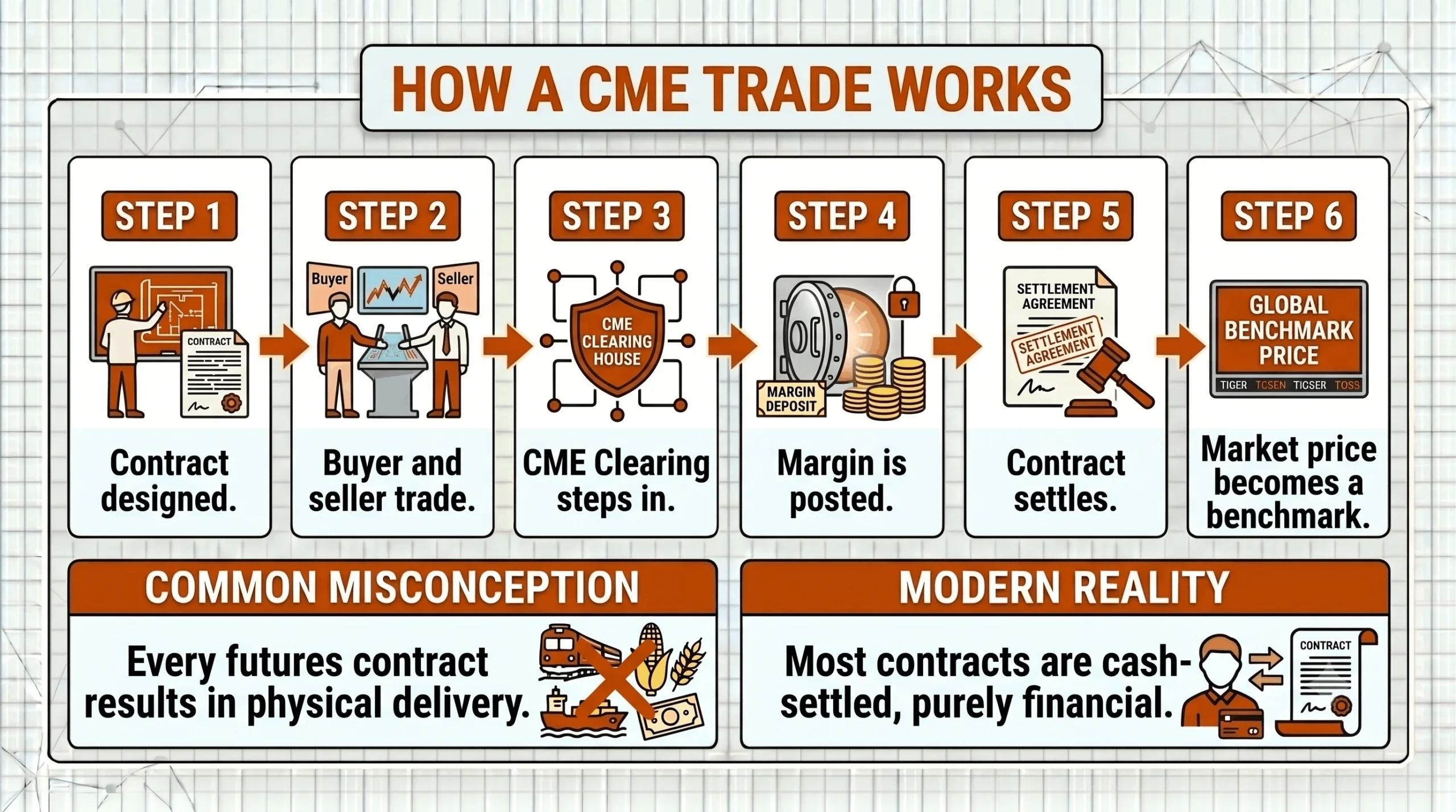
Two steps do the heavy lifting and deserve a closer look.
- Clearing reduces counterparty risk. When a trade is matched, CME Clearing steps between the two parties, becoming the buyer to every seller and the seller to every buyer. If one side defaults, the clearing house, backed by margin and a layered financial-safeguards system, stands behind the trade. This is the single biggest reason institutions trust regulated futures markets.
- Margin lets traders control large positions with a fraction of the capital. Instead of paying a contract’s full value upfront, participants post collateral known as the performance bond, or margin. That creates leverage, which magnifies gains and losses alike. In early 2026, the initial margin on a full-size Bitcoin futures contract ran roughly $140,000, while the much smaller Micro Bitcoin contract required only about $2,800. This is a reminder that contract size and leverage, not just price, decide how much risk you’re actually carrying.
Leverage of that kind is exactly why central clearing exists. Warren Buffett issued the most famous warning on the subject in his 2002 Berkshire Hathaway shareholder letter:
“Derivatives are financial weapons of mass destruction, carrying dangers that, while now latent, are potentially lethal.” | Warren Buffett, Chairman and CEO of Berkshire Hathaway
Buffett’s point cuts straight to why a clearing house matters. Because leverage can turn one firm’s blowup into everyone’s problem, the system needs a heavily regulated central counterparty (CME Clearing) sitting in the middle, ready to absorb the shock when a single party defaults.
CME Group Products and Markets
The breadth of CME Group’s product range is the detail most beginner explainers miss. Crypto grabs the headlines, but it’s one category inside a marketplace built over more than a century around the world’s core commodities and financial instruments.
Market categoryExamplesInterest ratesU.S. Treasury futures, SOFR contracts, Fed Funds productsEquity indexesS&P 500, Nasdaq-100 and Dow-linked futuresEnergyCrude oil, natural gas, refined productsAgricultureCorn, soybeans, wheat, livestock, dairyMetalsGold, silver, copperForeign exchangeMajor currency futuresCryptocurrenciesBitcoin, Micro Bitcoin, Ether, Micro Ether and newer altcoin futuresMarket categoryInterest ratesExamplesU.S. Treasury futures, SOFR contracts, Fed Funds productsMarket categoryEquity indexesExamplesS&P 500, Nasdaq-100 and Dow-linked futuresMarket categoryEnergyExamplesCrude oil, natural gas, refined productsMarket categoryAgricultureExamplesCorn, soybeans, wheat, livestock, dairyMarket categoryMetalsExamplesGold, silver, copperMarket categoryForeign exchangeExamplesMajor currency futuresMarket categoryCryptocurrenciesExamplesBitcoin, Micro Bitcoin, Ether, Micro Ether and newer altcoin futures
CME Group’s interest-rate and equity-index complexes rank among the most heavily traded markets on the planet, so when the crypto section below gets to Bitcoin and Ether, keep the scale in mind: those contracts sit beside the ones institutions use to hedge trillions in bonds, stocks and commodities.
CME Bitcoin Futures and Crypto Futures Explained
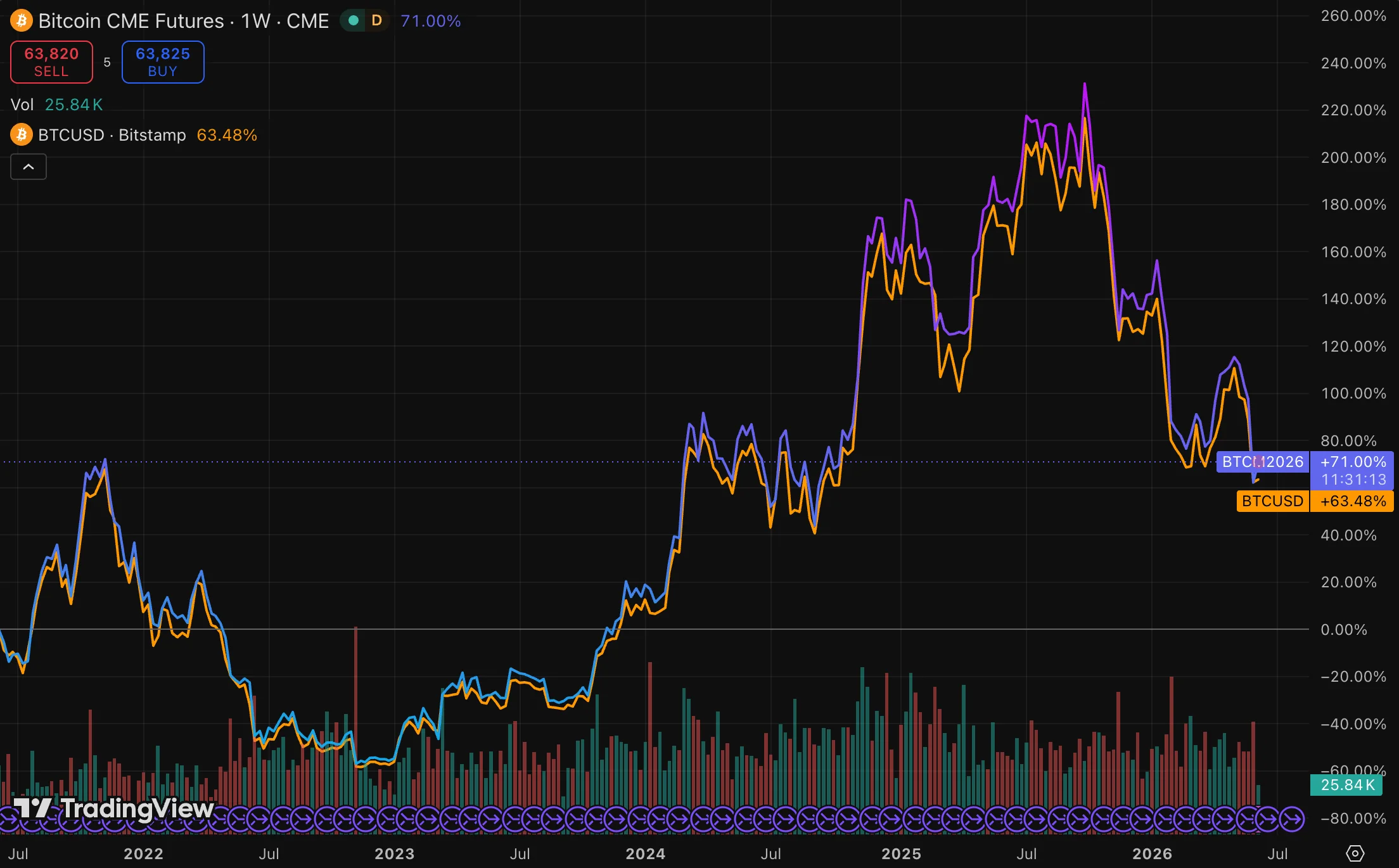
CME Bitcoin futures are regulated contracts that let participants gain or hedge exposure to Bitcoin’s price without ever holding a Bitcoin. CME Group launched them on December 18, 2017, becoming one of the first regulated venues to pull crypto into mainstream derivatives markets. The lineup has expanded steadily since.
Crypto contract specifications and margin
You briefly meet the margin numbers above; here are the hard specs traders actually reach for.
ContractTickerContract sizeUnderlying assetSettlementBitcoinBTC5 bitcoinCME CF Bitcoin Reference RateCashMicro BitcoinMBT0.1 bitcoinCME CF Bitcoin Reference RateCashEtherETH50 etherCME CF Ether-Dollar Reference RateCashMicro EtherMET0.1 etherCME CF Ether-Dollar Reference RateCashContractBitcoinTickerBTCContract size5 bitcoinUnderlying assetCME CF Bitcoin Reference RateSettlementCashContractMicro BitcoinTickerMBTContract size0.1 bitcoinUnderlying assetCME CF Bitcoin Reference RateSettlementCashContractEtherTickerETHContract size50 etherUnderlying assetCME CF Ether-Dollar Reference RateSettlementCashContractMicro EtherTickerMETContract size0.1 etherUnderlying assetCME CF Ether-Dollar Reference RateSettlementCash
Every CME crypto contract is cash-settled against a regulated benchmark. Bitcoin and Micro Bitcoin futures settle to the CME CF Bitcoin Reference Rate; Ether contracts settle to the CME CF Ether-Dollar Reference Rate. Maintained with CF Benchmarks and overseen by an independent committee, these rates blend prices from major spot exchanges into a single daily figure. This is the mechanism that lets an institution trust a contract will settle at a fair, manipulation-resistant price.
The product set keeps growing. CME added Bitcoin options in 2020, weekly Bitcoin Friday futures in 2024, and in early 2026 expanded into altcoins with futures on Cardano, Chainlink and Stellar, alongside its existing Solana and XRP contracts.
CME crypto futures vs. spot Bitcoin trading
The most common point of confusion: is buying a CME Bitcoin future the same as buying Bitcoin? No.
FeatureCME crypto futuresSpot crypto tradingWhat you holdA futures contractThe actual coinCustodyNo direct BTC/ETH custody requiredYou or a platform must hold the assetVenueRegulated derivatives exchangeCrypto exchange, broker or wallet appTypical useHedging, speculation, institutional exposureBuying, holding, spendingSettlementCash, against a reference rateDirect transfer of the assetMain risksLeverage, margin, contract expiryCustody, exchange and wallet riskFeatureWhat you holdCME crypto futuresA futures contractSpot crypto tradingThe actual coinFeatureCustodyCME crypto futuresNo direct BTC/ETH custody requiredSpot crypto tradingYou or a platform must hold the assetFeatureVenueCME crypto futuresRegulated derivatives exchangeSpot crypto tradingCrypto exchange, broker or wallet appFeatureTypical useCME crypto futuresHedging, speculation, institutional exposureSpot crypto tradingBuying, holding, spendingFeatureSettlementCME crypto futuresCash, against a reference rateSpot crypto tradingDirect transfer of the assetFeatureMain risksCME crypto futuresLeverage, margin, contract expirySpot crypto tradingCustody, exchange and wallet risk
The line to remember: a CME Bitcoin future tracks Bitcoin’s price without ever becoming Bitcoin. You take delivery of nothing, and you never need a wallet, precisely why regulated institutions favor them.
Why regulated crypto futures matter
For a hedge fund, asset manager or corporate treasury, holding Bitcoin directly raises hard operational questions. A regulated, cash-settled futures contract bypasses them by solving three hurdles at once:
- The custody problem: No cold storage, private keys or digital wallets to manage.
- The compliance hurdle: Trading happens on a CFTC-regulated exchange, not an offshore or unregulated crypto platform.
- The accounting friction: Cash settlement means the institution never touches the digital asset, which drastically simplifies balance-sheet reporting.
Demand has grown sharply: CME Group reported a record $3 trillion in notional volume across its crypto futures and options in 2025.
That momentum culminated in a structural shift. On May 29, 2026, CME switched its cryptocurrency futures and options to round-the-clock trading, the first time its regulated crypto contracts could be traded at any hour, on any day, with only a brief weekly maintenance pause. The change finally lines the regulated market up with crypto’s always-on spot markets.
Tim McCourt, CME Group’s Global Head of Equities, FX and Alternative Products, called the always-on model “the next natural evolution for the marketplace.” His brokerage partners put it more bluntly:
“Crypto is a 24/7 asset class.” | JB Mackenzie, Head of Futures and International at Robinhood
Until this launch, regulated futures simply hadn’t matched that reality, a legacy Chicago institution quietly bending its century-old rhythms to the clock of a new technology.
Why CME Group Matters
CME Group’s importance comes from the roles it plays across the financial system, not from any single product.
Why it mattersExplanationPrice discoveryCME prices signal market expectations for rates, commodities, indexes, FX and cryptoHedgingProducers, consumers, funds and institutions can offload price riskLiquidityActive markets make it easier to enter and exit positionsStandardizationClear, uniform contract terms make broad participation possibleClearingCentral clearing reduces the risk that a counterparty defaultsCrypto accessRegulated derivatives give institutions a compliant route to BTC and ETH exposureWhy it mattersPrice discoveryExplanationCME prices signal market expectations for rates, commodities, indexes, FX and cryptoWhy it mattersHedgingExplanationProducers, consumers, funds and institutions can offload price riskWhy it mattersLiquidityExplanationActive markets make it easier to enter and exit positionsWhy it mattersStandardizationExplanationClear, uniform contract terms make broad participation possibleWhy it mattersClearingExplanationCentral clearing reduces the risk that a counterparty defaultsWhy it mattersCrypto accessExplanationRegulated derivatives give institutions a compliant route to BTC and ETH exposure
Price discovery is the quietest of these roles and the most far-reaching. The Nobel laureate Merton Miller captured the idea more cleanly than any textbook:
“Everybody has some information. The function of the markets is to aggregate that information, evaluate it and get it incorporated into prices.” | Merton Miller, Nobel Laureate in Economics
A CME price is essentially that aggregation made visible, a giant running calculation of everything the market knows about a crop, an interest rate or a cryptocurrency at a single second. When a farmer prices grain, an airline budgets for fuel, or a fund values a crypto position, the reference number often traces back to a CME contract. Those prices become the points the rest of the market leans on, the exchange’s most underrated export.
CME Group vs. NYSE and Nasdaq
Newcomers often assume CME Group is a stock exchange. It isn’t, and the distinction is fundamental: stock exchanges trade ownership, derivatives exchanges trade risk.
FeatureCME GroupNYSE / NasdaqMain marketDerivativesStocks and other securitiesCommon productsFutures and optionsShares, ETFs, listed securitiesPurposeRisk management, hedging, price exposureCompany ownership and raising capitalExample tradeS&P 500 futures, crude oil futures, Bitcoin futuresApple shares, an index ETFSettlementCash or physical delivery, depending on contractOwnership of shares changes handsParticipantsHedgers, institutions, traders, brokersInvestors, companies, market makersFeatureMain marketCME GroupDerivativesNYSE / NasdaqStocks and other securitiesFeatureCommon productsCME GroupFutures and optionsNYSE / NasdaqShares, ETFs, listed securitiesFeaturePurposeCME GroupRisk management, hedging, price exposureNYSE / NasdaqCompany ownership and raising capitalFeatureExample tradeCME GroupS&P 500 futures, crude oil futures, Bitcoin futuresNYSE / NasdaqApple shares, an index ETFFeatureSettlementCME GroupCash or physical delivery, depending on contractNYSE / NasdaqOwnership of shares changes handsFeatureParticipantsCME GroupHedgers, institutions, traders, brokersNYSE / NasdaqInvestors, companies, market makers
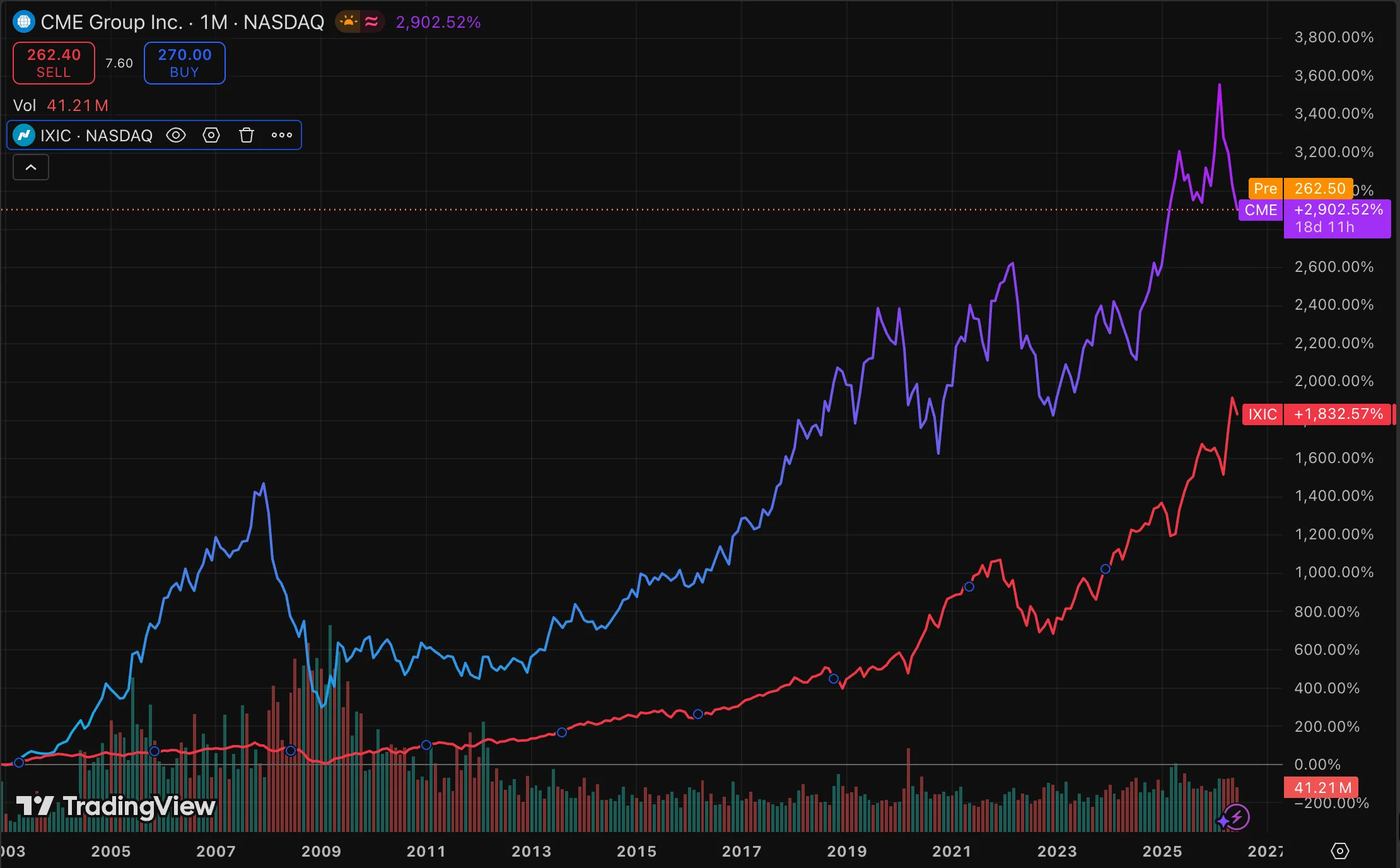
NYSE and Nasdaq are where companies list shares and investors buy ownership stakes; CME Group lists standardized contracts tied to prices. One neat irony: CME Group is itself a public company, and its shares trade on Nasdaq under the ticker CME . So, the world’s largest derivatives operator is, as a stock, just another Nasdaq listing.
A Brief History of CME Group
CME Group’s roots run deeper than crypto, deeper even than financial futures, back to a market for perishable goods in 19th-century Chicago.
The empire began, improbably, with butter and eggs. The Chicago Mercantile Exchange started in 1898 as the Chicago Butter and Egg Board, a marketplace for exactly those two perishables, and took its modern name in 1919. For an institution that would one day clear trillions in interest-rate and crypto risk, it’s a humble origin, and proof that you really shouldn’t keep all your eggs in one basket.
Its defining moment came in 1972. Under chairman Leo Melamed, the exchange created the International Monetary Market and launched futures on foreign currencies, the first financial futures ever traded. The motive was the economic anxiety of the era, as floating exchange rates replaced the old fixed-rate system and businesses suddenly had no idea what next quarter’s currencies would cost them. Melamed, widely called the father of financial futures and now CME Group’s chairman emeritus, later described the thinking behind it:
“The idea was simply a recognition that the world had entered an era of great financial uncertainty, that uncertainty breeds risk, that risk seeks insurance.” | Leo Melamed, Chairman Emeritus of CME Group and the “Father of Financial Futures”
That instinct, uncertainty breeds risk, risk seeks insurance, proved revolutionary. The notion that financial instruments, and not just crops and metals, could be standardized and traded as futures became the foundation of the modern derivatives industry.
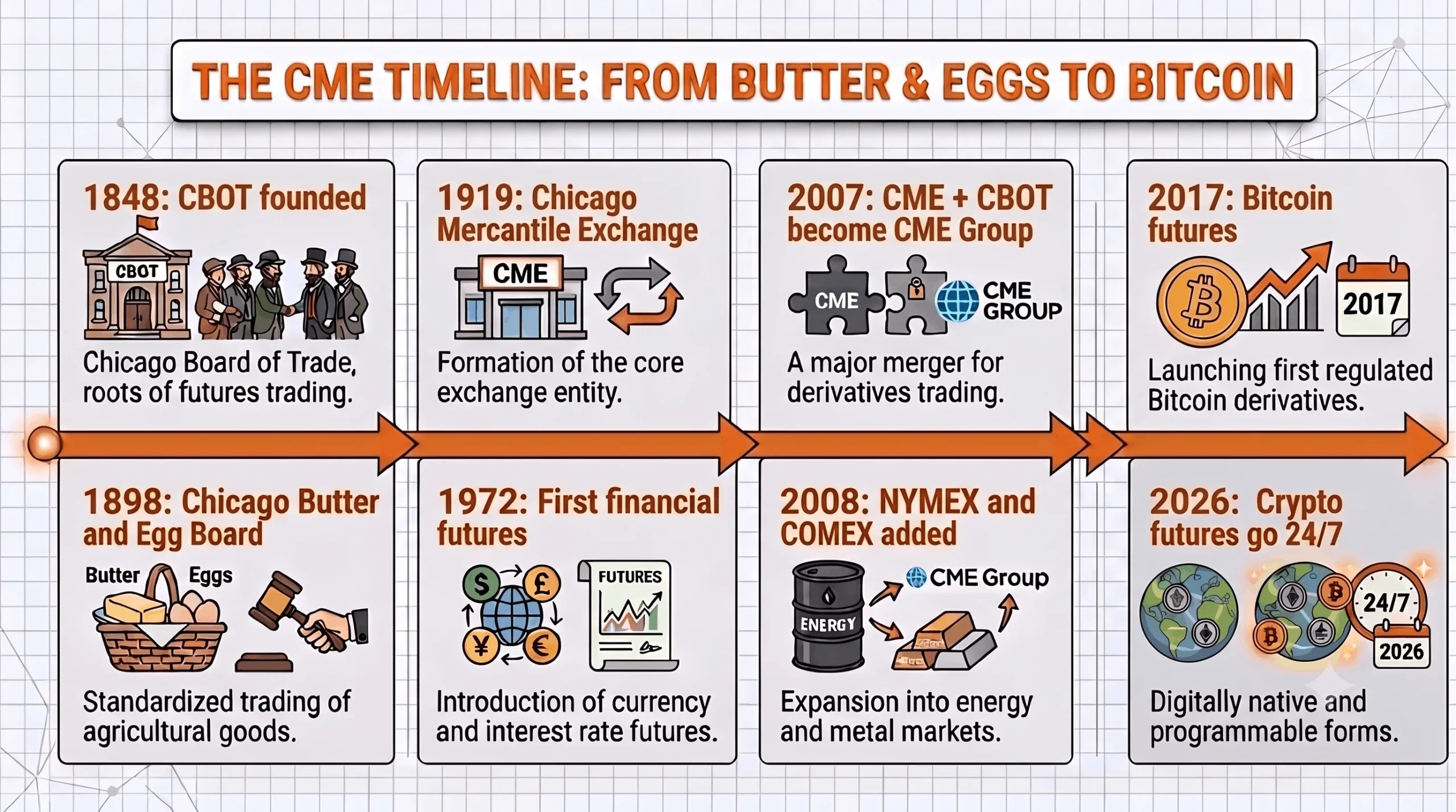
From there the institution scaled through consolidation: CME went public in 2002, merged with the older Chicago Board of Trade in 2007 to form CME Group, and absorbed the New York energy and metals exchanges, NYMEX and COMEX, in 2008. The 2017 launch of Bitcoin futures extended that century-long pattern of standardizing new markets. This time, a digital one.
Who Uses CME Group?
CME markets are used by anyone whose business or portfolio is exposed to changing prices.
User typeHow they use CME marketsFarmers and producersHedge crop or livestock prices ahead of harvestEnergy companiesManage oil, gas and power price riskAirlines and manufacturersLock in fuel and raw-material costsBanks and asset managersManage interest-rate and equity-index exposureCommodity tradersTrade metals, grains, energy and livestockCrypto funds and institutionsHedge or gain regulated exposure to BTC and ETHIndividual tradersAccess futures through brokers, where eligibleUser typeFarmers and producersHow they use CME marketsHedge crop or livestock prices ahead of harvestUser typeEnergy companiesHow they use CME marketsManage oil, gas and power price riskUser typeAirlines and manufacturersHow they use CME marketsLock in fuel and raw-material costsUser typeBanks and asset managersHow they use CME marketsManage interest-rate and equity-index exposureUser typeCommodity tradersHow they use CME marketsTrade metals, grains, energy and livestockUser typeCrypto funds and institutionsHow they use CME marketsHedge or gain regulated exposure to BTC and ETHUser typeIndividual tradersHow they use CME marketsAccess futures through brokers, where eligible
The common thread: none of these participants necessarily wants to own the underlying asset. They want to manage their exposure to its price, which is exactly what a futures market is built to do.
Closing Thoughts
CME Group is easy to mistake for just another exchange, but its real role is bigger and stranger than that. It does not mainly sell ownership in companies, like NYSE or Nasdaq. It sells standardized ways to transfer risk: from farmers, airlines, banks, funds, manufacturers and crypto traders who need protection or exposure, to counterparties willing to take the other side.
That makes CME Group one of the hidden pieces of infrastructure behind modern markets. Its futures and options help set prices, absorb uncertainty and turn scattered expectations into tradable contracts. The same machinery that once helped Chicago merchants manage butter, eggs and grain now clears risk tied to Treasury rates, crude oil, gold, the S&P 500 and Bitcoin.
For crypto, that matters because CME has given institutions a regulated, cash-settled path into an asset class that began outside the traditional system entirely. A CME Bitcoin future is not Bitcoin, and it does not replace self-custody, wallets or spot markets. But it does show how far digital assets have moved into the financial mainstream.
In the end, CME Group is best understood as a risk-transfer engine. Markets change, products evolve and trading hours now even run around crypto’s 24/7 clock, but the basic idea has stayed the same for more than a century: uncertainty creates risk, and risk needs a market.