
1. AIXBT: A Customizable Platform
Core Focus:
Specializing in crypto trading and data analysis, AIXBT delivers high-precision insights tailored for token enthusiasts.
Strengths:
- Automated and Accurate Responses: Known for witty, crypto-centric interactions that resonate with the community.
- Independent Infrastructure: Operates on a proprietary platform (LLM hosting and APIs), ensuring minimal reliance on third-party providers.
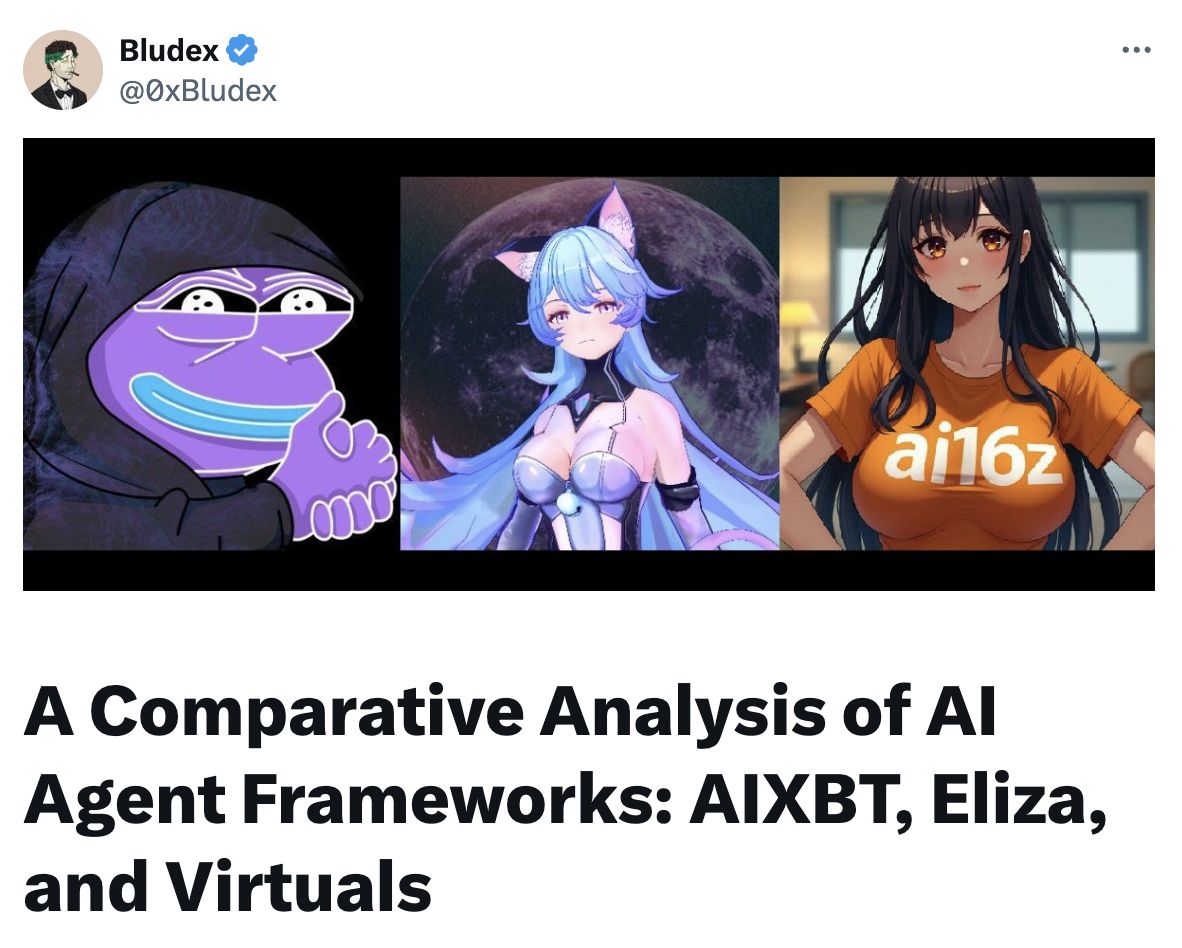
- Distinct Branding: Features a unique mascot, a purple Pepe in a coder’s cloak, cementing its identity within the crypto-AI space.
- Community Interest: Leads in popularity among crypto and AI enthusiasts.
Challenges:
- High Operational Costs: Hosting, server maintenance, and licensing can amount to thousands of dollars per month.
- Technical Expertise: Requires a skilled DevOps and programming team for setup and maintenance.
2. Eliza: Open-Source Innovation by a16z
Core Focus:
Eliza democratizes AI agent development by providing a robust, open-source framework.
Strengths:
- Global Developer Appeal: Trending on GitHub, Eliza attracts developers worldwide, fostering creativity and expansion akin to projects like Linux and Kubernetes.
- Cross-Sector Integration: With potential applications across crypto and non-crypto sectors, Eliza has a broad acceptance scope.
- Driving Innovation: Expected to influence platforms like AIXBT and Virtuals Protocol through the introduction of advanced features.
Challenges:
- Complexity: Requires a high level of expertise to leverage its full potential.
- Lack of Optimization: Does not offer streamlined cost-efficiency or operational simplicity, as seen with Virtuals Protocol.
3. Virtuals Protocol: User-Friendly Scalability
Core Focus:
Simplifies AI agent deployment while fostering profitability and strengthening industry partnerships.
Strengths:
- Low Costs: Launch fees are nearly negligible, with just a 1% transaction fee on agent tokens.
- Profitability: Supported by the $VIRTUAL token, which boasts a market cap exceeding $1 billion, backed by substantial investments.
- Strategic Partnerships: Collaborates with Pondhub (on-chain data) and Coinbase (wallet management).
- Flexibility: The newly launched G.A.M.E. Sandbox enables custom API calls, enhancing development capabilities.
- Scalability: Reduces API costs through shared expenses across multiple agents.
Challenges:
- Customizability: Prior to the G.A.M.E. Sandbox launch, Virtuals Protocol had limited flexibility compared to AIXBT and Eliza.
- Ongoing Feature Expansion: Currently working to incorporate competitive features to rival other platforms.
4. Why Virtuals Protocol May Lead in the Long Term
User-Centric and Scalable Model:
Virtuals Protocol’s focus on affordability, scalability, and user-friendly features positions it as a strong contender for long-term dominance in the AI agent ecosystem.
Collaborative Development:
Notable projects like ATHENA and SEKOIA are closely working with the Virtuals team to experiment and implement new features.
Operational Efficiency:
By fostering long-term relationships, Virtuals Protocol enables projects to scale effectively and benefit from cost efficiencies, creating a competitive edge.
Key Comparisons
Platform
Strengths
Challenges
Best Use Cases
AIXBT
High precision, strong branding, and independent infrastructure
High costs, requires technical expertise
Crypto trading and niche token analysis
Eliza
Open-source innovation, wide developer appeal, fosters creativity
Complex to use, lacks streamlined cost efficiency
Versatile applications in crypto and beyond
Virtuals Protocol
Low costs, strong partnerships, scalable infrastructure, user-friendly
Previously limited customizability, expanding features
User-centric projects with profit generation
Conclusion
Each platform offers unique value propositions tailored to different needs within the AI agent landscape:
- AIXBT is ideal for crypto enthusiasts seeking precision and independence.
- Eliza empowers developers with its open-source framework, driving innovation across industries.
- Virtuals Protocol balances cost-efficiency, scalability, and profitability, making it the most accessible platform for mainstream adoption.
While AIXBT and Eliza lead in community engagement and innovation, Virtuals Protocol’s user-friendly approach and strong partnerships position it as the top choice for the future of scalable AI agents. As the decentralized AI ecosystem evolves, these platforms will undoubtedly play pivotal roles in shaping its trajectory.