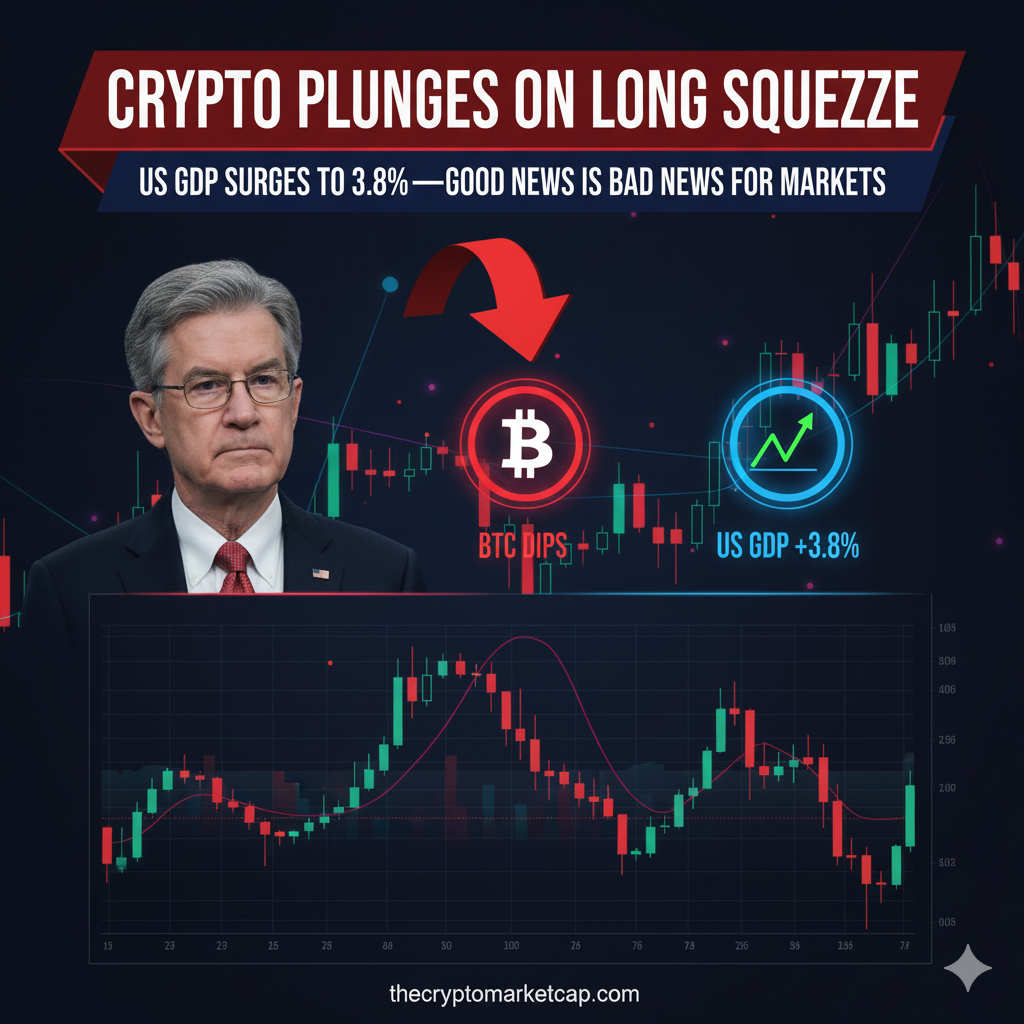
Crypto continues to decline as a massive volume of leveraged positions are liquidated. The upward revision of US GDP, while technically good news, is being interpreted as bad news by the market.
Market Plunges on Long Squeeze; US GDP Surges to 3.8%
Following the Fed Chair’s speech, the stock market continued to decline across all three indices, with the S&P 500 and Nasdaq dropping the most, by 0.5%. Stock futures continued their downward trend. Gold contracts rose to $3780 per ounce. Oil also saw a slight increase to $65 per barrel.

Bitcoin continued its decline to $109,000. Many major altcoins saw sharper drops. The overall crypto market capitalization fell to $3.84 trillion.

US BTC spot ETFs saw renewed outflows of $253.4 million as the market corrected. Similarly, ETH spot ETFs saw a total of $251.2 million leave the funds on Thursday. Conversely, SOL saw an inflow of $16.2 million.

The Crypto Market Correction: Over $1B in Longs Liquidated
Two factors are believed to be influencing the price of the crypto market. Firstly, the strong CPI report was interpreted as bad news, as many investors fear the Fed will not continue to cut interest rates. Secondly, a large volume of leveraged positions, including $1 billion in long bets, were liquidated, which aggressively pushed the BTC price down.

This “long squeeze” phenomenon caused Bitcoin‘s price to drop rapidly from $111,000 to $108,000, representing a decline of about 12% from its mid-August peak of $124,000. However, this level of correction is not unusual in BTC‘s history. The factor causing investor anxiety is time—with only three months left until the end of the year and the market yet to see a definitive breakthrough. Despite this, October is historically a strong month for growth, offering hope for a recovery. Furthermore, Tether just printed an additional 1 billion USDT on Ethereum, signaling positive liquidity in the system.
US GDP Jumps to 3.8%: Good News is Bad News for Stocks
US Q2 GDP was revised upwards from 3.3% to 3.8%, indicating stronger-than-expected economic growth. This is a rare occurrence, as revisions typically lower, not raise, initial estimates. However, the stock market fell, demonstrating the “good news is bad news” phenomenon.

Specifically, strong GDP growth and persistent inflation (2.9%) lead investors to believe the Fed will not cut interest rates as quickly or aggressively as hoped. Currently, mortgage rates in the US are still around 7%, and even with expected cuts, the estimated rate by the end of next year is still high at about 5.9%, which is insufficient to stimulate the real estate sector. After the Fed‘s first interest rate cut this year, the 10-year US government bond yield rose to 4.7%, reflecting a lack of confidence that the Fed will implement significant rate cuts soon due to prolonged inflation concerns.
The situation is complex: weakening employment and high inflation (around 2.9%) coupled with strong GDP growth create a paradox. When the US economy appears healthier, the likelihood of the Federal Reserve (Fed) implementing aggressive rate cuts decreases, disappointing investors and pushing the stock market into the red. This situation clearly illustrates the market’s paradox: good economic news causes stock prices to fall because it reduces the probability of a “dovish” monetary policy from the Fed. As a famous saying in investment goes: “The market fears a strong economy because it means the Fed won’t cut rates.”
Vietnam Engages Binance and Bybit on Crypto Framework
During a business trip to the United Arab Emirates (UAE), Standing Deputy Prime Minister Nguyen Hoa Binh held important working sessions with major corporations in the digital asset and real estate sectors, including Bybit, Binance, and Emaar.

Proposed Cooperation with Binance:
- Vietnam requested that Binance open a headquarters in Da Nang and collaborate closely with the Vietnam International Financial Center to implement a crypto asset exchange.
- Vietnam invited Richard Teng, CEO of Binance and former CEO of Abu Dhabi Global Market, to serve as a senior advisor for the process of building and developing the Vietnam International Financial Center.
- Binance also expressed its desire to work with Vietnam to promote blockchain and digital asset development, contributing to the goal of building an International Financial Center and a digital economy.
Cooperation with Other Major Businesses:
- During a meeting with Bybit, a company with over 2.5 million users in Vietnam, Bybit’s CEO welcomed Vietnam’s direction on piloting digital assets and committed to assisting with building the legal framework, sharing international experience, and training human resources. These high-level discussions signal Vietnam’s serious commitment to integrating crypto into its national financial strategy.
Other Key Crypto & Market Updates
BlackRock CEO Larry Fink revealed that Michael Saylor introduced him to Bitcoin when MicroStrategy‘s stock was below $20, around October 2020, shortly after MicroStrategy made its first Bitcoin purchase. Since then, BlackRock has continuously increased its ownership of MicroStrategy stock and currently holds about 5.4% of the company’s shares.
Nine European banks, including ING and UniCredit, have formed an alliance to develop a euro-backed stablecoin, headquartered in the Netherlands. The project aims to create an alternative solution to US-dominated stablecoins while enhancing Europe’s strategic autonomy in payments. The participating banks include UniCredit, ING, Banca Sella, KBC, Danske Bank, DekaBank, SEB, CaixaBank, and Raiffeisen Bank International. This stablecoin is expected to launch in the second half of 2026.
Circle is testing a mechanism for reversing USDC transactions in cases of fraud or hacking, which would allow refunds to victims while maintaining the finality of the transaction. This is an effort to combine the advantages of traditional banking with crypto to increase institutional trust. Additionally, Circle is developing its own blockchain called Arc, which uses USDC as the payment token, with the testnet expected to launch this fall.
The Australian government has released draft legislation to regulate crypto platforms, bringing the sector under its traditional financial framework. The law requires licensing, consumer protection, conflict-of-interest management, and custody/settlement standards; violations could be penalized with fines up to 10% of revenue. The new regulations aim to legitimize crypto operations and increase market transparency.
Disclaimer
This article is for informational purposes only and should not be considered financial advice. Please do your own research before making investment decisions.