
Bitcoin may be considered an emerging store of value by people who prize scarcity, portability, self-custody, and resistance to monetary debasement. The idea stays debated, though: Bitcoin is volatile, historically young, and less proven than traditional stores of value such as gold, fiat currency, and real estate.
So the honest answer is a nuanced one. Bitcoin has many of the properties people look for in a store of value, yet it does not behave like a stable one over every time period. Its usefulness depends on what someone is protecting against, how long their time horizon is, how they manage custody, and how much volatility they can stomach.
This guide explains what a store of value means, why people compare Bitcoin to gold, what gives Bitcoin value, and the strongest arguments for and against Bitcoin as a long-term store of value.
Key Takeaways
- A store of value is an asset expected to preserve purchasing power over time; good ones are durable, scarce, liquid, portable, and hard to debase.
- Bitcoin is best described as an emerging store of value. It has many of the right monetary properties but lacks the long track record of gold, fiat, or real estate.
- The case for it rests on a fixed 21-million supply, decentralization, portability, and self-custody: scarcity enforced by code rather than trust in a central bank.
- The case against rests on volatility, a short history, speculation, and custody risk; its purchasing power can fall sharply over short periods.
- “Digital gold” is useful shorthand, Bitcoin borrows gold’s scarcity logic and adds digital portability, but gold stays less volatile and far more proven.
- Bitcoin may suit holders who prioritize fixed supply, censorship resistance, and self-custody over a long horizon; it fits poorly for anyone who needs day-to-day price stability.
What Does Store of Value Mean?
A store of value is something that preserves purchasing power over time and can be exchanged later for goods, services, or another asset. Put plainly, it’s something people hold because they believe it will still be worth something in the future. Money, gold, land, real estate, and certain scarce collectibles have all played the role at different points in history.
What makes a good store of value
A good store of value is usually durable, scarce, liquid, portable, recognizable, divisible, and difficult to debase.
Store-of-value traitMeaningDurabilityIt does not decay, disappear, or become unusable easilyScarcityIts supply is limited or difficult to expandLiquidityIt can be exchanged relatively easilyPortabilityIt can be moved or transferredDivisibilityIt can be split into smaller unitsRecognizabilityOthers can identify and accept that it has valueResistance to debasementIts supply cannot be easily inflatedStore-of-value traitDurabilityMeaningIt does not decay, disappear, or become unusable easilyStore-of-value traitScarcityMeaningIts supply is limited or difficult to expandStore-of-value traitLiquidityMeaningIt can be exchanged relatively easilyStore-of-value traitPortabilityMeaningIt can be moved or transferredStore-of-value traitDivisibilityMeaningIt can be split into smaller unitsStore-of-value traitRecognizabilityMeaningOthers can identify and accept that it has valueStore-of-value traitResistance to debasementMeaningIts supply cannot be easily inflated
No asset aces every measure. Gold is durable and scarce but awkward to move in bulk. Fiat currency is liquid and widely accepted but loses purchasing power to inflation. Real estate preserves wealth across decades but is illiquid and costly to transact. That last trait, resistance to debasement, has tripped up empires: Roman emperors quietly shaved the silver out of the denarius until it was mostly base metal, an early and very analog lesson in what happens when the people who issue the money also control its supply.
Bitcoin’s store-of-value thesis rests on the idea that it blends some of gold’s monetary properties with the portability and transferability of the internet.
Traditional Examples of Stores of Value
Before comparing Bitcoin with other assets, it helps to see why people reach for different things to store value in the first place.
AssetWhy people use it as a store of valueWeaknessFiat currencyHighly liquid and widely acceptedInflation can reduce purchasing powerGoldScarce, durable, and historically trustedHarder to transport and use directlyReal estateScarce, useful, and historically valuableIlliquid and expensive to transactCollectiblesUnique or limited supplyHard to price and sellBitcoinScarce, portable, self-custodial, and globalVolatile and historically youngAssetFiat currencyWhy people use it as a store of valueHighly liquid and widely acceptedWeaknessInflation can reduce purchasing powerAssetGoldWhy people use it as a store of valueScarce, durable, and historically trustedWeaknessHarder to transport and use directlyAssetReal estateWhy people use it as a store of valueScarce, useful, and historically valuableWeaknessIlliquid and expensive to transactAssetCollectiblesWhy people use it as a store of valueUnique or limited supplyWeaknessHard to price and sellAssetBitcoinWhy people use it as a store of valueScarce, portable, self-custodial, and globalWeaknessVolatile and historically young
Each example solves a different problem. Fiat is built for spending and accounting. Gold is a historically recognized scarce asset. Real estate offers shelter, income potential, and long-term scarcity in desirable places. Bitcoin stands apart as a digital monetary asset with a fixed supply and no central issuer.
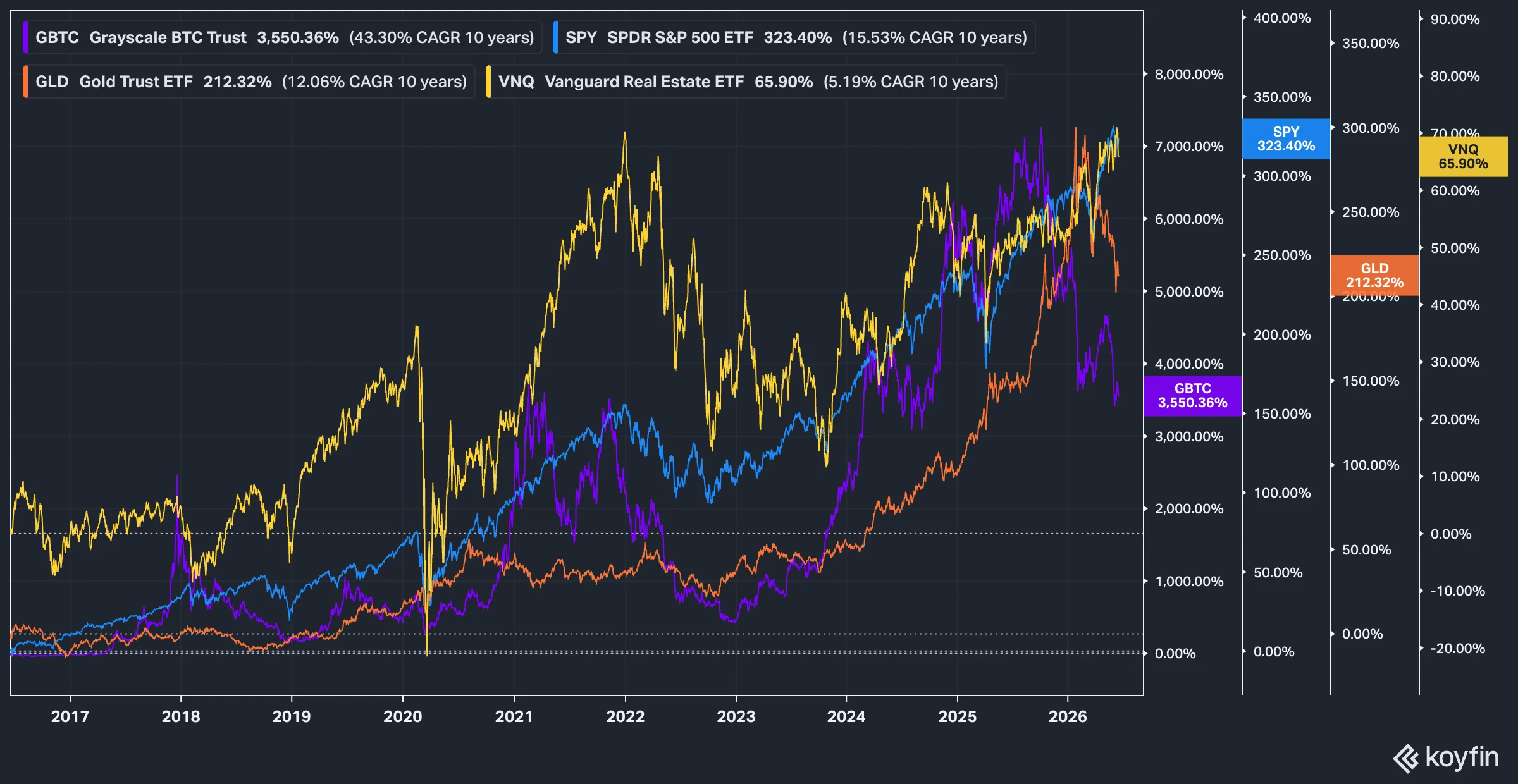
The performance gap between these assets over the past decade is striking. The chart below stacks ten years of cumulative returns for Bitcoin (via the Grayscale trust), the S&P 500, gold, and real estate, Bitcoin’s line towers over the rest. But that gap is a story about returns, not reliability: the same asset that led on performance is also the one with the wildest swings, which is the tension this guide keeps returning to.
That distrust of issuers is precisely what Bitcoin was built to answer. In the very first Bitcoin block, mined in January 2009, its pseudonymous creator embedded a newspaper headline — “Chancellor on brink of second bailout for banks” — a permanent timestamp and a pointed comment on the financial system Bitcoin was designed to sidestep. The reasoning was spelled out plainly:
“The root problem with conventional currency is all the trust that’s required to make it work. The central bank must be trusted not to debase the currency, but the history of fiat currencies is full of breaches of that trust.” | Satoshi Nakamoto, creator of Bitcoin
The real question, then, goes past whether Bitcoin is exactly like these older stores of value, to whether its properties make it useful for storing value in a digital, global, increasingly online economy.
Why Does Bitcoin Have Value?
Bitcoin’s value is debated. Supporters argue it has value because it is scarce, decentralized, secure, portable, divisible, and useful as money that depends on no central authority. Critics counter that Bitcoin lacks traditional intrinsic value because it produces no cash flow like a business, no rent like real estate, and no industrial use like some commodities.
Both views matter. Bitcoin does not carry value the way a stock or income-producing property does, it represents no ownership in a company and generates no earnings. Its value instead comes from its monetary properties and the network of users, miners, developers, wallets, exchanges, businesses, and institutions that recognize and use it.
Value driverWhy it mattersFixed supplyBitcoin’s supply is capped at 21 million coinsPredictable issuanceNew BTC follows a transparent scheduleDecentralizationNo single company or government controls the networkSecurityBitcoin is protected by proof-of-work mining and network participantsPortabilityLarge amounts of value can be moved digitallyDivisibilityBitcoin can be divided into small unitsSelf-custodyUsers can hold BTC without relying on a bankNetwork effectMore users, exchanges, wallets, and institutions increase utilityValue driverFixed supplyWhy it mattersBitcoin’s supply is capped at 21 million coinsValue driverPredictable issuanceWhy it mattersNew BTC follows a transparent scheduleValue driverDecentralizationWhy it mattersNo single company or government controls the networkValue driverSecurityWhy it mattersBitcoin is protected by proof-of-work mining and network participantsValue driverPortabilityWhy it mattersLarge amounts of value can be moved digitallyValue driverDivisibilityWhy it mattersBitcoin can be divided into small unitsValue driverSelf-custodyWhy it mattersUsers can hold BTC without relying on a bankValue driverNetwork effectWhy it mattersMore users, exchanges, wallets, and institutions increase utility
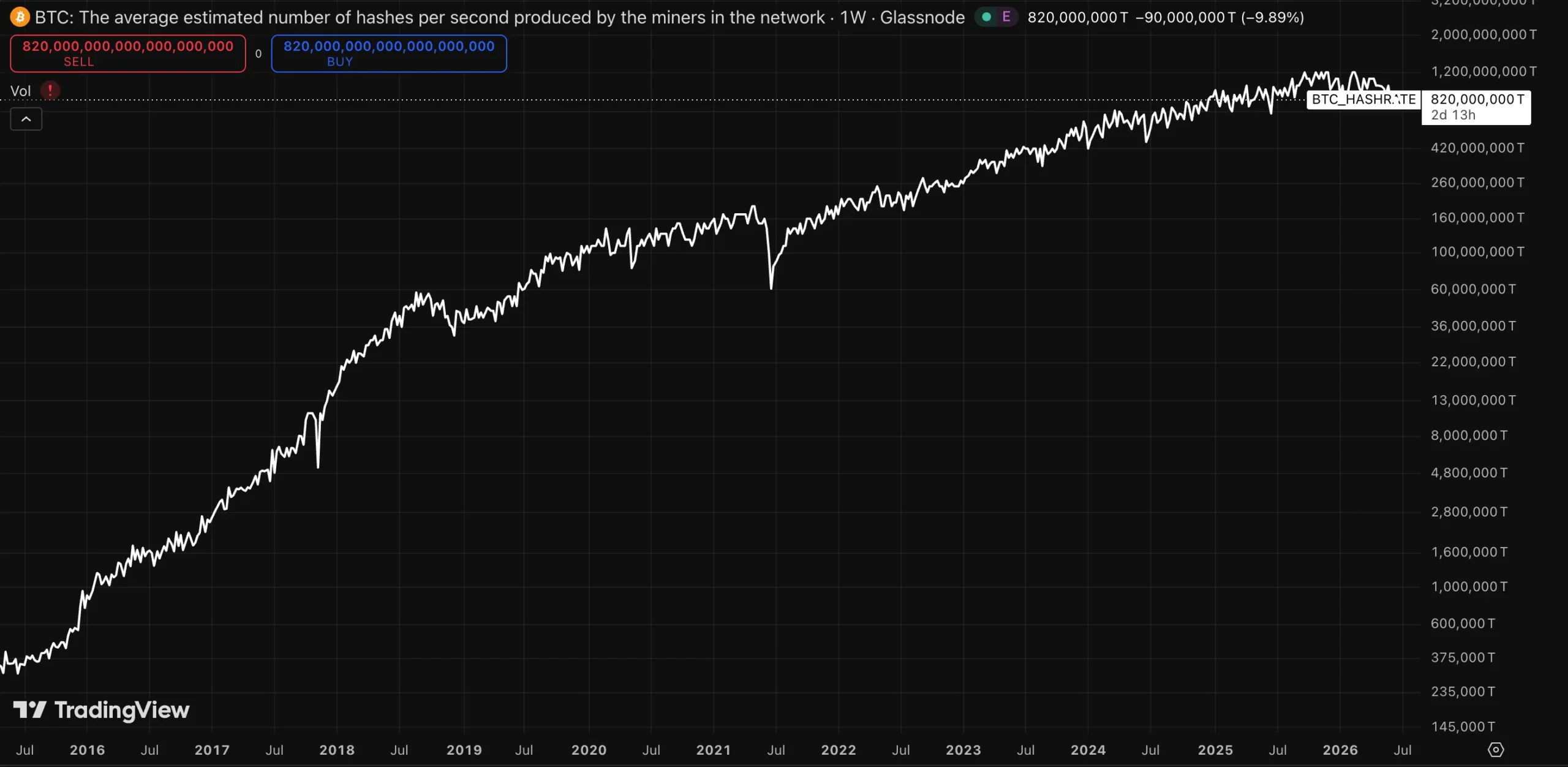
That security has compounded over time. The chart below plots Bitcoin’s network hash rate, the total computing power securing the chain, which has climbed by orders of magnitude since 2016. The more hashing power defending the network, the more expensive any attack on it becomes, which is a core part of why holders trust the ledger to stay intact.
The “does Bitcoin have intrinsic value?” question turns on how you define the term. If intrinsic value means cash flows, dividends, or productive output, Bitcoin doesn’t have it the way a business or rental property does. If it means useful monetary properties (scarcity, censorship resistance, and the ability to transfer value without a central intermediary) supporters argue Bitcoin has it in abundance. This is why Bitcoin is usually analyzed as a monetary asset rather than a conventional investment.
The Argument for Bitcoin as a Store of Value
The case for Bitcoin as a store of value rests on a handful of core properties.
Bitcoin propertyStore-of-value relevanceFixed supplyLimits monetary debasementDigital portabilityEasier to move than gold or real estateDivisibilityCan be split into small unitsSelf-custodyReduces reliance on banks or custodiansGlobal marketTrades across many jurisdictionsDecentralizationNo single issuer controls monetary policyLiquidityCan be exchanged on many venuesNetwork effectsWider adoption may strengthen recognitionBitcoin propertyFixed supplyStore-of-value relevanceLimits monetary debasementBitcoin propertyDigital portabilityStore-of-value relevanceEasier to move than gold or real estateBitcoin propertyDivisibilityStore-of-value relevanceCan be split into small unitsBitcoin propertySelf-custodyStore-of-value relevanceReduces reliance on banks or custodiansBitcoin propertyGlobal marketStore-of-value relevanceTrades across many jurisdictionsBitcoin propertyDecentralizationStore-of-value relevanceNo single issuer controls monetary policyBitcoin propertyLiquidityStore-of-value relevanceCan be exchanged on many venuesBitcoin propertyNetwork effectsStore-of-value relevanceWider adoption may strengthen recognition
Fixed supply and scarcity
Bitcoin’s most famous monetary property is its fixed supply: there will only ever be 21 million BTC, issued on a transparent schedule that steadily slows through halving events. Many stores of value are judged partly by how hard they are to produce more of: gold because mining is slow and expensive, prime real estate because desirable land is finite. Bitcoin’s scarcity is enforced instead by code, network consensus, and the rules its nodes follow. Supporters argue that predictable scarcity is uniquely valuable in a world where central banks can expand fiat at will.
Decentralization and censorship resistance
Bitcoin is issued by no government, company, or central bank; it runs on a decentralized network that validates transactions and enforces the protocol’s rules. No single authority can easily change the supply cap, freeze the whole network, or mint new BTC outside the rules. For people worried about capital controls, banking restrictions, currency instability, or third-party seizure, that design is much of the appeal. Decentralization removes some risks but not all. Individuals can still lose access through poor custody, scams, phishing, exchange failures, or local legal restrictions.
Portability and divisibility
Being digital makes Bitcoin highly portable. Unlike physical gold or real estate, it crosses borders without moving an object or relying on a title registry. It is also deeply divisible: one bitcoin splits into 100 million satoshis, making it far easier to transfer in small amounts than a gold bar or a building. Those two traits are why Bitcoin gets described as internet-native money.
Self-custody
Bitcoin can be self-custodied, meaning users can hold it directly with private keys rather than leaning entirely on a bank, broker, or vault. For many holders, that’s the heart of the thesis: if a store of value depends on a third party that can freeze, restrict, or lose it, the holder never had full control. The flip side is responsibility: lose your private keys or seed phrase, and the Bitcoin can be gone for good. Self-custody trades counterparty risk for the burden of secure key management.
Liquidity and global access
Bitcoin trades globally, around the clock, through a wide range of wallets, exchanges, and custody services. People in different countries reach the same network, and BTC moves across borders more easily than most traditional assets. Liquidity still varies with region, regulation, and market conditions, and sharp price moves can strike during periods of stress.
Network effects and adoption
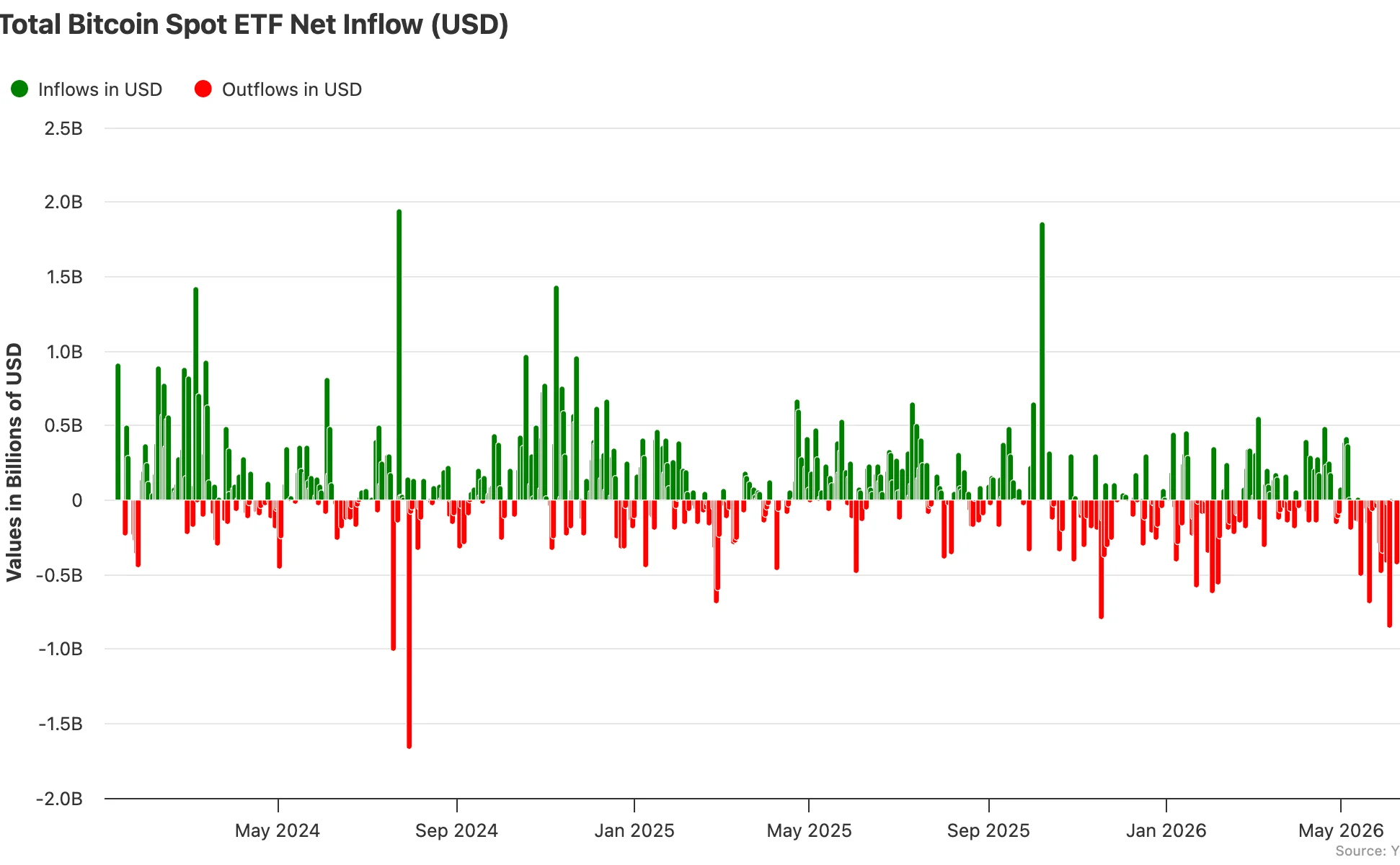
A monetary asset grows more useful as more people recognize, accept, and build around it. Bitcoin benefits from network effects: more users, miners, developers, exchanges, wallets, and institutional products deepen its utility and recognition. One of the clearest recent signals of that institutional adoption is the spot Bitcoin ETF. The chart below shows daily net flows into these funds: large green inflows interspersed with red outflow days, evidence of deepening institutional participation, though the two-way nature of the bars is a reminder that this demand can reverse as quickly as it arrives.
None of that guarantees future value, but it explains why supporters say Bitcoin’s scarcity is as much social and economic as it is technical: copying the code does not copy the network, security, liquidity, brand, or history.
The Argument Against Bitcoin as a Store of Value
The case against is equally serious, and a credible explainer has to give it real weight. Bitcoin is volatile, speculative, relatively young, exposed to regulatory uncertainty, and hard for some people to custody safely. Plenty of seasoned investors remain unconvinced. Warren Buffett, no fan, once dismissed it as “probably rat poison squared.”
CriticismWhy it mattersCounterpointHigh volatilityValue can fall sharplyLong-term holders focus on multi-year periodsYoung assetLess proven than goldBitcoin has survived multiple cyclesSpeculationPrice may be driven by hypeSpeculation also occurs in gold, real estate, and stocksNo cash flowNo earnings or rentMonetary assets do not need cash flow in the same wayRegulatory riskRules can affect accessThe network itself is global and decentralizedCopycat coinsCode can be copiedNetwork effects and security are harder to copyCustody riskPrivate keys can be lostSelf-custody tools and education can reduce riskCriticismHigh volatilityWhy it mattersValue can fall sharplyCounterpointLong-term holders focus on multi-year periodsCriticismYoung assetWhy it mattersLess proven than goldCounterpointBitcoin has survived multiple cyclesCriticismSpeculationWhy it mattersPrice may be driven by hypeCounterpointSpeculation also occurs in gold, real estate, and stocksCriticismNo cash flowWhy it mattersNo earnings or rentCounterpointMonetary assets do not need cash flow in the same wayCriticismRegulatory riskWhy it mattersRules can affect accessCounterpointThe network itself is global and decentralizedCriticismCopycat coinsWhy it mattersCode can be copiedCounterpointNetwork effects and security are harder to copyCriticismCustody riskWhy it mattersPrivate keys can be lostCounterpointSelf-custody tools and education can reduce risk
Volatility and drawdowns
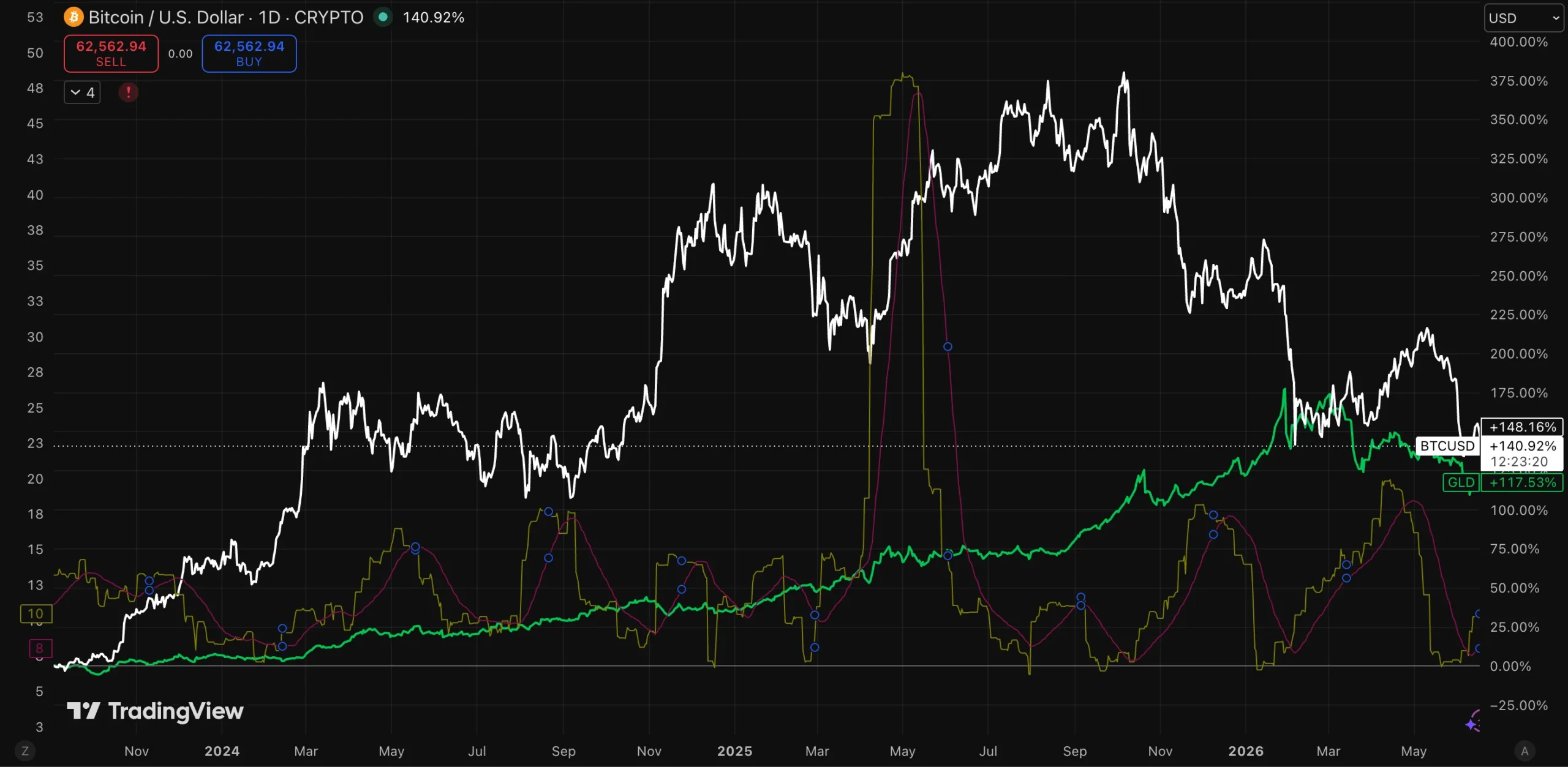
Volatility is Bitcoin’s biggest weakness as a store of value. Its price can swing dramatically over short and medium horizons, which strains the claim that it reliably preserves purchasing power at all times. The chart below makes that gap concrete: it tracks Bitcoin’s rolling 90-day volatility against the S&P 500 and gold, and Bitcoin’s swings repeatedly spike well above both, even as its long-run price has outrun them.
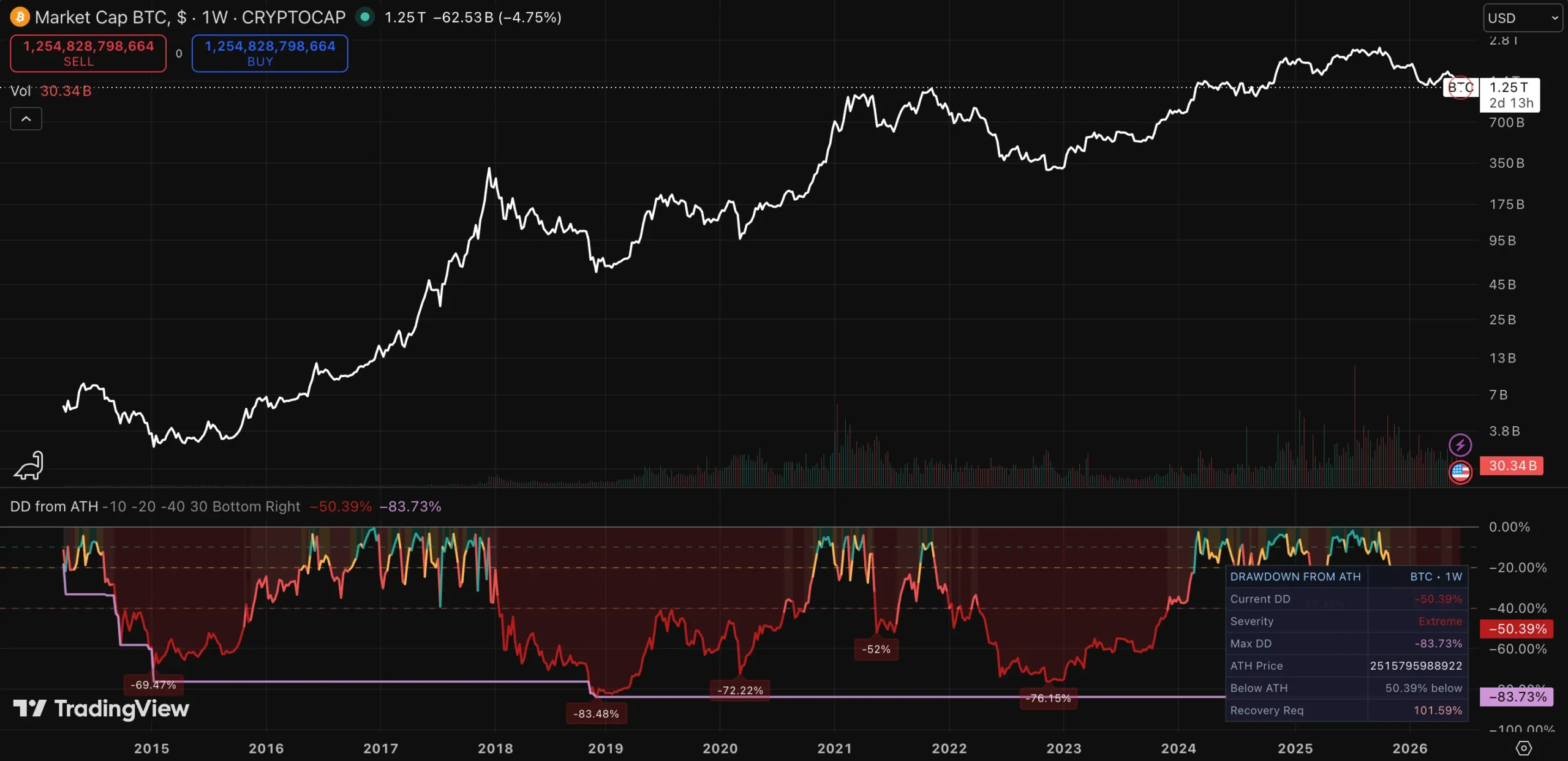
The wild ride cuts both ways: in 2010 someone famously paid 10,000 BTC for two pizzas, a sum that would later be worth hundreds of millions of dollars, but the same volatility that produced that story has also delivered brutal drawdowns inside every market cycle. Those swings show up as deep, recurring declines from prior highs. The chart below marks Bitcoin’s major peak-to-trough drawdowns, several of them in the 70–85% range, including drops of roughly 72%, 76%, and 83%. An asset that can lose three-quarters of its value and take years to recover is hard to lean on for stability over short horizons.
For anyone who might need to sell within weeks or months, that’s a genuine risk. Supporters frame the thesis as long-term and treat volatility as the price of a young, monetizing asset; skeptics reply that an asset whose purchasing power can crater exactly when people need stability is hard to call a reliable store of value. Both points hold, which is why Bitcoin is better understood as a long-term candidate than a low-volatility savings instrument.
Short history compared with gold
Gold has served as a store of value for thousands of years; real estate has preserved wealth across civilizations; major fiat currencies are deeply embedded in legal and financial systems. Bitcoin has existed only since 2009. It has weathered multiple market cycles, technical fights, exchange collapses, regulatory challenges, and waves of public skepticism, but it simply lacks gold’s track record. That’s why “emerging” store of value fits it better than “proven.”
Speculation and market cycles
Some Bitcoin demand comes from people betting the price will rise, and that speculative demand amplifies its cycles. Speculation doesn’t render an asset worthless (gold, real estate, stocks, art, and collectibles all attract it) but it does blur the line between long-term store-of-value demand and short-term momentum. A balanced view accepts that some holders use Bitcoin to store value while others trade it for the swings.
Regulatory and custody risks
The network is decentralized, but users still touch wallets, exchanges, tax systems, banks, and local laws. Regulation can shape access, taxation, reporting, custody, and liquidity. Custody is the other major hazard: people lose bitcoin by mishandling keys, falling for scams, using insecure devices, or leaving funds on platforms that fail. A traditional bank account is easier for many people, even though it means trusting a third party. Bitcoin hands users more control and, with it, more responsibility.
Bitcoin vs Gold as a Store of Value
Bitcoin gets compared to gold constantly, because both are scarce monetary assets that no central bank issues, which is exactly why Bitcoin is nicknamed “digital gold.” The comparison is useful but incomplete: gold is physical, ancient, widely understood, and less volatile, while Bitcoin is digital, newer, easier to move, easier to divide, and built for self-custody over the internet.
TraitBitcoinGoldSupplyFixed cap of 21 million BTCScarce, but new supply can be minedHistorySince 2009Thousands of yearsPortabilityDigital and easy to move globallyPhysical and costly to move in sizeDivisibilityHighly divisibleDivisible, but physical handling is harderLiquidityHigh, with 24/7 crypto marketsVery high, with mature global marketsVolatilityHighUsually lower than BitcoinCustodySelf-custody possible with private keysPhysical custody or vault/custodianSeizure resistanceStrong if self-custodied properlyPhysical gold can be seized or restrictedUse outside moneyMonetary networkJewelry, industry, and central bank reservesTraitSupplyBitcoinFixed cap of 21 million BTCGoldScarce, but new supply can be minedTraitHistoryBitcoinSince 2009GoldThousands of yearsTraitPortabilityBitcoinDigital and easy to move globallyGoldPhysical and costly to move in sizeTraitDivisibilityBitcoinHighly divisibleGoldDivisible, but physical handling is harderTraitLiquidityBitcoinHigh, with 24/7 crypto marketsGoldVery high, with mature global marketsTraitVolatilityBitcoinHighGoldUsually lower than BitcoinTraitCustodyBitcoinSelf-custody possible with private keysGoldPhysical custody or vault/custodianTraitSeizure resistanceBitcoinStrong if self-custodied properlyGoldPhysical gold can be seized or restrictedTraitUse outside moneyBitcoinMonetary networkGoldJewelry, industry, and central bank reserves
The stronger claim sidesteps “better than gold” entirely: Bitcoin offers a digital alternative for people who want gold-like scarcity with internet-native portability and self-custody. Gold answers with something Bitcoin can’t match, a multi-millennium record of trust.
Bitcoin vs Fiat Currency as a Store of Value
Fiat currency is government-issued money (the dollar, euro, yen, pound) and it’s usually the best tool for everyday spending, accounting, taxes, salaries, and short-term liquidity. As a store of value it’s a mixed bag: stable day to day and universally accepted, but vulnerable to inflation eroding its purchasing power over time.
TraitBitcoinFiat currencySupplyFixed capCan expand through monetary policyStabilityVolatile in market priceUsually stable day to dayInflation riskNo supply inflation after the cap, but price fluctuatesPurchasing power can fall with inflationDaily spendingLess widely acceptedHighly acceptedControlDecentralized networkIssued by governments and central banksCustodySelf-custody possibleUsually held through banks or payment appsLegal statusVaries by jurisdictionLegal tender in issuing countryTraitSupplyBitcoinFixed capFiat currencyCan expand through monetary policyTraitStabilityBitcoinVolatile in market priceFiat currencyUsually stable day to dayTraitInflation riskBitcoinNo supply inflation after the cap, but price fluctuatesFiat currencyPurchasing power can fall with inflationTraitDaily spendingBitcoinLess widely acceptedFiat currencyHighly acceptedTraitControlBitcoinDecentralized networkFiat currencyIssued by governments and central banksTraitCustodyBitcoinSelf-custody possibleFiat currencyUsually held through banks or payment appsTraitLegal statusBitcoinVaries by jurisdictionFiat currencyLegal tender in issuing country
The two end up playing different roles. Fiat is the better day-to-day money. Bitcoin’s pitch is long-term scarcity and independence from monetary debasement, appealing to people who want an asset with a fixed supply and no central issuer.
Bitcoin vs Real Estate as a Store of Value
Real estate is one of the most common stores of value, and for good reason: it has obvious use value (you can live in it, rent it, or run a business from it) plus scarcity in desirable locations. As the line often attributed to Mark Twain goes, “Buy land, they’re not making any more of it.” Bitcoin makes a similar scarcity claim, but digitally and with a hard 21-million cap rather than a finite supply of dirt.
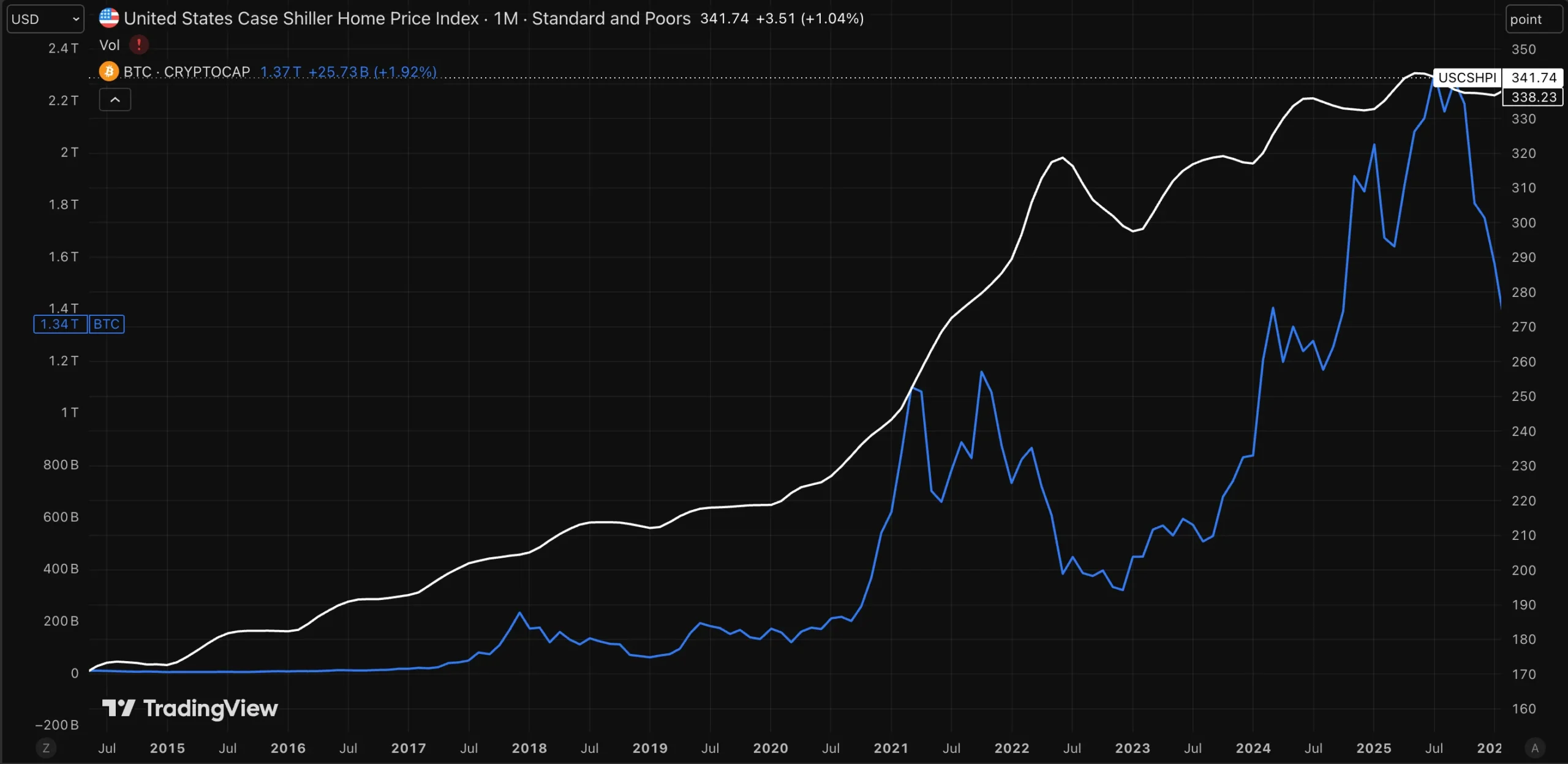
The contrast in how each behaves is easy to see when you put them side by side. The chart below sets Bitcoin’s market cap against the Case-Shiller US home price index over the past decade. The trajectories capture the trade-off this section is about: housing grinds upward in a relatively smooth line, while Bitcoin covers far more ground but in violent surges and pullbacks.
 TraitBitcoinReal estateLiquidityCan be sold quickly on exchangesOften slow to sellPortabilityDigital and globalFixed locationDivisibilityHighly divisibleHard to splitUtilityMonetary networkShelter, income, or use valueSupplyFixed capLimited by land, zoning, and constructionMaintenanceNo physical upkeepTaxes, repairs, and managementVolatilityHigh market volatilityUsually slower price changesCustody riskKey managementLegal, title, and property riskTraitLiquidityBitcoinCan be sold quickly on exchangesReal estateOften slow to sellTraitPortabilityBitcoinDigital and globalReal estateFixed locationTraitDivisibilityBitcoinHighly divisibleReal estateHard to splitTraitUtilityBitcoinMonetary networkReal estateShelter, income, or use valueTraitSupplyBitcoinFixed capReal estateLimited by land, zoning, and constructionTraitMaintenanceBitcoinNo physical upkeepReal estateTaxes, repairs, and managementTraitVolatilityBitcoinHigh market volatilityReal estateUsually slower price changesTraitCustody riskBitcoinKey managementReal estateLegal, title, and property risk
Real estate produces rental income, provides shelter, and benefits from local development, and it’s far more familiar to lenders and investors. Bitcoin needs no maintenance, moves globally, divides into tiny units, and self-custodies without a title registry. Neither is automatically superior; they solve different problems.
Is Bitcoin an Inflation Hedge?
Bitcoin’s fixed supply makes it attractive to people worried about inflation and currency debasement: no central bank can mint more BTC beyond the protocol’s rules, so supporters argue it can hedge monetary inflation over the long run. In practice, though, Bitcoin has not always behaved like a clean short-term inflation hedge.
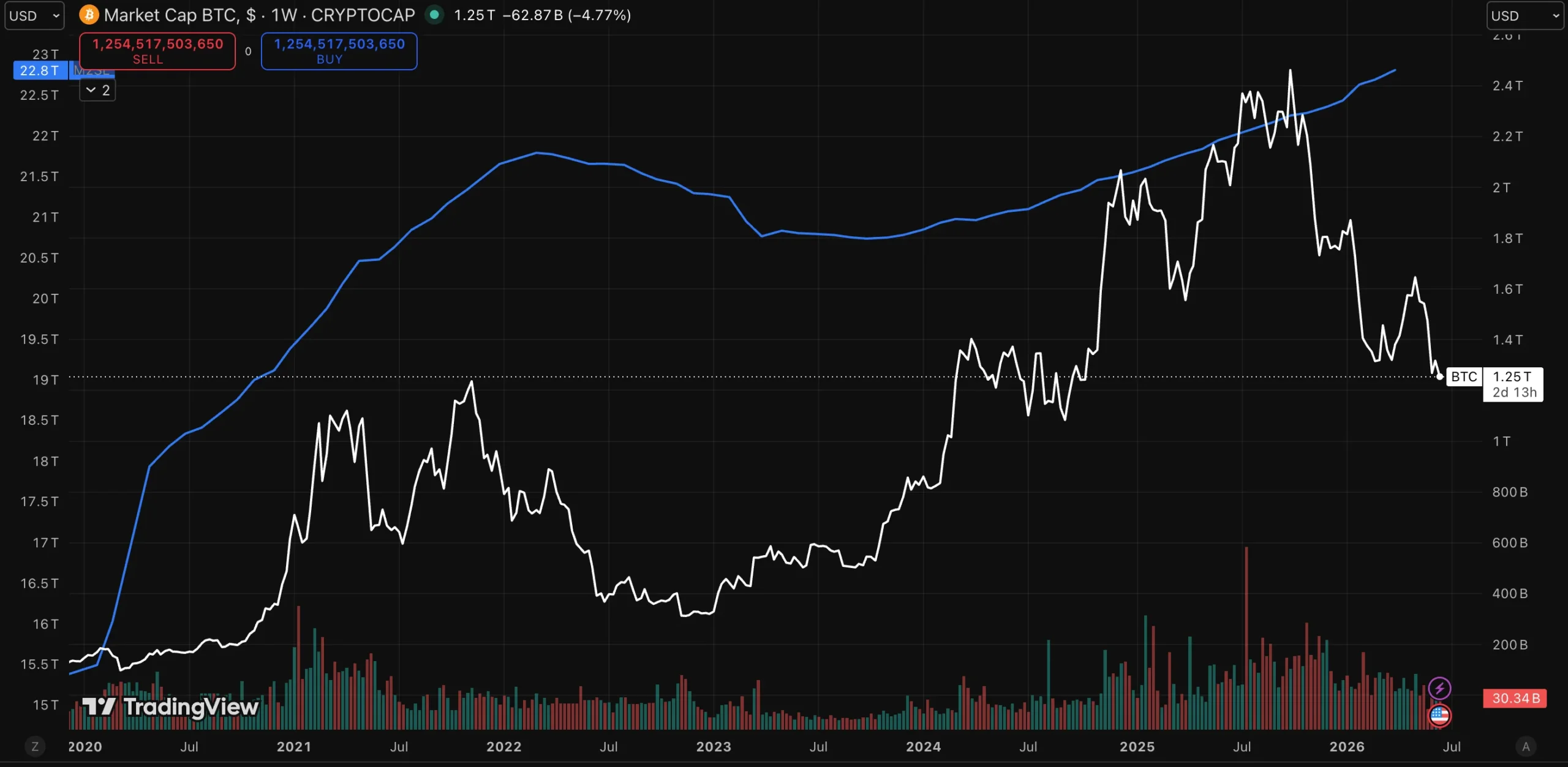
The chart below overlays global M2 money supply against Bitcoin’s market cap. M2 climbs in a relatively steady line as more currency enters the system, while Bitcoin trends higher over the long run but in jagged, volatile steps, a visual version of the point above: closer to a long-horizon debasement bet than a smooth, dependable inflation hedge.
“If I am forced to forecast, my bet is it will be the fastest horse. If you want to own the ultimate inflation hedge, you want to be the fastest horse.” | Paul Tudor Jones, hedge fund manager
ArgumentExplanationPro inflation-hedge caseBitcoin’s supply cannot be expanded by central banksCounterargumentBitcoin can fall during inflationary or risk-off periodsBetter framingBitcoin may be a long-term debasement hedge, not a guaranteed short-term inflation hedgeArgumentPro inflation-hedge caseExplanationBitcoin’s supply cannot be expanded by central banksArgumentCounterargumentExplanationBitcoin can fall during inflationary or risk-off periodsArgumentBetter framingExplanationBitcoin may be a long-term debasement hedge, not a guaranteed short-term inflation hedge
The key variable is time horizon. Over short periods, Bitcoin often trades like a risk asset. Over longer periods, some holders see it as protection against debasement because its supply schedule is fixed and transparent. None of that makes it risk-free, a fixed supply does not guarantee stable purchasing power.
Is Bitcoin “Digital Gold”?
Bitcoin earns the “digital gold” label because it shares gold-like monetary traits: scarce, durable in digital form, divisible, portable, and not issued by a central bank. The phrase has even won mainstream financial backing. Larry Fink, who runs the world’s largest asset manager, framed Bitcoin in terms that would once have been unthinkable from Wall Street:
“It is no different than what gold represented over thousands of years. It is an asset class that protects you. It is a flight to quality.” | Larry Fink, CEO of BlackRock
Read it as shorthand rather than a literal equivalence. Gold has the far longer track record, lower volatility, and demand from jewelry, industry, and central banks; Bitcoin is younger, more volatile, and dependent on digital infrastructure, but easier to transfer and divide and native to the internet. Bitcoin borrows some of gold’s scarcity logic and adds digital portability, programmability, and self-custody.
How to Use Bitcoin as a Store of Value
Holding Bitcoin as a store of value asks more of you than parking money in a bank account: education, risk awareness, and careful custody. Before treating it as long-term savings, it helps to run through a practical checklist.
- Treat education as your first investment: Don’t buy Bitcoin until you understand how private keys, network fees, and wallets actually work.
- Audit your time horizon: Only commit capital you won’t need to touch for at least three to five years, so you can ride out the volatility.
- Choose your custody model carefully: Decide whether the convenience of an ETF or exchange outweighs the security of learning to use a hardware wallet.
- Automate your buys: Dollar-cost averaging (buying small, fixed amounts on a regular schedule) strips the emotion out of timing the market.
- Plan for succession: If you self-custody, make sure someone you trust has clear instructions for accessing your seed phrase if something happens to you.
Where you actually keep your bitcoin involves a trade-off between convenience and control. The more someone else handles for you, the less you truly own, and vice versa.
Custody methodWho controls the keys?ProsConsBitcoin ETFWall Street custodianMaximum convenience, standard tax reportingNo direct ownership; you cannot move the BTCCrypto exchangeThe platformEasy to buy and sell, high liquidityRisk of exchange bankruptcy or account freezesHardware walletYou (self-custody)Absolute control, immune to bank runsLose your seed phrase and the wealth is gone for goodMultisig vaultShared (you + a partner or service)High security, no single point of failureTechnical to set up, slightly slower to transactCustody methodBitcoin ETFWho controls the keys?Wall Street custodianProsMaximum convenience, standard tax reportingConsNo direct ownership; you cannot move the BTCCustody methodCrypto exchangeWho controls the keys?The platformProsEasy to buy and sell, high liquidityConsRisk of exchange bankruptcy or account freezesCustody methodHardware walletWho controls the keys?You (self-custody)ProsAbsolute control, immune to bank runsConsLose your seed phrase and the wealth is gone for goodCustody methodMultisig vaultWho controls the keys?Shared (you + a partner or service)ProsHigh security, no single point of failureConsTechnical to set up, slightly slower to transact
People who treat Bitcoin as a long-term store of value tend to focus on secure storage, careful backups, and resisting short-term emotional decisions. Bitcoin should never be treated as risk-free, and none of this is investment advice. Anyone considering it should weigh the risks, local tax rules, and custody responsibilities first.
So, Is Bitcoin a Good Store of Value?
Bitcoin can be considered a potential or emerging store of value, especially for people who value fixed supply, portability, self-custody, censorship resistance, and resistance to monetary debasement. It is not a perfect one. Its volatility, short history, regulatory uncertainty, custody risks, and speculative market cycles make it behave differently from gold, fiat currency, and real estate.
Bitcoin may appeal as a store of value if you care about…Bitcoin may not fit if you need…Fixed supplyLow volatilitySelf-custodyGuaranteed purchasing-power stabilityPortabilityGovernment-backed legal tenderCensorship resistanceA long historical track recordGlobal liquiditySimple custodyDigital ownershipNo risk of loss from private keysBitcoin may appeal as a store of value if you care about…Fixed supplyBitcoin may not fit if you need…Low volatilityBitcoin may appeal as a store of value if you care about…Self-custodyBitcoin may not fit if you need…Guaranteed purchasing-power stabilityBitcoin may appeal as a store of value if you care about…PortabilityBitcoin may not fit if you need…Government-backed legal tenderBitcoin may appeal as a store of value if you care about…Censorship resistanceBitcoin may not fit if you need…A long historical track recordBitcoin may appeal as a store of value if you care about…Global liquidityBitcoin may not fit if you need…Simple custodyBitcoin may appeal as a store of value if you care about…Digital ownershipBitcoin may not fit if you need…No risk of loss from private keys
The most balanced conclusion is that Bitcoin is an emerging digital store-of-value asset, not a guaranteed safe haven. It carries powerful monetary properties alongside serious risks. For long-term holders, the appeal lies in scarcity, independence, and global access; for skeptics, the volatility and short track record keep it too uncertain to call reliable. Both views belong in the debate.