
Bond Market Turmoil in Japan Sparks New Warnings on US Fiscal Stability, Bitwise Says
Japanese government bond markets plunged into rare disorder as long-term yields spiked to levels unseen in decades. Asset manager Bitwise warned on Jan. 20 that the violent repricing in Japan’s debt market exposes deep structural vulnerabilities and signals that the U.S. fiscal path may be equally exposed as borrowing costs rise.
Bitwise’s director and European head of research, André Dragosch, stated on social media platform X:
“Japanese bonds are literally crashing this morning.”
The comment came as investors rapidly dumped Japanese government bonds across the curve. A long-term chart shared by the Bitwise European head of research, stretching back to 1980, highlighted the scale of the dislocation, showing Japanese government bond prices breaking sharply lower and marking a decisive rupture from the ultra-low yield regime that had defined the market for more than two decades.
Stress was most acute at the long end of the curve. A separate Bloomberg chart circulated by market commentator Holger Zschäpitz showed 30-year Japanese government bond yields surging to 3.863%, a jump of roughly 26 basis points on the session that pushed rates toward the 4% threshold and reinforced fears that fiscal credibility was eroding rapidly.
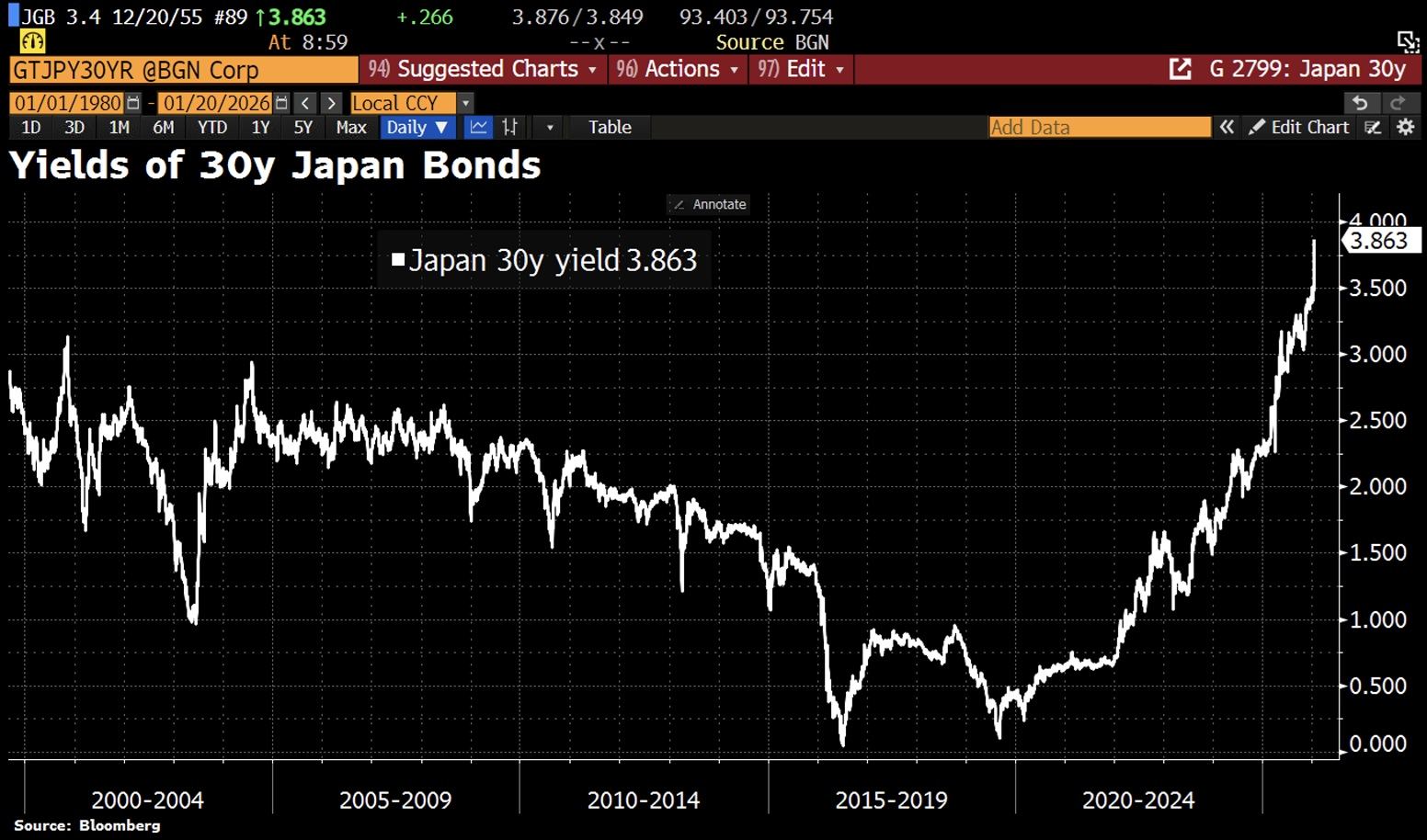
Zschäpitz directly linked the sell-off to fiscal concerns, writing on X:
“The slump in Japanese bonds deepened, sending yields soaring to records as investors gave a thumbs down to PM Sanae Takaichi’s election pitch to cut taxes on food. Japan’s 30y yields rocketed 26bps towards 4%.”
The turmoil in Japan has sharpened attention on broader sovereign risk, particularly in the United States. In a separate post on X, Dragosch wrote: “The GS US inflation Comeback equity index is going parabolic,” pointing to accelerating inflation sensitivity in U.S. equity markets.
He later compared fiscal dynamics across advanced economies, noting that rising interest burdens are increasingly constraining government finances. Data cited alongside those remarks showed U.S. net interest outlays projected near $970 billion for fiscal 2025, equivalent to about 14% of government expenditures, compared with Japan’s estimated 9.1%. As Japan’s bond market shock reverberates globally, the combination of higher yields, expanding deficits, and rising debt servicing costs is forcing investors to reassess assumptions about fiscal resilience, culminating in Dragosch’s warning:
“Contrary to public opinion, the current US fiscal situation is not better than Japan’s.”
FAQ 🧭
- Why did Japanese government bond markets experience a sudden sell-off?
Japanese government bonds sold off sharply as long-term yields spiked toward 4%, signaling a break from decades of ultra-low rates and raising investor fears over fiscal credibility and debt sustainability. - What does the surge in Japan’s 30-year yields mean for investors?
The jump in 30-year Japanese yields to nearly 3.9% reflects rising risk premiums, threatening bond prices, increasing government borrowing costs, and pressuring equity and currency markets. - How is Japan’s bond market turmoil linked to U.S. fiscal risk?
Asset managers warn Japan’s debt shock highlights similar vulnerabilities in the U.S., where rising interest rates and expanding deficits are pushing net interest costs toward $1 trillion annually. - Why are rising interest expenses a red flag for global sovereign markets?
Higher debt servicing costs reduce fiscal flexibility, weaken confidence in government finances, and increase the risk of market instability across highly indebted economies.