“Decentralized exchanges have evolved into two distinct models: Spot DEXs that enable direct ownership of crypto assets, and Perp DEXs that provide leveraged exposure through perpetual contracts. This article breaks down how both types work, their respective benefits and risks, and how they interact to form the backbone of on-chain trading in 2026.”
Start trading and managing crypto securely – download the Bitcoin.com Wallet app to access both Spot and Perp DEXs directly from your self-custodial wallet.
Overview – The Two Pillars of On-Chain Trading
Decentralized exchanges (DEXs) have evolved into two dominant categories: Spot DEXs, such as Uniswap, SushiSwap, and Curve, and Perpetual DEXs, such as GMX, dYdX, Hyperliquid, and Drift.
The distinction reflects two different trading intents:
- Spot traders seek ownership of assets for investment, yield, or utility.
- Perp traders seek exposure to price movements – both upward and downward – often using leverage.
By 2026, Perp DEXs have become a core component of the on-chain economy, processing more than $15 billion in daily derivatives volume, while spot DEXs handle more than $30 billion in swaps and liquidity provisioning across Ethereum, Solana, and other networks.
Understanding how these two models differ – and complement each other – is essential for navigating decentralized markets responsibly.
How Spot DEXs Work
Spot DEXs are the foundation of decentralized finance (DeFi). They allow users to swap one asset for another instantly through liquidity pools or order books, using smart contracts instead of centralized custodians.
When you buy Bitcoin or Ethereum on a Spot DEX, the trade occurs directly between you and the protocol – not a company. You take immediate ownership of the asset, which is then stored in your wallet.
Mechanics
- AMM-Based Model: Most Spot DEXs, including Uniswap, SushiSwap, and Curve, use automated market makers (AMMs). Liquidity providers (LPs) deposit token pairs (e.g., ETH/USDC), and the protocol automatically prices trades using a formula such as x * y = k.
- Order-Book Model: Some advanced DEXs like Serum and Raydium (on Solana) use order books similar to traditional exchanges, offering more precision but requiring faster networks.
Use Cases
- Acquiring crypto assets for long-term holding or staking.
- Providing liquidity to earn trading fees.
- Accessing tokens unavailable on centralized exchanges.
Spot DEXs are simple, transparent, and user-controlled, but they do not provide leveraged trading or short exposure.
How Perp DEXs Work
Perp DEXs extend DeFi into derivatives trading. They let users speculate on asset prices without owning the asset itself, using perpetual contracts.
Mechanics
- Traders deposit collateral (e.g., USDC, USDT, or ETH).
- The smart contract creates a synthetic position tied to the asset’s price.
- Funding rates align the perpetual price with the spot market.
- Positions remain open indefinitely until the trader closes or is liquidated.
Examples include:
- GMX and Level Finance using AMM liquidity pools.
- dYdX v4, Hyperliquid, and Reya using on-chain order books.
- Drift, MUX, Avantis, and Ethereal using hybrid or aggregated models.
Use Cases
- Hedging long-term portfolios.
- Speculating on price direction with leverage.
- Gaining synthetic exposure to assets without holding them.
Key Differences Between Perp DEXs and Spot DEXs
| Feature | Spot DEX | Perp DEX |
|---|---|---|
| Asset Ownership | Yes — you receive tokens directly | No — exposure through derivative contracts |
| Leverage | None | Up to 100x (depending on platform) |
| Expiration | Immediate settlement | No expiry (perpetual) |
| Funding Mechanism | Not applicable | Funding rate keeps price near spot |
| Collateral Type | Traded asset pair (e.g., ETH/USDC) | Stablecoins or crypto used as margin |
| Risk | Market volatility only | Market + liquidation + funding risk |
| Liquidity Source | AMMs or order books | AMMs, oracles, or hybrid routing |
| Primary Purpose | Exchange and ownership | Speculation and hedging |
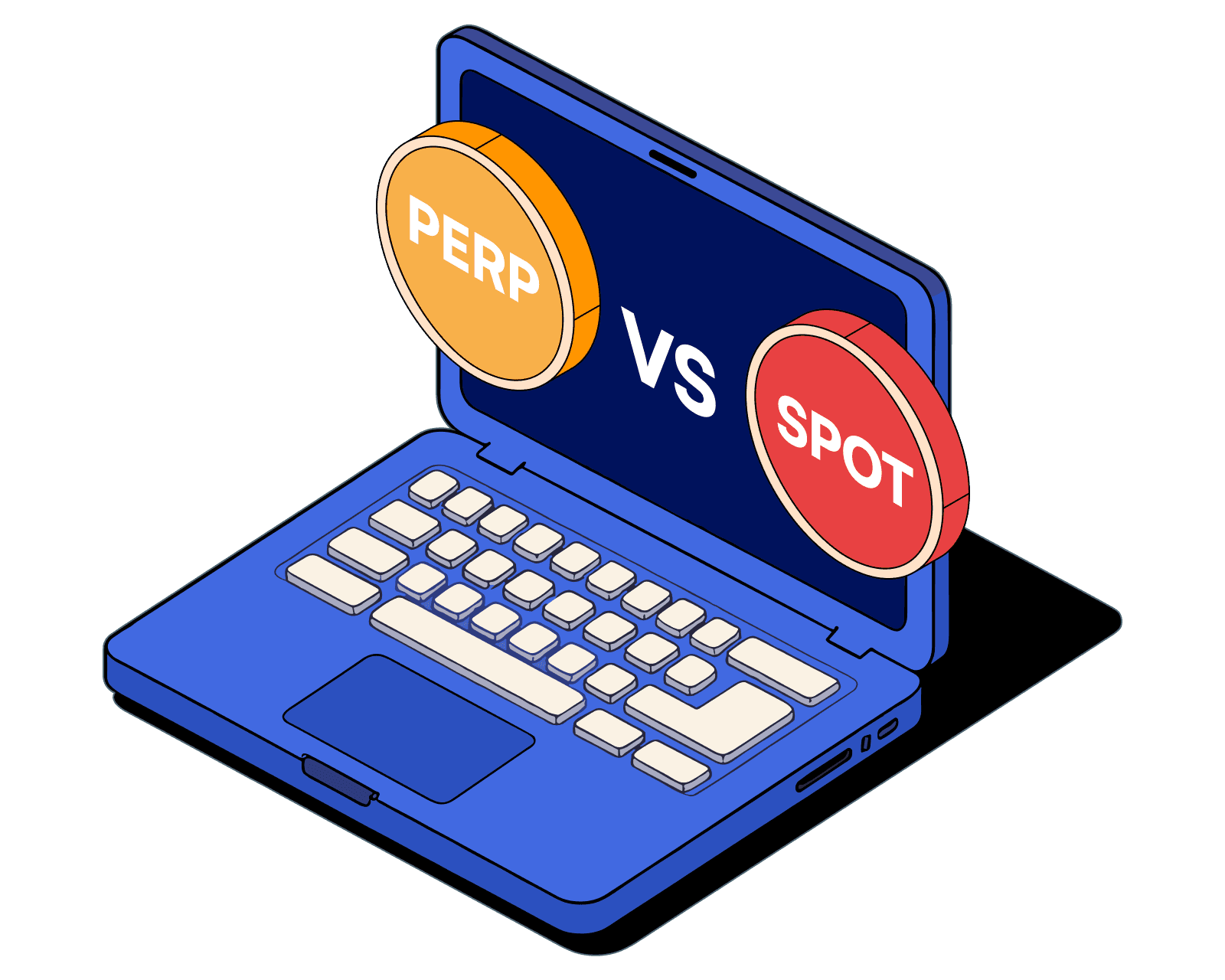
This comparison underscores the ownership vs. exposure dichotomy at the heart of DeFi trading. Spot DEXs are built for asset accumulation and liquidity; Perp DEXs are engineered for leveraged speculation and risk management.
When to Use Each Type
Use a Spot DEX if You:
- Want to own the underlying asset.
- Are engaging in staking, yield farming, or governance participation.
- Prefer low-risk, no-liquidation environments.
Use a Perp DEX if You:
- Want to speculate on price movements without holding the asset.
- Need to hedge exposure using short positions.
- Understand how leverage and liquidation mechanics work.
For instance, a trader who holds Bitcoin long-term might short BTC-PERP on Hyperliquid or GMX to hedge temporary downside risk. Conversely, a new investor looking to build a portfolio might use Uniswap or Jupiter to accumulate assets over time.
Interconnection Between Perp and Spot Markets
Perpetual and spot markets are not isolated – they are deeply intertwined:
- Price Discovery:
Spot markets establish the base price that perpetual contracts follow through oracle feeds. - Liquidity Flow:
Traders often arbitrage between Perp and Spot DEXs to capture price imbalances, tightening spreads. - Funding Alignment:
Funding rates ensure perpetual prices remain close to spot. If the perpetual premium widens, arbitrageurs short the perp and buy spot until equilibrium returns.
This dynamic relationship keeps DeFi markets efficient and synchronized across layers and liquidity pools.
Examples of Leading Platforms (2026)
| Category | Platform | Model | Notable Feature |
|---|---|---|---|
| Spot DEX | Uniswap | AMM | Largest on-chain liquidity network |
| Spot DEX | Curve | AMM | Optimized for stablecoin swaps |
| Spot DEX | Jupiter | Aggregator | Routes liquidity across Solana DEXs |
| Spot DEX | SushiSwap | AMM | Multi-chain spot liquidity |
| Perp DEX | GMX | AMM | Decentralized perpetuals with GLP liquidity |
| Perp DEX | dYdX v4 | Order-book | Fully decentralized appchain |
| Perp DEX | Hyperliquid | Order-book | High-performance Layer 1 engine |
| Perp DEX | Drift | Hybrid | On-chain liquidity plus order matching |
| Perp DEX | Aster | AMM | Focused on altcoin perpetual markets |
| Perp DEX | MUX Protocol | Aggregator | Unified margin and cross-chain routing |
Risks and Considerations
Spot DEX Risks:
- Impermanent loss for liquidity providers.
- Slippage during high volatility.
- Smart contract vulnerabilities.
Perp DEX Risks:
- Liquidation and leverage risk.
- Funding rate fluctuations.
- Oracle and contract exploits.
Risk management is essential when transitioning between spot and perpetual trading environments.
Why Both Matter to DeFi
Spot and perpetual exchanges serve complementary purposes in the decentralized economy. Spot DEXs anchor the ecosystem by enabling asset exchange, liquidity formation, and price discovery, while Perp DEXs add depth, hedging tools, and capital efficiency.
Together, they form the dual backbone of decentralized finance – one built on ownership, the other on exposure. As technology advances, cross-margin systems and on-chain derivatives aggregation may further blur the line between the two, giving traders unified control over both spot and perpetual portfolios.