
Home » Taiko Halts Withdrawals as Hackers Pull $1.7M Through Bridge Validation Flaw

Taiko Halts Withdrawals as Hackers Pull $1.7M Through Bridge Validation Flaw

Taiko Halts Withdrawals as Hackers Pull $1.7M Through Bridge Validation Flaw 1

Technical Flaw Leads to $1.7 Million Loss

Ethereum scaling solution Taiko confirmed June 22 that its chain state verification mechanism had been compromised. As a consequence, the “security assumptions” of all bridges deployed on the platform can no longer be relied upon, Taiko said in a statement.
Taiko Halts Withdrawals as Hackers Pull $1.7M Through Bridge Validation Flaw 2

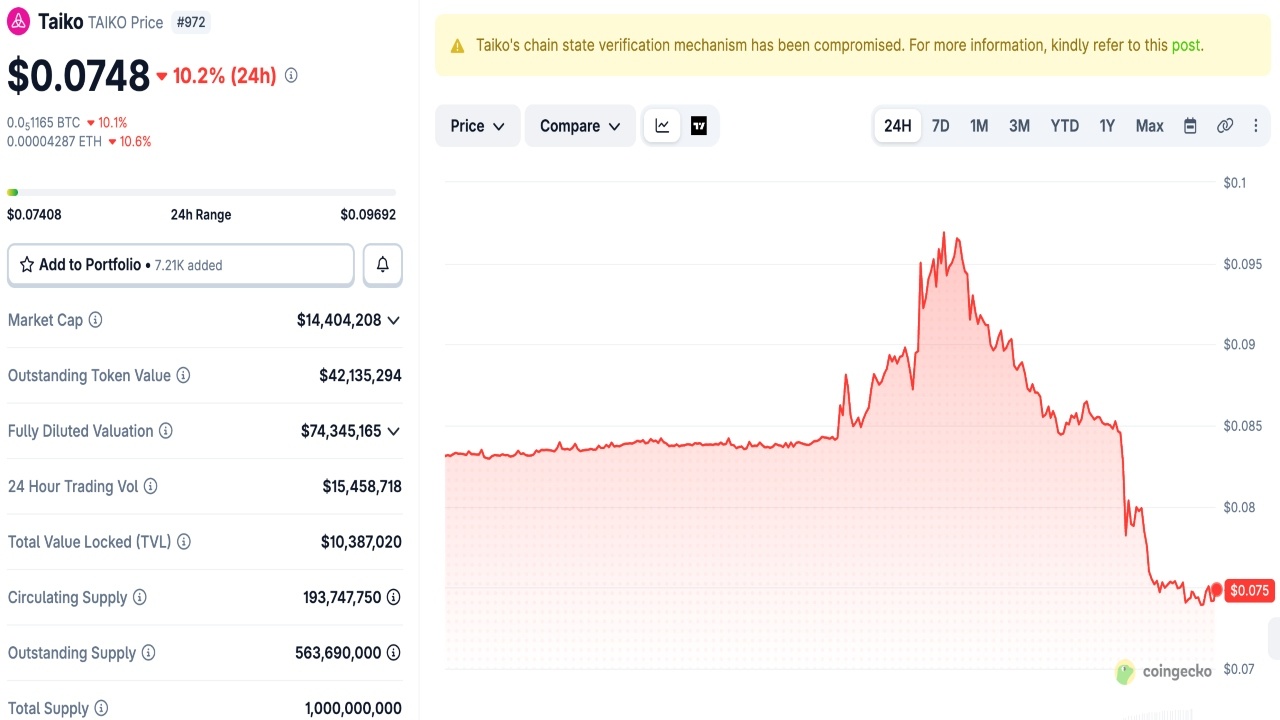
On Coingecko, the platform token initially appeared to surge on the news, rising from $0.0842 to nearly $0.097 before sliding to $0.075 cents, a drop of approximately 10%. However, according to one social media user, Vietnam Penguin, the token went as high as $0.0133 —an approximately 100% jump—before it began descending.

In a post on X, Taiko said it was working with partners to contain the fallout and identify the culprits.

“We are actively coordinating with the Security Council and ecosystem partners to contain the incident, pause affected systems where possible, and take all necessary technical and legal action. We strongly advise all users to withdraw their funds from all bridges deployed on Taiko immediately,” Taiko said.

However, in a later update, Taiko claimed that the incident had been contained after it fully stopped withdrawals via the bridge and the ERC-20 vault. As a result, Taiko said users do not need to take action and its earlier advice to withdraw no longer stands. Nevertheless, the request to centralized exchanges to suspend TAIKO deposits remains in place.

The exploit, which blockchain security firms attribute to a flaw in Taiko’s bridge source-signal proof validation, allowed attackers to bypass normal validation protocols. By submitting crafted message proofs that were mistakenly accepted as valid on the Ethereum layer-1 network, the hackers initiated unauthorized withdrawals, draining an estimated $1.7 million from Taiko’s ERC-20 vault.

Meanwhile, the incident highlights how proof verification has become the primary attack surface for layer-2 bridges. According to X user Master of Crypto, the Taiko exploit was unique because it was a fundamental design flaw rather than a traditional hack.


Related Articles

El Salvador Keeps Stacking: 8 BTC Added in a Week as Reserve Tops 7,689 BTC 1

El Salvador Keeps Stacking: 8 BTC Added in a Week as Reserve Tops 7,689 BTC

Buying the Dip, Every Day The latest additions, tracked through the country’s official bitcoin reserve data, bring El Salvador’s stack

A whale just opened $48 million in shorts against Bitcoin, Solana, and Ethereum. 1

A whale just opened $48 million in shorts against Bitcoin, Solana, and Ethereum.

Anatomy of the Bet Onchain analytics firm Lookonchain reported that the wallet, labeled 0xaeaa, moved 6.68 million USDC onto Hyperliquid

FDIC: US Banks Report $80 Billion in Profit as Unrealized Losses Rise to $325 Billion 1

FDIC: US Banks Report $80 Billion in Profit as Unrealized Losses Rise to $325 Billion

A Growing Paper Loss The Federal Deposit Insurance Corporation (FDIC) said total unrealized losses climbed $19.0 billion, or 6.2%, from

Why Lummis Says the CLARITY Act Will End the 'Absurdity' Facing US Software Developers 1

Why Lummis Says the CLARITY Act Will End the ‘Absurdity’ Facing US Software Developers

Developers in the Crosshairs Lummis made her case via a statement shared on June 22, singling out the legal exposure

Bitcoin Steadies Around $64,000 as US and Iran Agree on Roadmap to a Final Deal Within 60 Days 1

Bitcoin Steadies Around $64,000 as US and Iran Agree on Roadmap to a Final Deal Within 60 Days

A 60-Day Window The two mediators said a high-level committee agreed on a roadmap toward reaching a final deal within

Base Activates Beryl Upgrade June 25 as B20 Token Standard Goes Live 1

B20 Token Standard Enhances Base Upgrade

A New Native Token Standard The upgrade introduces B20, a new native token standard built directly into the node software