
Chile Shuts Down $88 Million Crypto Money Laundering Group Linked To Tren de Aragua
A two-year investigation has resulted in the arrest of 18 individuals who operated a scheme that included crypto assets to launder the proceeds of illicit activities or the Venezuelan Tren de Aragua gang in Chile.
The operation, executed on Tuesday by the Chilean police and the Southern Prosecutor’s Office, was carried out in three regions of the country and uncovered a complex network of bank accounts, irregular companies, and cryptocurrency remittances.
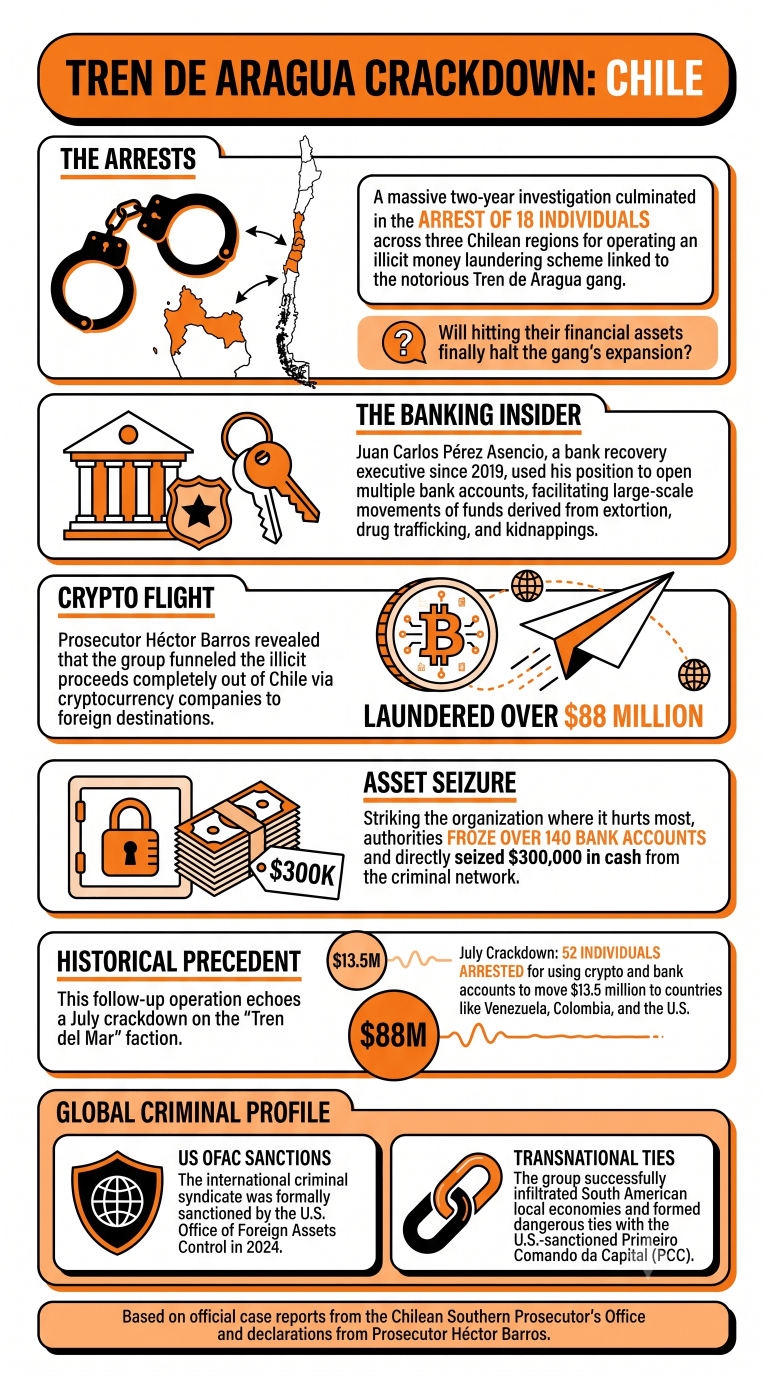
Juan Carlos Pérez Asencio, a Venezuelan national who served as Banco Santander’s recovery executive since 2019, played an important role in providing the group’s tools to effectively carry out its operation.
Local reports indicated that Pérez Asencio opened several bank accounts for the group, which allowed it to execute large transactions whose funds came from drug trafficking, extortion, prostitution, and kidnappings.
Héctor Barros, the prosecutor in charge of the case, stated that the group had laundered over $88 million, declaring this was “one of the largest money laundering cases we have seen in our country, linked to the Tren de Aragua.” “I would say this is the first time we have hit them where it hurts the most: their assets,” he added.
Barros specified that these funds “left our country via cryptocurrency companies, heading to other countries.” During the action, over 140 bank accounts were frozen and $300K was seized from the group.
The action follows another high-profile operation executed in July, when Chilean authorities also disrupted a group called “Tren del Mar.” At that time, 52 individuals were arrested for using bank accounts and cryptocurrency to launder an estimated $13.5 million and move these funds to Venezuela, Colombia, the U.S., Paraguay, Mexico, Spain, and Argentina.
Tren de Aragua, an international criminal group with Venezuelan origins, was sanctioned by the U.S. Office of Foreign Assets Control (OFAC) in 2024. The office stated that the group “infiltrated local criminal economies in South America, established transnational financial operations, laundered funds through cryptocurrency, and formed ties with the U.S.-sanctioned Primeiro Comando da Capital (PCC).”