

Navigating Through Bitcoin’s Imminent Reward Halving
As of now, fewer than 2,900 blocks remain until the forthcoming Bitcoin halving event. To grasp the concept of halving, it’s beneficial to first understand how new bitcoins come into existence, primarily through the process of bitcoin mining.
This involves entities, known as miners, validating blocks packed with transactions awaiting confirmation. In their pursuit to secure bitcoin rewards, miners engage in a computational contest, applying their processing power in a method referred to as ‘Proof-of-Work’ ( PoW).
Upon successfully discovering a block and validating the held transfers, miners are rewarded with 6.25 newly created bitcoins, in addition to collecting transaction fees from each transfer processed. While the discovery of blocks occurs on average every ten minutes, this duration can vary.
The Bitcoin halving, embedded within the network’s framework, is designed to regulate the currency’s supply, occurring once every 210,000 blocks, or around every four years. Initially, when Satoshi Nakamoto introduced the Bitcoin protocol, miners were awarded 50 BTC for each block discovered, up until Nov. 28, 2012.
Subsequently, this reward was halved to 25 BTC per block. Following another 210,000 blocks, with blocks emerging roughly every ten minutes or so, the reward was further reduced to 12.5 bitcoins on July 9, 2016. The most recent halving, which took place on May 11, 2020, saw the block reward decrease to the current rate of 6.25 bitcoins.
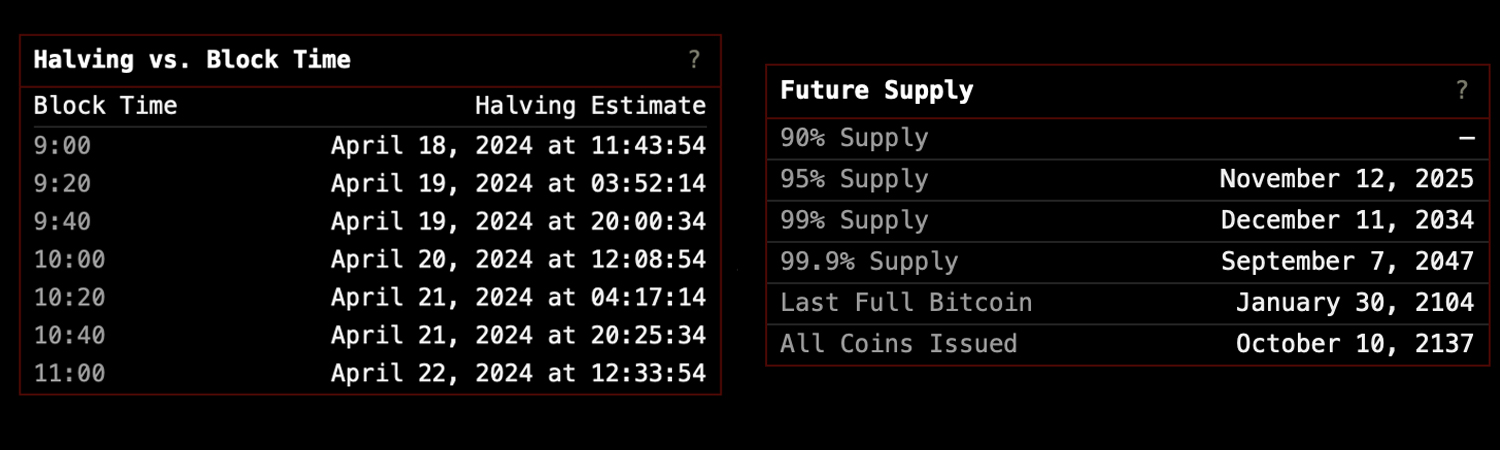
The countdown to the fourth halving ticks on, with the 210,000th block since block 630,000 marking its onset at block 840,000. Armed with data and the average timing of block creation, we’re able to narrow down the expected date of the halving with considerable accuracy. Traditionally set at a ten-minute interval, the halving is poised to happen around April 20.
However, with blocks being mined at a slightly quicker pace, the significant event could shift to as early as April 17, possibly even sooner. As the halving approaches, predictions become increasingly precise, right up to the final block. Post-halving, miners will see their rewards halved from 6.25 to 3.125 bitcoins per block, a steep drop from the current daily total of about 900 BTC to 450 BTC.
With today’s figures, that equates to a drop in daily earnings from $62.72 million to $31.36 million, assuming prices stayed the same ($69.9K to $70.4K). Essentially, the halving’s primary function is to halve mining rewards every four years, which greatly impacts miners more than the average bitcoin user or holder. This reduction can lead to variations in the network’s hashrate as miners assess profitability.
The Bitcoin white paper highlights:
The steady addition of a constant amount of new coins is analogous to gold miners expending resources to add gold to circulation. In our case, it is CPU time and electricity that is expended.
For most, the halving is an event that can be observed from afar, tracked through online countdowns, signaling a deliberate slowdown in Bitcoin’s issuance. This introduces a deflationary element to Bitcoin’s economic structure. Since Bitcoin is a worldwide and borderless phenomenon, the halving event is observed across various time zones, celebrated globally.
Miners, meanwhile, face the strategic challenge of modernizing their equipment and possibly expanding operations to mitigate the impact of a 50% cut in revenue.
What do you think about the upcoming Bitcoin halving event? Share your thoughts and opinions about this subject in the comments section below.