Comparing $RAY and $UNI: Transaction Fees and Market Valuation
According to data from CryptoStreamHub, Raydium ($RAY) and Uniswap ($UNI) are two prominent decentralized exchanges (DEXs) that have been compared for their performance, transaction fees, and market valuations. Both tokens hold strong positions within the DeFi landscape, but $RAY stands out in specific metrics, particularly transaction fees and revenue distribution.
Key Transaction Fee Metrics: $RAY vs. $UNI
When looking at transaction fees, Raydium ($RAY) currently outpaces Uniswap ($UNI) across multiple timeframes, reflecting its strong user activity and revenue generation.
Timeframe
$RAY Transaction Fees
$UNI Transaction Fees
1 Day
$2.42 million
$1.32 million
7 Days
$17.62 million
$9.94 million
30 Days
$71.62 million
$42.32 million
These metrics indicate that Raydium consistently generates higher transaction fees compared to Uniswap. For example, in the past 30 days, Raydium’s transaction fees totaled $71.62 million, significantly surpassing Uniswap’s $42.32 million.
Revenue Sharing: An Edge for $RAY
One of the most notable distinctions between $RAY and $UNI is the revenue-sharing model. Raydium allocates a portion of its transaction fees back to its community, enhancing its appeal to holders and creating additional incentives for token ownership. Approximately 12% of the total transaction fees on Raydium are used for buybacks of $RAY from the open market. This buyback strategy helps stabilize and potentially increase $RAY’s value over time.
Uniswap, in contrast, does not currently distribute any transaction fees to $UNI holders, which may limit its appeal among investors seeking direct income or staking rewards. The absence of revenue-sharing mechanisms is a considerable factor that sets $RAY apart as a more community-centric platform.
Market Valuation: $RAY and $UNI
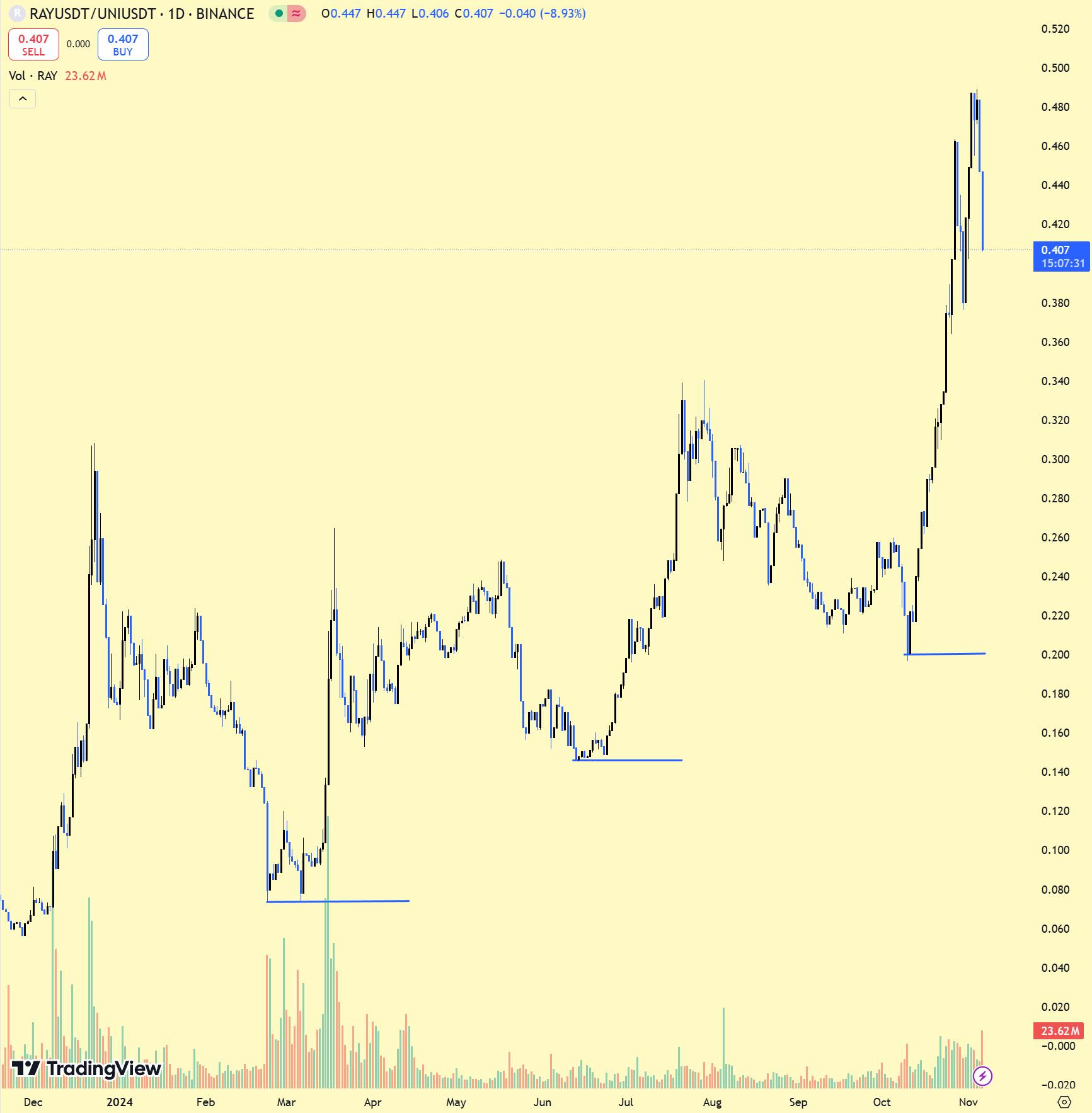
In terms of market valuation, $RAY and $UNI also diverge significantly. Despite its higher transaction fees, $RAY has a notably lower market cap than $UNI, suggesting potential upside for investors.
- $UNI Market Cap: $5 billion
- $UNI Fully Diluted Valuation (FDV): $8.6 billion
- $RAY Market Cap: $0.9 billion
- $RAY Fully Diluted Valuation (FDV): $1.9 billion
Even if $RAY were to quadruple in value, its market cap would still remain below that of $UNI, highlighting a valuation gap that may present an attractive opportunity for investors. This disparity suggests that $RAY’s market is currently undervalued, especially considering its higher transaction fee generation and community revenue-sharing model.
My Perspective on $RAY vs. $UNI
While $UNI remains a staple within the DeFi ecosystem, $RAY’s growing transaction volume and user-oriented revenue-sharing model set it apart as a compelling alternative. Raydium’s commitment to reinvesting transaction fees through buybacks enhances its potential for value appreciation and showcases its commitment to rewarding its community—a feature that $UNI lacks. This approach not only stabilizes $RAY’s value but also builds confidence among token holders and increases the appeal of long-term investment.
Conclusion: $RAY currently outperforms $UNI in daily transaction fees and offers a more favorable revenue-sharing model. With a significantly lower market cap, $RAY has the potential for further growth, making it an interesting option for investors seeking exposure to high-performing, community-oriented DEX tokens.
Raydium’s proactive steps to reward holders and address market demand could position $RAY for strong performance in the evolving DeFi space, especially if it continues to surpass $UNI in transaction fee generation.