
What is Rise Chain?
Rise Chain is an Ethereum Layer 2 blockchain designed to enhance Ethereum’s scalability while maintaining its security and decentralization. Launching in late 2023, Rise Chain aims to process over 100,000 transactions per second (TPS) with groundbreaking technologies such as Parallel EVM, Continuous Block Pipeline, and Mempool Preprocessing.
How Rise Chain Works: Key Components of Its Modular Architecture
Rise Chain’s architecture is multilayered, with each component optimized to maximize scalability and performance:
1. Execution Layer
- Parallel EVM: A fully open-source parallel execution engine, enabling faster transaction processing and improving throughput.
- Continuous Execution (Continuous Block Pipeline): Allows continuous transaction processing without waiting for block completion, reducing latency and enhancing system efficiency.
2. State Access Layer
- Versioned Merkle Trees (VMT): Optimizes state access and boosts overall system performance.
- RiseDB: A custom database tailored specifically for EVM state management, improving transaction data retrieval speeds.
3. Reth Client
- Built on Reth, an execution client in Rust by Paradigm, Rise Chain’s foundation benefits from Rust’s efficiency and modularity, ensuring fast, secure transaction processing.
4. Data Availability
- Rise’s high bandwidth requirements enable continuous, rapid data provision through a modular framework, supporting diverse data delivery solutions.
5. Decentralized Sequencing
- Utilizes decentralized sequencing for block creation, enhancing security and scalability by distributing transaction ordering.
This modular blockchain structure aligns each component to maximize network bandwidth and transaction processing speed.
Rise Chain’s Unique Features
Gigagas Throughput
Traditional TPS metrics can be misleading, as transaction complexity varies. Gigagas/s is a more precise bandwidth measure, reflecting the actual gas consumption per transaction. Rise Chain has developed technology to exceed 1 Gigagas/s, enabling it to handle over 47,600 ETH transfers per second. This far surpasses other blockchains, providing scalability that meets growing user demands.
Parallel Execution with PEVM
Most EVM-compatible blockchains process transactions sequentially due to limitations in programming languages like Go. By leveraging Rust, Rise Chain’s RISE PEVM (Parallel EVM) significantly reduces transaction processing delays. RISE PEVM reaches speeds up to 30 Gigagas/s on 32-core AWS Graviton3 CPUs, achieving 22 times the current maximum processing speed. Though still in pre-alpha, PEVM opens opportunities for novel dApp designs and functionalities like Sharded AMM, optimizing liquidity and reducing slippage for smoother transactions within the EVM ecosystem.
Continuous Block Pipeline (CBP)
Rise Chain’s CBP technology redefines block production, ensuring seamless and efficient transaction processing even under high traffic. Key aspects include:
- Parallel Transaction Processing: Processes transactions concurrently without waiting for block finalization.
- Continuous State Root Calculation: Updates blockchain states in real-time during transaction processing.
- Optimized Mempool Structure: Organizes transactions to minimize shared states, enhancing parallel processing.
- Adaptive Block Sizing: Ensures blocks remain manageable, reducing latency and maintaining smooth transaction processing.
Rise Chain also incorporates Versioned Merkle Tree and RiseDB for accelerated Ethereum data storage and access, while Mempool Preprocessing balances latency and throughput.
Development Roadmap
Rise Chain aims to refine Parallel EVM by optimizing concurrent data structures, implementing detailed memory positions, and expanding executor support. The ultimate goal is to reach a throughput of over 10 Gigagas/s, setting a new industry benchmark for Ethereum scalability.
Team, Investors, and Partners
Project Team
Rise Chain’s team comprises blockchain veterans, including:
- Sam Battenally (CEO and Co-founder): Former senior software engineer with experience at Seeing Machines and Okra Solar, and co-founder of Robo Labs.
- Sasha Mai Herbert (CGO and Co-founder): Former growth director at Kyber Network.
- Hai Nguyen (CTO and Co-founder): Founder of multiple blockchain ventures, including Kikao, MELD, and Kreate.
Investors and Strategic Partners
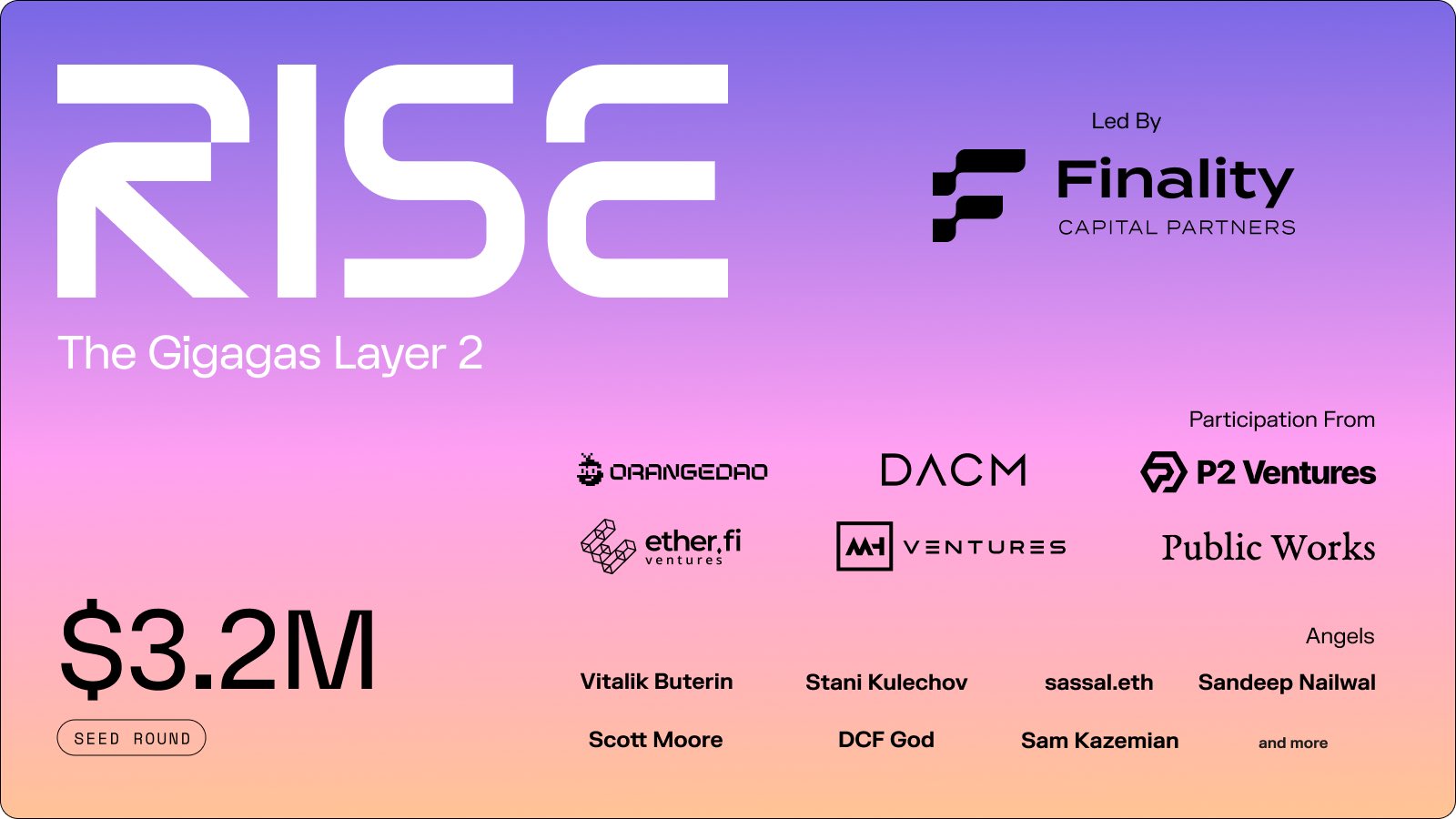
In September 2024, Rise Chain raised $3.2 million from notable investors, including ether.fi Ventures, Orange DAO, DACM, P2 Ventures, and Ethereum’s co-founder, Vitalik Buterin.
Comparable Projects in the Ethereum Layer 2 Space
- Arbitrum: Offers three scaling solutions—State Channels, Sidechains, and Rollups.
- Optimism: Provides an OP Stack SDK toolkit for Layer 2 developers, utilized by projects like Base, opBNB, Zora, Celo, and DeBank.
Conclusion: The Future of Ethereum Scalability with Rise Chain
Rise Chain’s Layer 2 advancements could transform Ethereum’s ability to handle massive transaction volumes while maintaining decentralization. With its groundbreaking technologies like Gigagas throughput, PEVM, and Continuous Block Pipeline, Rise Chain is positioned to meet the scalability demands of tomorrow’s blockchain ecosystem.
Disclaimer: This article is for informational purposes only and should not be considered financial or investment advice. Always conduct your own research and consult with a professional before making any investment decisions.