
Home » Stablecoin Risks: Bitgo CEO on MiCA Regulations

Stablecoin Risks: Bitgo CEO on MiCA Regulations

Bitgo CEO Warns Europe's MiCA Rules Could Trigger a Massive Stablecoin Crisis 1

Bitgo CEO States MiCA Brings Systemic Risks to Stablecoin Issuers

Mike Belshe, CEO of Bitgo, one of the largest custody providers in the crypto industry, believes that current cryptocurrency regulation in Europe might contribute to a potential stablecoin debacle.

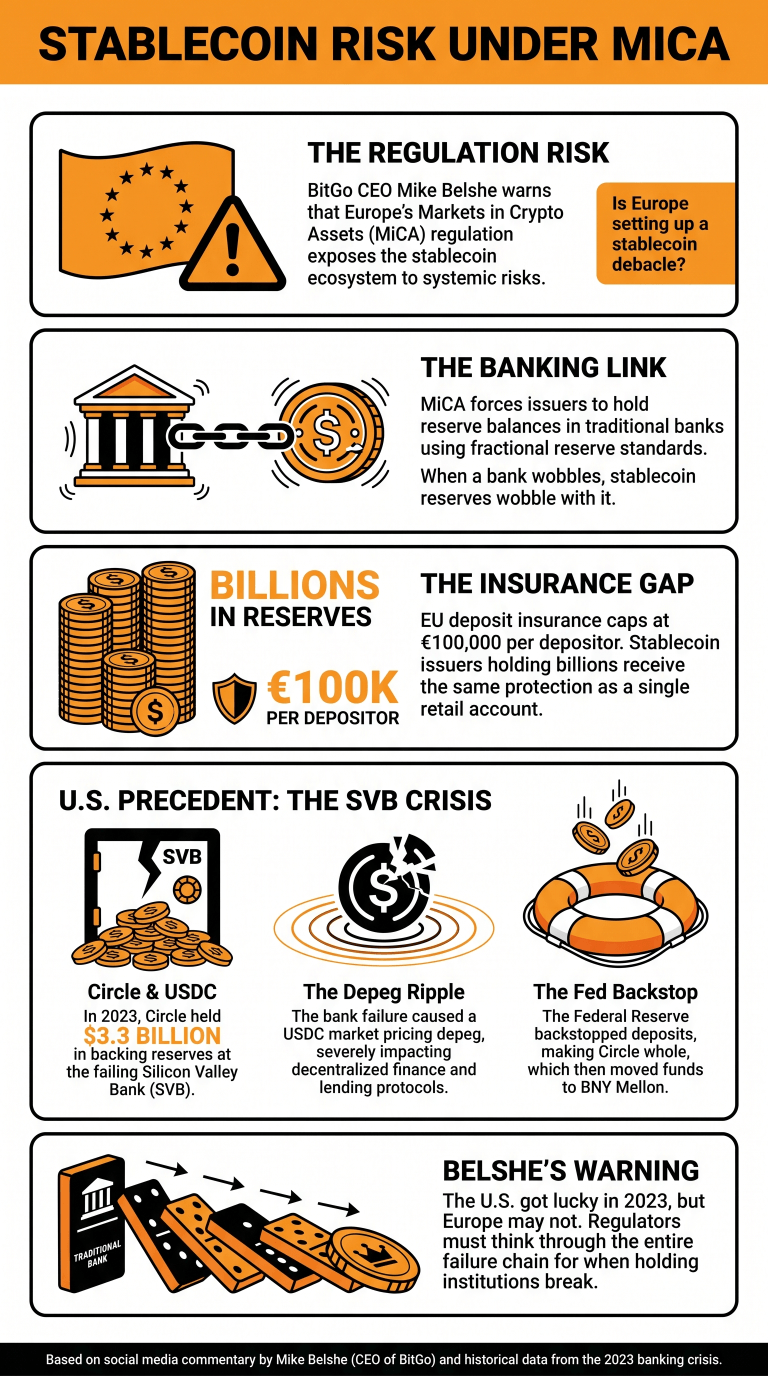
On social media, Belshe explained that the Markets in Crypto Assets (MiCA) regulation exposes the stablecoin ecosystem in Europe to systemic risks, forcing stablecoin issuers to hold reserve balances in traditional banks that follow fractional reserve standards.
Bitgo CEO Warns Europe's MiCA Rules Could Trigger a Massive Stablecoin Crisis 2

“That creates a direct link between cryptomarkets and traditional banking stress. When a bank wobbles, stablecoin reserves wobble with it,” Belshe stated, clarifying that this was possible as stablecoin issuers would be subject to the same insurance as a retail customer.

“EU deposit insurance caps at €100K per depositor. A stablecoin issuer holding billions in reserves gets the same protection as a retail savings account. That’s not a rounding error — it’s a structural gap,” Belshe stressed.

The U.S. has already experienced a similar episode to the one Belshe described, when a failure of the traditional fiat system bled into crypto. Circle, issuer of the USDC stablecoin, was affected by the closure of Silicon Valley Bank (SVB) in 2023, as the company held $3.3 billion backing its stablecoin in the bank. This caused a depeg in its market pricing, affecting decentralized finance and rippling into lending protocols as well.

Nonetheless, at the time, the Federal Reserve backstopped all the deposits and made all customers whole, including Circle, which moved their funds to BNY Mellon shortly afterwards.

Belshe reinforced the need to get regulation right in this regard, as failing to do so would open the doors for a similar event affecting stablecoin issuers in Europe.

“The U.S. got lucky in 2023. Europe may not. Proper stablecoin regulation means thinking through the entire failure chain — not just who holds the reserves, but what happens when the institution holding them breaks,” he concluded.

Related Articles

ICE Joins OKX in 50-50 Broker-Dealer Deal Targeting US Tokenized Equity Markets 1

ICE Joins OKX in 50-50 Broker-Dealer Deal Targeting US Tokenized Equity Markets

The two companies disclosed the deal Monday, describing the venture as infrastructure focused on tokenized and digitally native financial products.

Strategy Acquires 520 More Bitcoin for $35M Despite Being Nearly $10B Underwater 1

Strategy Acquires 520 More Bitcoin for $35M Despite Being Nearly $10B Underwater

Smaller Buy, Same Cadence The purchase marks the third consecutive week of bitcoin accumulation for Strategy. Saylor disclosed the transaction

El Salvador Keeps Stacking: 8 BTC Added in a Week as Reserve Tops 7,689 BTC 1

El Salvador Keeps Stacking: 8 BTC Added in a Week as Reserve Tops 7,689 BTC

Buying the Dip, Every Day The latest additions, tracked through the country’s official bitcoin reserve data, bring El Salvador’s stack

Taiko Halts Withdrawals as Hackers Pull $1.7M Through Bridge Validation Flaw 1

Taiko Halts Withdrawals as Hackers Pull $1.7M Through Bridge Validation Flaw

Technical Flaw Leads to $1.7 Million Loss Ethereum scaling solution Taiko confirmed June 22 that its chain state verification mechanism

A whale just opened $48 million in shorts against Bitcoin, Solana, and Ethereum. 1

A whale just opened $48 million in shorts against Bitcoin, Solana, and Ethereum.

Anatomy of the Bet Onchain analytics firm Lookonchain reported that the wallet, labeled 0xaeaa, moved 6.68 million USDC onto Hyperliquid

FDIC: US Banks Report $80 Billion in Profit as Unrealized Losses Rise to $325 Billion 1

FDIC: US Banks Report $80 Billion in Profit as Unrealized Losses Rise to $325 Billion

A Growing Paper Loss The Federal Deposit Insurance Corporation (FDIC) said total unrealized losses climbed $19.0 billion, or 6.2%, from