Market Overview
The Federal Reserve has kept interest rates unchanged as expected while signaling a slowdown in its quantitative tightening (QT) program, which initially boosted market sentiment. However, concerns over additional tariffs announced by President Trump overshadowed the optimism.
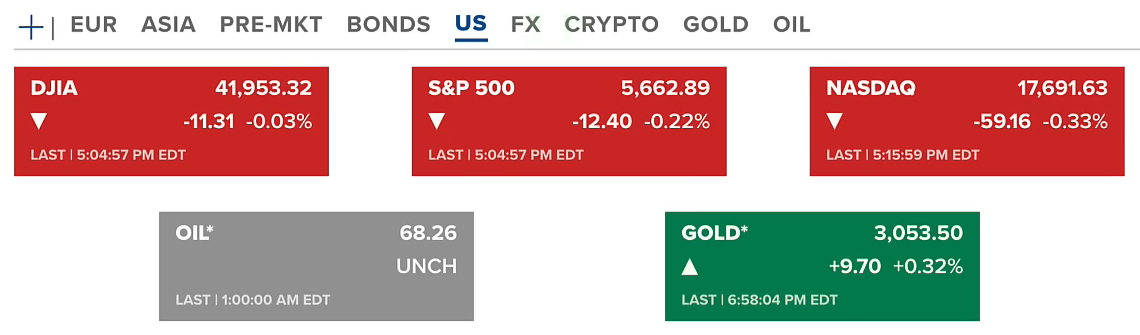
On Thursday, March 20, U.S. stock markets closed lower across all three indices, with Nasdaq leading the decline at -0.33%. Crude oil remained around $68 per barrel, while gold held above its record high of $3,053 per ounce.
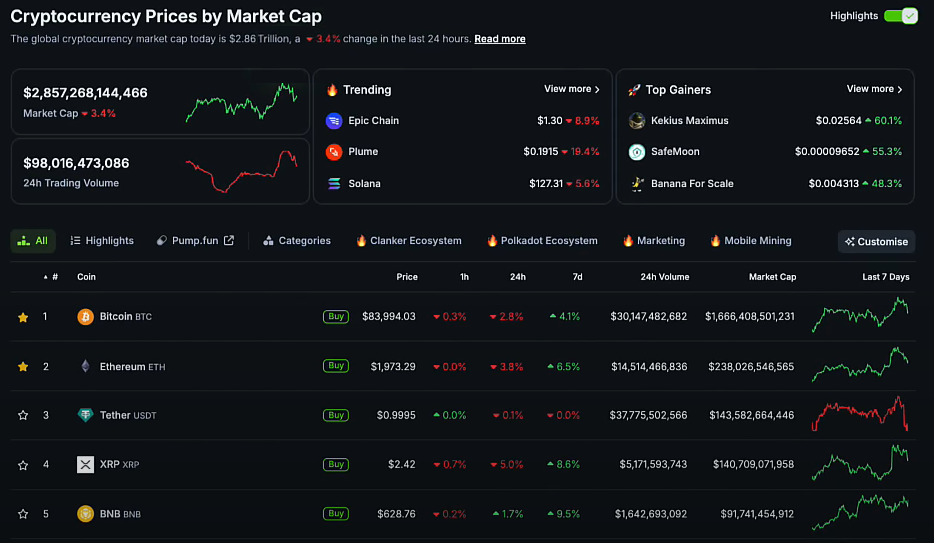
Bitcoin adjusted slightly, hovering around $83,000, while some altcoins saw minor fluctuations. The total crypto market capitalization now stands at $2.85 trillion.
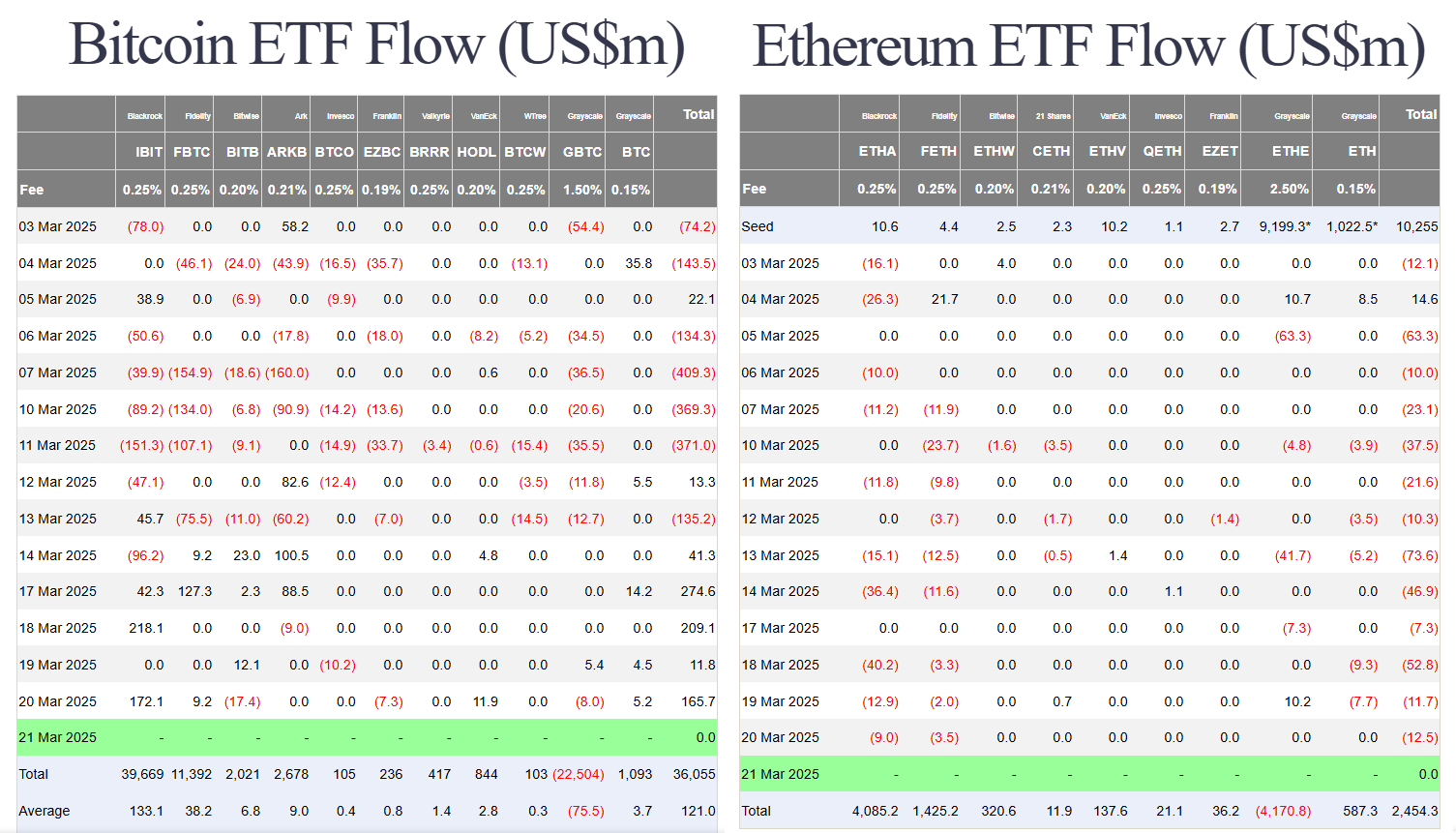
Spot Bitcoin ETFs in the U.S. continued to see inflows, with $165.7 million entering these funds, mainly through BlackRock’s IBIT ETF. In contrast, ETH spot ETFs recorded an outflow of $12.5 million, reflecting diverging investor sentiment between the two largest cryptocurrencies.
Fed Interest Rate Decision and Economic Impact
The Federal Reserve decided to maintain interest rates at 4.25% – 4.5%, a level held since December. However, the Fed reduced its GDP growth forecast for 2025 while raising its inflation projection.
- 2025 U.S. GDP growth forecast was lowered to 1.7%, a 0.4% downward revision.
- Inflation expectations for 2025 increased to 2.8%, reflecting continued price pressures.
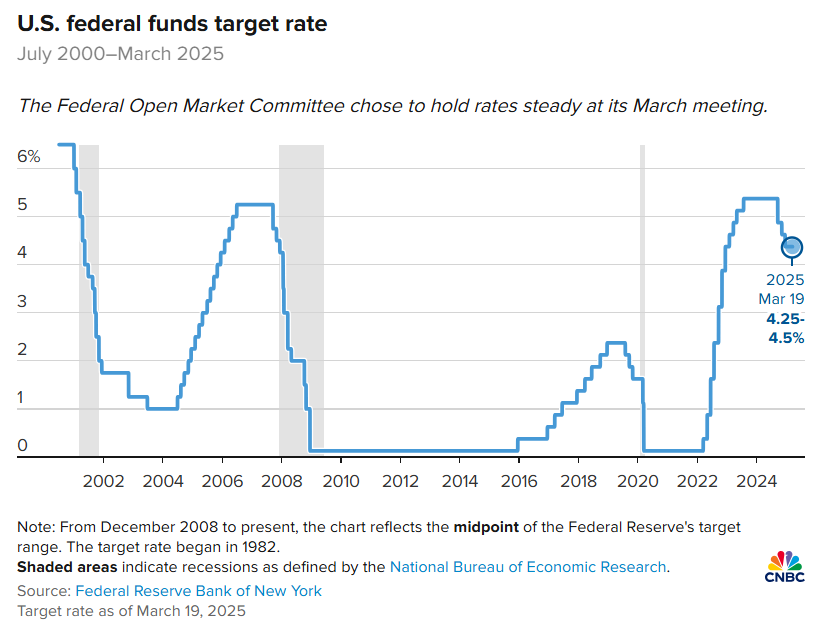
The Fed announced a slowdown in its QT program, meaning it will sell fewer Treasury bonds, effectively increasing market liquidity. This move is seen as a precursor to potential rate cuts.
Fed Chairman Jerome Powell stated that interest rates would remain elevated if necessary but hinted at two potential rate cuts in 2025, with a median forecast of a 0.5% reduction.
Powell also attributed some inflationary pressures to Trump’s tariffs, a statement that is not entirely accurate. Inflation had already started rising in late 2023, months before Trump’s tariff policies were introduced in February 2024.
Initially, markets reacted positively to the Fed’s decision, with the Dow Jones rallying over 400 points. However, Trump’s tariff announcement later in the day reversed sentiment, leading to a broader market correction.
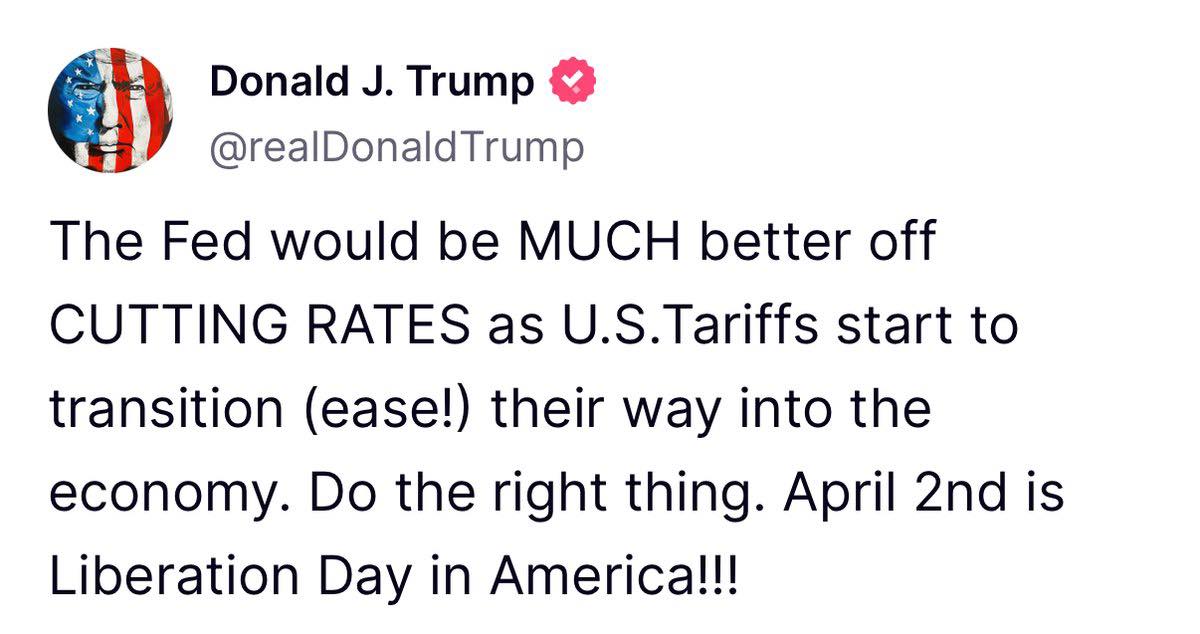
Trump’s Tariff Strategy: Market Uncertainty Grows
Shortly after the Fed’s announcement, President Trump posted on Truth Social, stating that tariffs will gradually impact the economy, with additional tariffs scheduled for April 2. This puts pressure on the Fed to cut interest rates sooner to counterbalance economic strain.

The U.S. has already implemented tariffs on European goods, prompting the EU to threaten retaliatory measures. However, the EU has postponed its first wave of U.S. tariffs until mid-April, which temporarily eases market concerns.
European officials did not specify why they delayed the tariffs, but many policymakers acknowledged ongoing economic struggles. Other major economies, including Canada, the UK, and China, are also showing signs of slowing growth, suggesting that a prolonged trade war may not be sustainable.
In response to economic pressures:
- The UK has kept its interest rates at 4.5%.
- Germany’s Parliament (Bundestag) has approved significant government spending increases, abandoning decades of fiscal austerity.
This marks a major shift in European economic policy, as Germany injects billions into economic stimulus and defense spending. The move is expected to boost market liquidity, providing a potential tailwind for risk assets, including crypto.
Long-Term Economic Projections: Will a U.S. Recession Happen?
Following the Fed’s first rate cut in September 2024, economic downturns typically take about a year to materialize. If this trend holds, the true impact of rate cuts on recession risks may not be clear until September 2025.
Market cycles repeat historical patterns, and while reasons for expansion, contraction, or recession vary, economic trends tend to follow predictable phases.
SEC vs. Ripple Case Ends – Regulatory Shifts in the U.S.
At the Digital Asset Summit, President Trump reaffirmed his support for crypto, emphasizing that most of his campaign promises related to the industry have been fulfilled.
While the government has halted SEC enforcement actions against crypto firms and established a national Bitcoin reserve, Trump has never promised that the U.S. government would buy Bitcoin. Any such decision requires congressional approval, a frustration for some in the crypto community.
SEC Drops Lawsuit Against Ripple
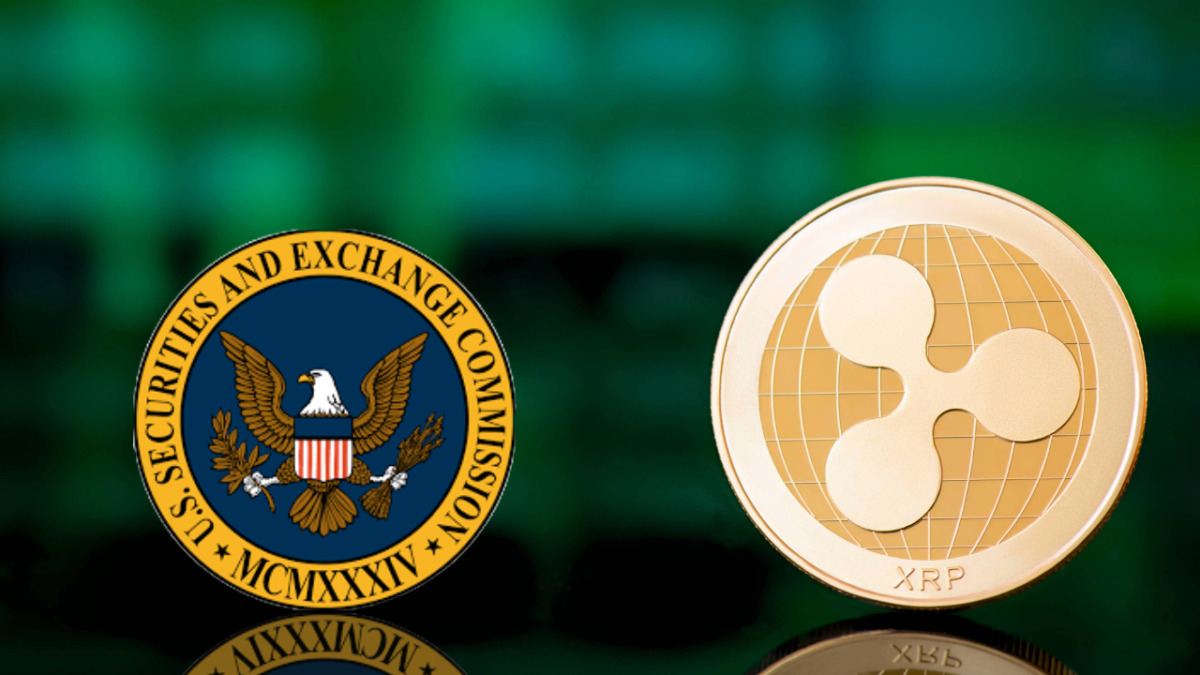
After four years of legal battles, the SEC has dismissed its lawsuit against Ripple Labs, marking a landmark victory for the crypto industry.
Ripple CEO Brad Garlinghouse called this a major win, criticizing the SEC for overstepping its authority. The case initially accused Ripple of selling unregistered securities through XRP, but a 2023 ruling determined that secondary XRP transactions did not violate securities laws. Ripple will only pay a $125 million fine related to institutional sales.
Additionally, the SEC’s Corporate Finance Division clarified that Bitcoin mining (Proof-of-Work) is not considered a securities transaction, providing regulatory certainty for BTC miners.
At the state level, crypto adoption continues to progress. North Carolina lawmakers have introduced the Bitcoin Reserve and Investment Act (SB327), which would allow the state to invest up to $950 million (10% of public funds) into Bitcoin.
MicroStrategy’s Debt-Fueled Bitcoin Strategy: Is It Too Risky?
MicroStrategy’s aggressive Bitcoin accumulation strategy relies on debt financing and preferred stock issuance, raising concerns about financial risk exposure.

Company’s Financial Position:
- Total debt: $8.214 billion, with maturities between 2028 and 2032.
- Additional capital raised: $742 million through preferred stock issuance.
- Total liabilities: $8.956 billion.
- Bitcoin holdings: 41.4 billion USD, significantly exceeding total debt.
Risk Analysis:
- Current Status: MicroStrategy’s Bitcoin assets far exceed its debt, meaning the company remains financially stable.
- Positive Outlook: If Bitcoin prices continue rising, MicroStrategy’s stock value and financial standing will improve.
- Potential Risk: If Bitcoin crashes, MicroStrategy could face liquidity issues, especially with debt maturities between 2028-2032.
Currently, MicroStrategy’s financial position is strong, but long-term risk depends on Bitcoin’s price trajectory.
Other Key Market Developments
Crypto Adoption in Europe
According to Oobit, 70% of crypto transactions in the EU are used for retail purchases, food, and beverages, with an average payment size of $8.36. Another 26% of transactions go toward travel expenses, while 1.5% are allocated to government services, healthcare, and entertainment.
Despite regulatory challenges under MiCA, 92% of these transactions are processed using USDT, highlighting Tether’s dominance in global stablecoin usage.
Tether Becomes a Major U.S. Treasury Bond Holder
Tether is now the 7th largest buyer of U.S. Treasury bonds, holding $33.1 billion in U.S. debt, placing it on par with major sovereign nations. Stablecoins are increasingly influencing global liquidity, reinforcing the U.S. dollar’s dominance in digital finance.
Argentina’s Growing Bitcoin Interest
The Argentine Senate hosted the Bitcoin Argentina NGO for discussions on Bitcoin regulation, signaling growing interest in BTC at the government level.
Bitcoin-Backed Loans
Xapo Bank has launched a new lending service, allowing members to borrow up to $1 million in USD using Bitcoin as collateral. Loans have flexible terms (30-365 days) with a loan-to-value ratio of 20%-40%. This allows investors to access liquidity without selling Bitcoin, preserving long-term investment exposure.
Solana ETF Launch Signals Market Growth
Volatility Shares announced the launch of the first Solana Futures ETF, indicating growing institutional interest in SOL. Historically, crypto ETFs often start with futures before transitioning to spot ETFs, making this a bullish signal for Solana’s ecosystem.