
When you hear that CPI rose 3% last month, that single number drives a lot of decisions: Federal Reserve rate moves, your Social Security adjustment next year, the interest on certain Treasury bonds, even some union contract negotiations. But what exactly does that 3% measure? And how is it calculated?
CPI stands for Consumer Price Index. (Not to be confused with the Crisis Prevention Institute, the home security company called CPI, or the project management metric “Cost Performance Index”.)
The Consumer Price Index is a monthly measurement of how prices change for a typical basket of consumer goods and services in the United States, published by the Bureau of Labor Statistics (BLS).
This article explains how CPI is built, what it actually measures, and how it touches your finances.
What Is the Consumer Price Index?
The Consumer Price Index (CPI) is a monthly measurement of the average change in prices paid by US consumers for a representative basket of goods and services. It’s published by the Bureau of Labor Statistics and used as the primary measure of consumer-level inflation in the United States.
CPI has been published in the US since 1913, one of the longest-running official price indexes in the world. The BLS releases each month’s report in the middle of the following month, with the data immediately rippling through markets, news coverage, and a long list of inflation-linked contracts and benefits.
The basic idea is straightforward. BLS economists track the prices of thousands of specific goods and services across the country (groceries, gasoline, rent, doctor visits, haircuts, airline tickets, streaming subscriptions) and combine them into a single index number showing how prices have changed compared to a base period.
CPI is the most-watched US inflation measure, but not the only one. The Personal Consumption Expenditures (PCE) price index, published by the Bureau of Economic Analysis, is another. The Federal Reserve uses core PCE as its preferred inflation gauge for monetary policy, though it watches CPI closely too. They generally move in the same direction but can disagree by a few tenths of a percentage point in any given month.
How Is CPI Calculated?
CPI is built from three things: a defined basket of goods and services, a set of weights, and a steady stream of monthly price data.

The basket of goods and services
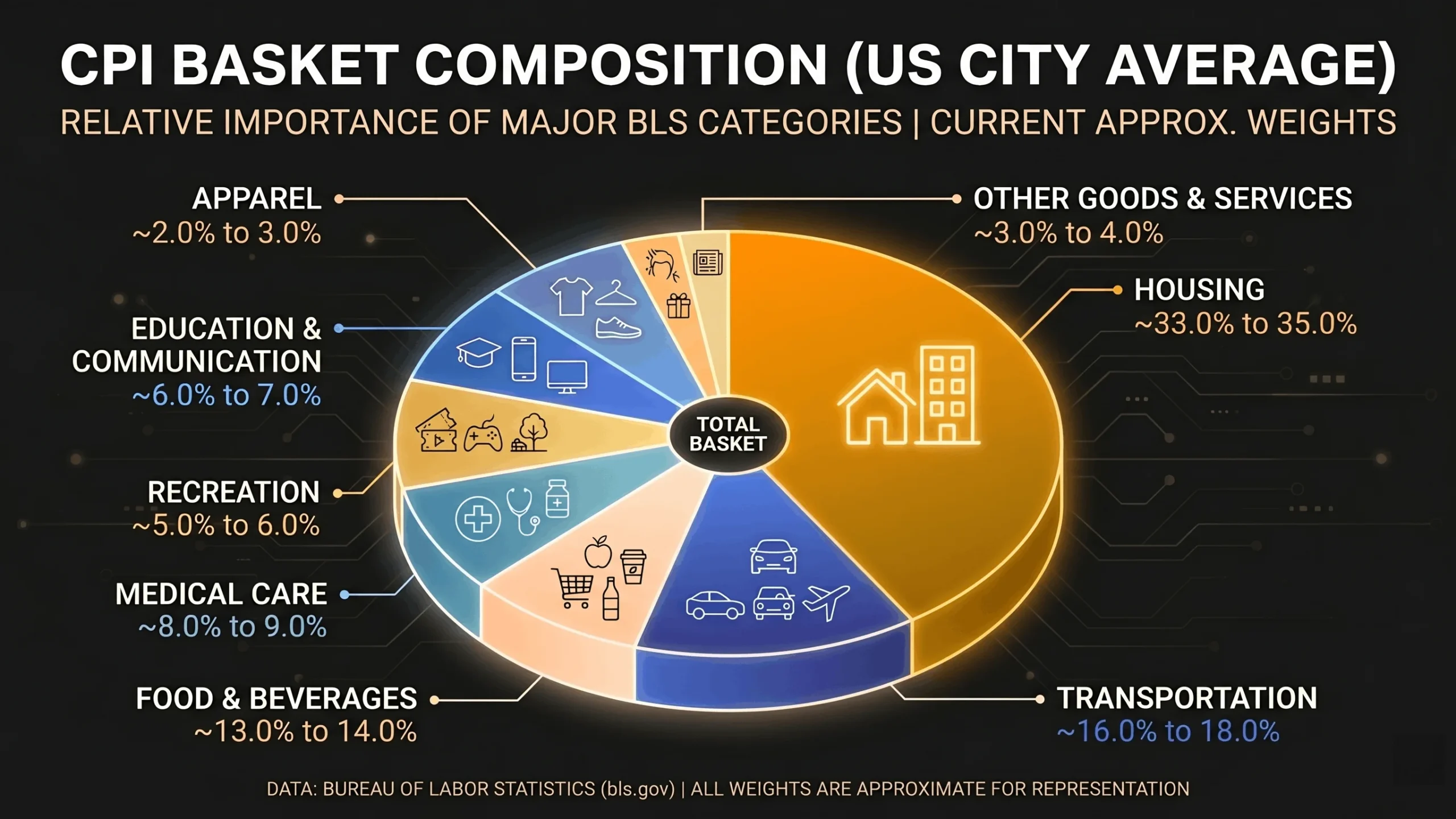
The BLS divides consumer spending into eight major categories: food, housing, apparel, transportation, medical care, recreation, education and communication, and “other goods and services” (which catches things like tobacco, personal care, and funerals). Each category contains hundreds of specific items. “Food at home” alone covers dozens of grocery line items; “transportation” includes new cars, used cars, gasoline, motor vehicle insurance, airline fares, and several others.
The weights
Not every item counts equally. Housing is the largest single category, accounting for roughly a third of headline CPI. Owners’ equivalent rent, the BLS’s estimate of what homeowners would pay to rent their own homes, is the single biggest line item. Food and energy together are a much smaller share. Apparel and “other goods and services” are the smallest categories.
Weights are based on the Consumer Expenditure Survey (CES), which surveys US households about what they actually buy. Under current methodology, weights are updated annually, with the most recent update taking effect in December 2025.
The formula
In simplified form, CPI is the price of the basket today divided by the price of the same basket in a reference period, expressed as an index. The current base period is set to equal 100 for the 1982–1984 average. So a CPI reading around 325 means the basket costs roughly 3.25 times what it did in the early 1980s. Inflation is the percentage change in this index, month-over-month or year-over-year, not the index level itself.
Data collection
BLS field staff and contractors collect roughly 80,000 price quotes per month from retail outlets, service establishments, rental units, and online sources across urban areas. The shelter component is its own large survey: each housing unit in the sample is checked every six months, and missing values are filled in using statistical imputation.
That imputation method became newsworthy in late 2025. A lapse in federal appropriations meant the BLS couldn’t collect October 2025 housing data on schedule, so it carried forward prior values. The agency has been transparent about the distortion working its way through the data into mid-2026, a reminder that even the most-watched economic statistic depends on people in the field doing the work.
Headline CPI vs Core CPI
Headline CPI is the full basket. All items, including food and energy. It’s the number quoted in most news headlines.
Core CPI is the same basket with food and energy excluded.
Why exclude two real categories of consumer spending? Because food and energy are unusually volatile from month to month. A cold snap spikes natural gas prices; an OPEC announcement moves gasoline; a drought hits beef prices the next quarter. The volatility can drown out the underlying trend in a single month’s headline number.

Core CPI smooths that noise out, giving a clearer picture of where prices are heading over time. That’s why economists and the Federal Reserve tend to pay more attention to core CPI (and the related core PCE) when setting policy. Monetary policy works with long lags; the Fed wants to react to the trend, not to last month’s gasoline shock.
One-line takeaway: headline CPI tells you what consumers feel today. Core CPI tells you where inflation is probably heading. Both are useful for different questions.
CPI vs Inflation vs Cost-of-Living Index
Three terms readers often treat as interchangeable. They aren’t.
CPI is a measure of inflation, not inflation itself. Inflation is the general phenomenon of prices rising across an economy. CPI is one specific way to measure it. PCE is another. The wholesale-side Producer Price Index (PPI) is another. They generally move in the same direction, but in any given month they can disagree by several tenths of a percentage point.
CPI is not, technically, a cost-of-living index, even though it’s often used as one. A true cost-of-living index would adjust for substitution behavior (when steak gets expensive, you buy chicken) and for changes in quality of life. CPI does adjust for some of this (quality adjustments for things like new car features, and a “chained CPI” variant that captures substitution) but the BLS is explicit that headline CPI is not a cost-of-living index in the strict sense. Separate measures (like the C2ER COLI used to compare cities) exist for that purpose.
The practical implication: when CPI rises 3%, prices for the CPI basket rose roughly 3%, but your personal cost of living may have moved more or less depending on what you actually spend money on.
Why CPI Matters for You
Even if you’ve never read a CPI report, the index has probably touched your finances in the last 12 months through at least one of these channels:
- Social Security adjustments: The annual cost-of-living adjustment (COLA) for Social Security is calculated using a CPI variant called CPI-W. Higher CPI means a larger Social Security increase the following year.
- Federal tax brackets: The IRS uses chained CPI to adjust tax brackets, the standard deduction, and other thresholds each year. When inflation runs hotter, the brackets move up faster.
- TIPS bonds: Treasury Inflation-Protected Securities adjust their principal value based on CPI, providing returns that keep up with measured inflation.
- Union and labor contracts: Many union contracts include CPI-linked wage escalators that bump pay in line with the index.
- Child support and alimony: Some agreements include CPI-linked annual adjustments.
- Rent and lease escalators: Many commercial and some residential leases include CPI-based rent increases.
- Federal Reserve decisions: The Fed watches CPI (and PCE) closely; persistent high readings push toward rate hikes, persistent low readings push toward cuts.
CPI is one of those statistics that quietly does a lot of work in the background of modern economic life. The monthly headline is just the visible tip.
Conclusion
The Consumer Price Index is a system. Eight categories, hundreds of items, weights from millions of household-spending data points, and roughly 80,000 monthly price quotes from across the country. Knowing how the system works, and the difference between headline and core, between CPI and inflation, between CPI and a cost-of-living index turns those monthly headlines into something you can actually read.